
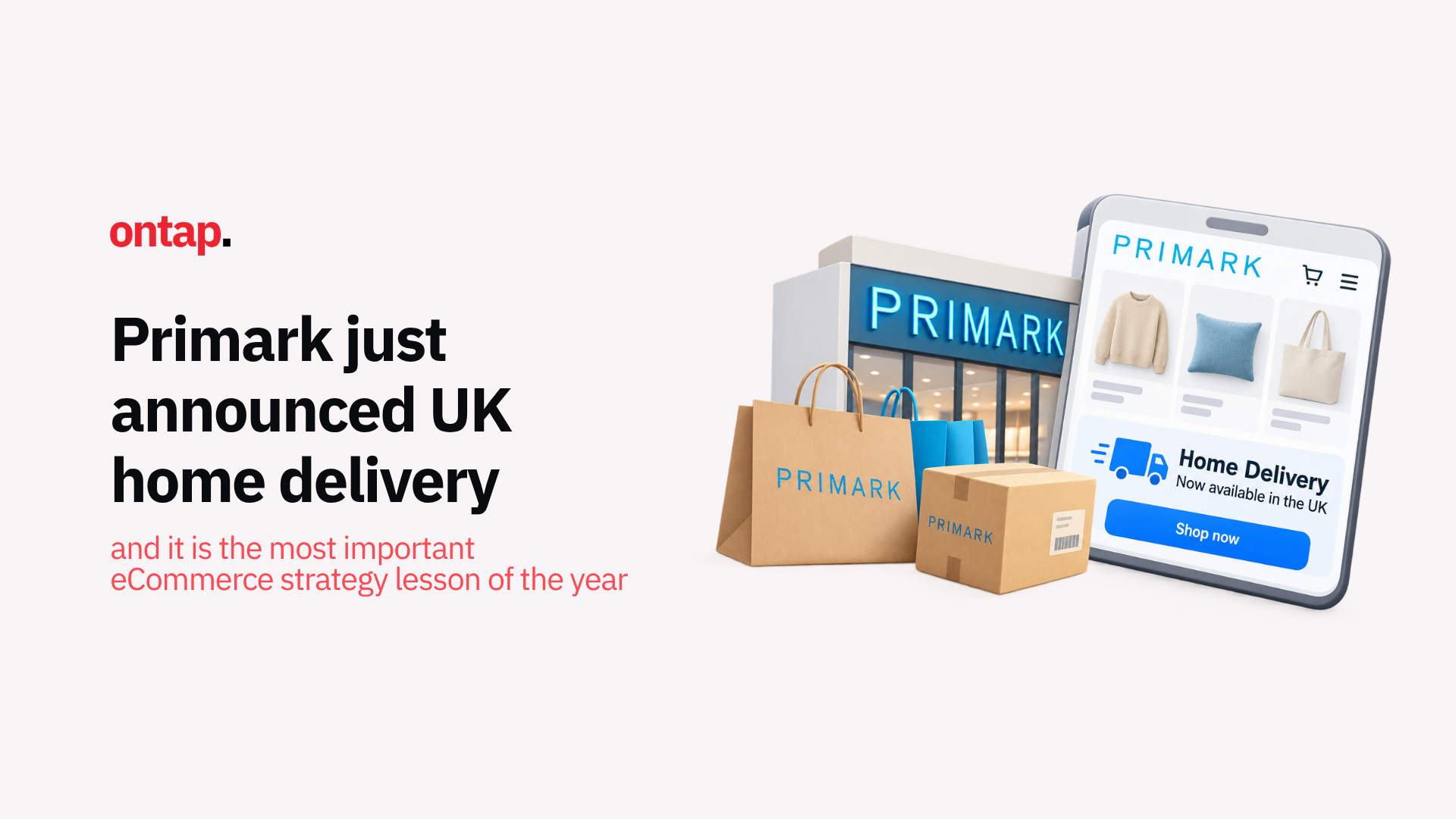
On 10 September 2026, Primark’s parent company, Associated British Foods (ABF), announced plans to introduce home delivery in Great Britain. Its September trading update did not specify a launch date.
The decision marks a change from Primark’s longstanding position that home delivery was difficult to reconcile with its low-price model. It also builds on an existing digital business: customers can already order selected products online through Click & Collect.
For eCommerce merchants, the useful lesson is to revisit channel assumptions as customer demand, operational capabilities and commercial conditions change.
Why Primark resisted, and why the logic was sound
To appreciate why this decision matters, it helps to understand the economics behind Primark’s store-led approach. Picking, packing and delivering individual orders adds costs that are harder to absorb when product prices and basket values are low.
Consider a hypothetical £4 T-shirt with £3 in fulfilment costs. That leaves £1 before accounting for VAT, the product itself, payment processing and other costs. This illustrates the pressure on a low-value order; it is not a statement of Primark’s actual costs. Larger baskets, delivery charges and returns policies can change the calculation.
Primark has consistently linked its value proposition to a simple, cost-efficient model centred on stores. In its April 2024 Click & Collect announcement, it described digital convenience as something that needed to complement that model.
The business remained profitable. ABF’s 2026 interim results recorded £469 million in Primark operating profit for the 24 weeks ended 28 February 2026, down from £537 million a year earlier.
Those figures demonstrate the scale of the existing business. They do not, on their own, establish whether home delivery would improve its profitability.
What changed, and how the channel opportunity developed
ABF attributed the decision to Primark’s digital maturity, the success of Click & Collect and developments in the online market. Three considerations help explain the opportunity, although the public evidence does not establish the precise weight of each.
-
Online competition: Retailers and marketplaces such as Shein and Temu give shoppers alternatives to visiting a physical store. Their presence makes price, convenience and delivery relevant considerations when assessing a channel strategy. It does not establish that their prices consistently match Primark’s or that they caused its decision;
-
Evidence from Click & Collect: Primark completed its rollout across Great Britain in May 2025. Earlier customer feedback highlighted convenience and access to additional ranges. This supports demand for online ordering with store collection, although it does not directly quantify demand for home delivery;
-
The search for additional growth: Primark has acquired a highly automated fulfilment facility in Sheffield to support the planned service. ABF presents home delivery as an opportunity for profitable growth alongside stores. Whether it delivers that growth will depend on the eventual offer, costs and customer response.
The opportunity reflects both market conditions and Primark’s developing capabilities. Treating the decision solely as a response to competitors would overlook the operational work behind it.
The lesson every eCommerce merchant should take from this
Primark’s decision illustrates a principle that applies to businesses at every scale: a channel strategy needs periodic reassessment as the conditions supporting it evolve.
If you have resisted expanding into physical retail, marketplace selling or international channels because the economics do not work today, the practical response is to test whether those assumptions still hold. Expansion needs a credible business case, rather than a competitor’s decision alone.
On Tap recommends starting with three questions.
-
Are you leaving demand data unexamined? Review customer searches, enquiries, delivery requests and geographic demand. Look for customers who want your products but cannot conveniently buy through your current channels. Treat these signals as grounds for investigation, rather than proof that a new channel will be profitable;
-
Are you treating current margins as permanent? Recalculate the economics using realistic basket values, delivery income, fulfilment costs, returns, acquisition costs and investment requirements. Model different volumes and include the possibility that a new channel shifts existing sales rather than creating additional demand;
-
Are you examining how competitors attract new customers? Study where shoppers discover alternatives and what they value about those buying experiences. Use customer research and controlled tests to assess whether your absence from a channel limits acquisition, rather than assuming that competitors’ growth represents your lost sales.
The aim is to identify which assumptions deserve testing and what evidence would justify a change.
What Primark’s next move tells us about where eCommerce is heading
Primark’s planned home delivery service, existing Click & Collect offer and investment in fulfilment point towards a broader omnichannel proposition. This is our interpretation of the direction of travel, rather than confirmation of how every part of the future service will operate.
For merchants, the practical issue is how channels work together. A website can support discovery, online ordering and store visits. Stores can provide collection and customer service. The right fulfilment arrangement depends on product economics, inventory availability and the delivery promise.
An omnichannel approach needs clear operational choices:
-
Inventory visibility: Give customers reliable information about what they can buy and where it is available;
-
Fulfilment design: Decide which orders are best served from stores, a central facility or another fulfilment partner;
-
Performance measurement: Assess additional sales, contribution after fulfilment and returns, and any effect on existing channels.
These capabilities can support a more convenient customer experience, but adding channels does not guarantee better performance.
Primark’s announcement is a useful prompt to review your own approach: which assumptions still hold, which have changed, and what would make the next channel commercially viable?
About On Tap
On Tap is an eCommerce agency helping merchants develop and improve their online businesses through consultancy, development, digital marketing and systems integration.
Our eCommerce consultancy services help businesses assess their approach and plan practical improvements aligned with their commercial goals.
If you are reassessing your channel mix ahead of peak season, get in touch.