
For years, eCommerce SEO rewarded scale. More category pages, more blog posts, more long-tail coverage. But the economics of organic growth are changing quickly. As AI reshapes how search engines evaluate and surface information, many brands are discovering that publishing more content no longer creates more visibility. In fact, excessive content is increasingly diluting authority rather than strengthening it.
Three structural shifts are driving this change: Keyword cannibalisation caused by uncontrolled content expansion, AI-driven search systems placing greater weight on expertise and content quality, and the rise of AI-generated content, making generic information easier than ever to produce. For eCommerce brands, the advantage no longer belongs to those publishing the most content, but to those building the strongest authority, expertise, and brand trust.
The three forces killing the “more content” strategy
Keyword cannibalisation is weakening commercial authority
One of the biggest risks of large-scale content production is keyword cannibalisation. For eCommerce sites, this is rarely just a case of two pages targeting the same keyword. The deeper issue is intent overlap: category pages, filtered collections, buying guides, comparison articles, and blog posts can all start competing for the same underlying search demand.
When this happens, the site stops building one clear authority destination for a topic and starts spreading relevance across several weaker URLs. Internal links, topical signals, and ranking equity become fragmented, while search engines receive less consistent signals about which page should represent the query or buyer intent.
The business impact is not simply lower rankings. It is misallocated visibility. A supporting blog post may rank where a commercial category page should appear, or several similar URLs may compete without any one of them becoming strong enough to rank consistently. Organic traffic may still arrive, but it lands on pages that are less commercially useful, further from purchase, or less aligned with the buyer’s next action.
AI-driven search is raising the bar for content quality and source credibility
AI Overviews, AI Mode, and other AI-driven search experiences are changing what it takes to be visible. Search is moving beyond simple keyword matching and placing greater emphasis on sources that can support useful, trustworthy, and well-evidenced answers.
This does not remove traditional SEO fundamentals. eCommerce sites still need crawlable pages, clean indexation, structured data, internal linking, and clear page targeting. But low-signal content created mainly to capture long-tail traffic is becoming less defensible when AI systems can summarise generic information from many similar sources.
For eCommerce brands, content now needs to show why the brand is qualified to advise the buyer. That means demonstrating product knowledge, category expertise, real use-case understanding, original comparisons, and decision-supporting guidance.
AI has made content easier to produce, but harder to differentiate
AI has dramatically lowered the cost and speed of content production. But because every competitor now has access to the same production advantage, publishing more content is no longer a defensible moat.
The issue is not that AI-generated content cannot perform. The issue is that average content is now easier than ever to produce at scale. If every brand can publish similar explainers, buying guides, and long-tail articles, then volume alone does not make a brand more memorable, more trusted, or more commercially compelling.
This is where brand value proposition becomes critical. Content needs to show what the brand understands better, curates better, solves better, delivers better, or proves more convincingly than competitors.
AI can help structure and scale content, but it cannot create meaningful brand differentiation on its own. Without a clear value proposition behind it, AI-assisted content quickly becomes interchangeable with everything else competing for the same search visibility.
What this means for eCommerce merchants
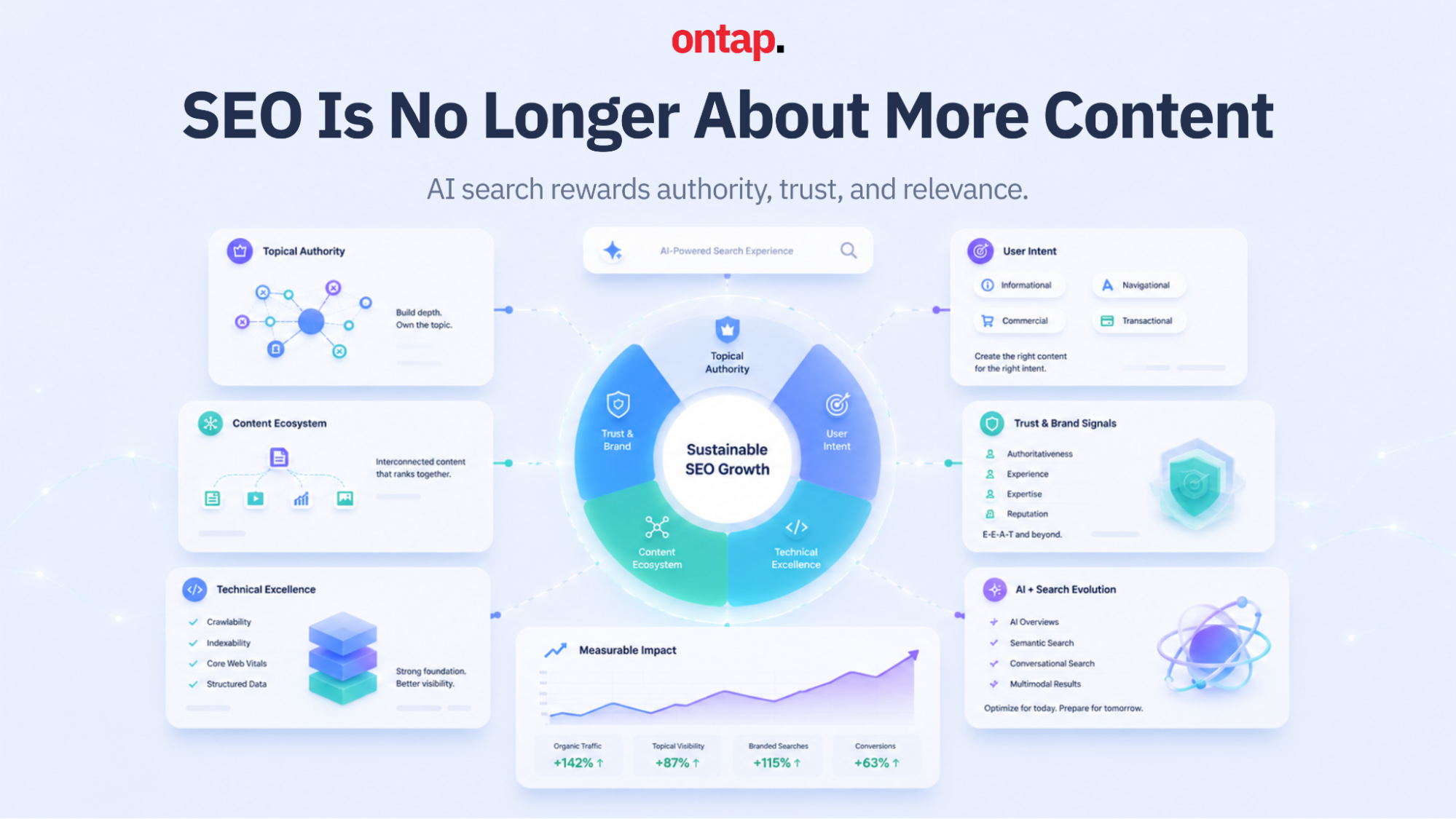
For eCommerce brands, the implication is clear: organic growth is no longer a publishing problem. It is an authority-building problem. The brands performing best in AI-era search are not necessarily producing more content, but creating stronger signals around expertise, structure, and trust.
Product pages now need to function as authority assets, not just conversion pages. Search engines and AI systems increasingly rely on structured product information to understand, compare, and cite products, making complete schema implementation, detailed specifications, and useful product context more valuable than large volumes of supporting blog content targeting adjacent long-tail queries.
For many eCommerce sites, consolidation is becoming more valuable than expansion. Instead of continuously publishing new pages, brands are seeing stronger results from merging overlapping content, removing thin pages, redirecting duplicate topic coverage, and concentrating authority into fewer, higher-quality URLs with clearer search intent.
Internal linking and brand reputation are becoming significantly more important in the AI era. Strong internal linking structures help consolidate authority around commercially important pages, while off-site trust signals such as expert mentions, third-party reviews, and wider brand recognition increasingly influence which brands AI systems choose to surface and cite.
What the big players are telling us
The shift away from content volume is no longer theoretical. Across large retail, the focus is moving away from publishing scale and towards authority consolidation, operational efficiency, and stronger expertise signals.
AI is accelerating this change. As content production becomes cheaper and more accessible, generic informational content is rapidly losing competitive value. The brands most likely to win visibility in AI-driven search are not those producing the highest volume of pages, but those creating the clearest signals of expertise, trust, and category authority.
For eCommerce businesses, this creates both a warning and an opportunity. The old publish-and-scale model is becoming increasingly inefficient, but brands willing to consolidate authority and invest in differentiated expertise now have a much stronger opportunity to stand out.
The On Tap perspective
At On Tap, we believe the role of SEO is changing fundamentally. Organic growth is no longer driven by publishing velocity alone, but by the ability to build concentrated authority, credible expertise, and trusted brand signals across an entire eCommerce ecosystem.
That is why our approach focuses less on content volume and more on content architecture, structured product data, intent clarity, and authority consolidation. In many cases, the most valuable SEO work today is not expanding a content library, but refining it: removing overlap, strengthening commercial pages, and building clearer signals for both search engines and AI systems.
The agencies that continue measuring success by publishing frequency are optimising for a search landscape that no longer exists. The brands winning in AI-driven search are increasingly those building differentiated expertise and genuine category authority, not simply producing more content than everyone else.
At On Tap, we help eCommerce brands build organic strategies for the AI era, focused on authority rather than content volume. To learn more, visit ontapgroup.com to book a discovery call.