
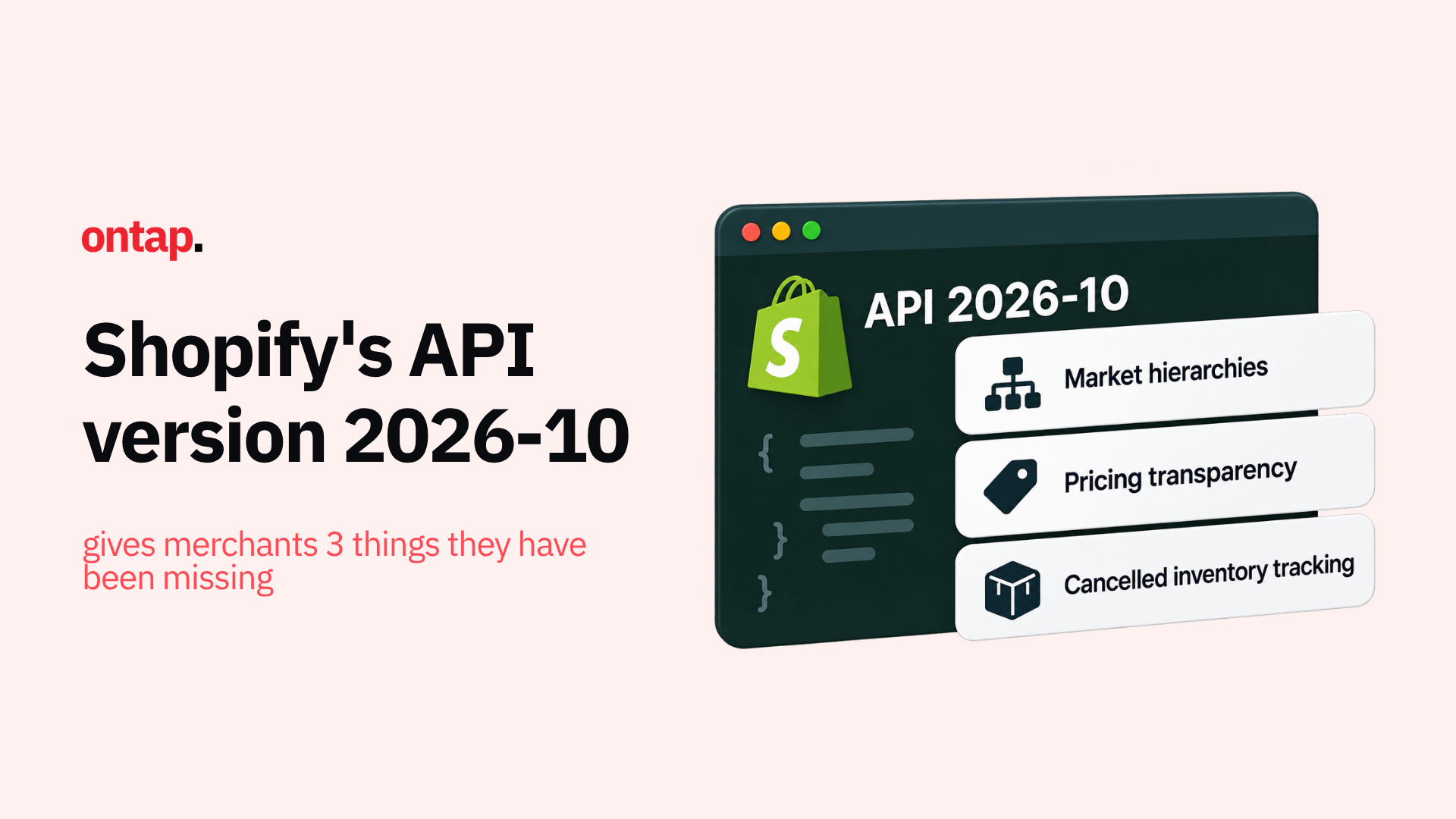
Shopify published its API version 2026-10 release candidate on 17 September, and while the changelog reads like a developer document, the three headline additions solve merchant-level problems that have been causing operational friction for months — particularly for businesses scaling internationally, managing complex pricing, and running warehouse receiving operations.
Here is what changed, why it matters, and what you should do about it.
Market relationships: finally, apps can see your market hierarchy
If you sell internationally on Shopify, you have probably built a market hierarchy: parent markets that control pricing and settings for child markets beneath them. Until now, the apps you rely on could not see that hierarchy. They could query individual markets, but they had no way to understand which markets were parents, which were children, or how they related to each other.
API version 2026-10 changes that. The new marketRelationships query returns a connection of relationship objects, each including a childMarket and a nullable parentMarket. The Market object now includes parentMarkets, childMarkets, and counts for both.
For merchants, the impact is direct. Every app that helps you manage international pricing, tax configuration, or localised content has been operating with an incomplete picture. Your ERP integration could not validate that a pricing change cascaded correctly through your market hierarchy. Your analytics tools could not segment performance by market family. Your content management tools could not ensure that parent market settings were being inherited properly.
Apps that adopt 2026-10 will be able to build market-aware features that actually reflect how your business is structured. If you are expanding into new geographies before peak season, ask your app developers whether they plan to adopt the market relationships API and when.
One important operational note: market relationships are rebuilt asynchronously when you change your hierarchy. The API provides a marketRelationshipsStatus query that returns a version value you can poll to detect when the rebuild is complete. If you are making hierarchy changes close to peak season, build in time for the async rebuild before verifying that everything looks correct.
Pricing audit trails: now you can see how Shopify calculated a price
This one is subtle but commercially significant. If you use contextual pricing, prices that vary by market, customer segment, or B2B catalogue, you have probably asked: how did Shopify arrive at this specific price for this specific customer in this specific market?
Until now, the answer was opaque. You could see the final price but not the chain of adjustments that produced it. API version 2026-10 introduces the auditTrail field on ProductVariantContextualPricing, which returns the ordered sequence of adjustments Shopify applied. Each adjustment includes the operation type (addition, multiplication, or replacement), the value used, and the resulting price after that step.
For B2B merchants, this is particularly valuable. When a buyer questions why their price differs from what they expected, you can now trace the exact calculation: was it a base price replacement from their company catalogue, followed by a volume discount multiplication, followed by a market-specific adjustment? The audit trail answers that question definitively.
For ERP and accounting integrations, this means price reconciliation can finally be automated rather than requiring manual investigation when contextual prices do not match expectations.
The limitation to be aware of: this first release covers product variant contextual pricing only. It does not yet include audit trails for order line items or draft order line items. And if Shopify cannot return a complete trail, it returns an empty list rather than a partial one, which is the right design decision, since a partial audit trail is worse than no audit trail.
Cancelled inventory receiving: the missing state in warehouse operations
When inventory arrives at a warehouse, some items get accepted, some get rejected (damaged, wrong SKU), and some never arrive at all. Until now, Shopify's inventory shipments API only tracked accepted and rejected. If a supplier confirmed 100 units shipped but only 85 arrived and the remaining 15 were lost in transit, you had to track those cancelled units outside of Shopify.
API version 2026-10 adds a CANCELED receive action. You can now mark shipment line item units as cancelled when they will never arrive, and read cancelled quantities alongside accepted and rejected counts. The totalReceivedQuantity now breaks down fully into all three categories.
For merchants running warehouse operations, especially those using Shopify for inventory management across multiple locations, this closes a data integrity gap. Your received totals will now account for every unit, whether it was accepted, rejected, or cancelled. No more spreadsheets tracking the gap between what shipped and what arrived.
The webhook updates are equally important: subscriptions on 2026-10 now receive old_canceled_quantity and new_canceled_quantity on each item, and cancelled-only receives trigger webhook deliveries. This means your inventory management integrations can react to cancellations in real time rather than discovering discrepancies during reconciliation.
What merchants should do now?
-
If you sell internationally: ask your app developers, particularly ERP, analytics, and content management apps, whether they plan to adopt the market relationships API. The information gap between your market structure and what your apps can see has been a source of operational friction, and this closes it.
-
If you use contextual or B2B pricing: evaluate whether pricing audit trails would improve your ability to handle buyer queries and reconcile pricing across systems. This is especially relevant if you are onboarding new B2B customers before peak season.
-
If you manage warehouse receiving: check whether your inventory management tools plan to support the cancelled receiving action. If you are currently tracking lost or cancelled shipment units outside of Shopify, this is your opportunity to consolidate that data.
-
For all merchants: 2026-10 is currently a release candidate. These features are available for testing but will not be the stable API version until Q4. The time to influence your app developers' roadmaps is now, not when the version goes stable and you discover your critical apps have not yet adopted it.
Shopify's API evolution continues to shift from developer-facing infrastructure changes to merchant-facing operational capabilities. These three additions may not make headlines, but they solve the kind of day-to-day operational problems that compound during high-volume periods. Getting your stack aligned with 2026-10 before peak season is a worthwhile investment.
About On Tap
On Tap is a growth-focused eCommerce consultancy helping mid-market and enterprise merchants align their Shopify stack with platform evolution. From API adoption planning and app developer coordination to international market configuration and peak season readiness, On Tap helps merchants turn platform capabilities into operational advantages.
If you want help assessing how 2026-10 affects your app stack, get in touch.