
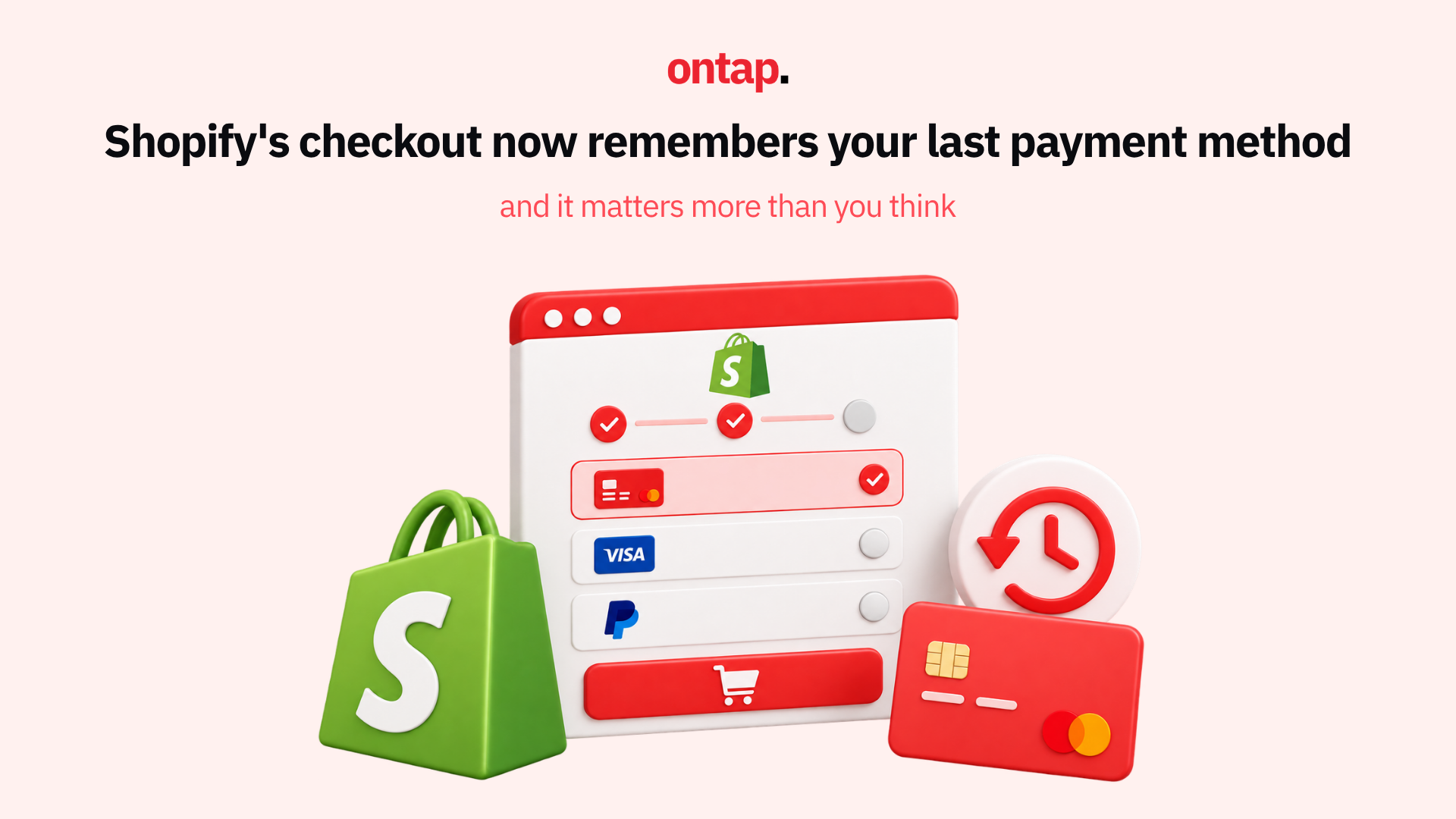
On 21 August, Shopify quietly rolled out a change that most merchants will overlook but every repeat customer will notice: checkout now defaults to the customer's last-used payment method when they are signed in.
It sounds minor. It is not.
The friction you stopped seeing
Every eCommerce operator knows that checkout is where conversions die. Cart abandonment rates hover around 70% industry-wide, and a significant portion of that abandonment comes from payment friction: customers being asked to re-enter card details, re-select payment methods, or navigate a payment flow they have already completed before.
For first-time buyers, that friction is unavoidable. For returning customers, the segment that typically generates the highest lifetime value and the best margins, it is entirely unnecessary.
Shopify's change addresses this directly. When a signed-in customer reaches checkout, the system now pre-selects whatever payment method they used on their most recent order. If they paid with Apple Pay last time, Apple Pay is pre-selected. If they used a credit card, that card is ready. The customer does not need to think, scroll, or choose. They just confirm and buy.
This is a meaningful reduction in cognitive load at the exact moment in the purchase journey where cognitive load is most costly.
Why this changes the customer account calculation
The feature only works for signed-in customers. That creates a new, concrete incentive for merchants to encourage customer account creation.
Until now, the case for pushing customer accounts has been somewhat abstract: better personalisation, order history access, saved addresses. Those benefits are real but they are hard to quantify at the point of account creation. "Your checkout will be faster next time" is a much more tangible and immediate value proposition.
For merchants who have not invested in their customer account strategy, this is the prompt to do so. The timing, six weeks before peak season traffic arrives, makes it operationally urgent.
If you convert even 10% more of your guest checkout customers into account holders, and those account holders have a measurably higher repeat purchase rate because checkout is frictionless, the compound effect on peak season revenue is significant. You are not just making one checkout faster. You are making every future checkout faster.
Part of a pattern, not an isolated feature
This change did not happen in isolation. Throughout August, Shopify has been systematically reducing friction across its checkout infrastructure. On 26 August, Shopify Payments became available to UAE merchants on the Advanced plan. Tax calculation accuracy improved for US orders based on fulfilment location. A new payments activity report gives merchants visibility into balance movements, fees, and payouts.
Read together, these changes paint a picture of a platform methodically optimising both sides of the checkout transaction.
What merchants should do now?
-
Audit your customer account adoption rate: How many of your customers are checking out as guests versus signed-in users? If your account adoption rate is low, you are leaving the payment memory benefit on the table. Check your Shopify analytics for the split between guest and account-based checkouts.
-
Create an account creation incentive: Give customers a reason to create an account. "Faster checkout next time" is now a genuine benefit you can articulate. Consider pairing account creation with a small loyalty incentive.
-
Ensure your payment method mix is optimised: The last-used payment method feature only helps if the customer's preferred payment method is available. If you have been slow to add Apple Pay, Google Pay, or Shop Pay, this is additional motivation.
-
Test your signed-in checkout flow: Before peak season, walk through your checkout as a signed-in customer who has placed a previous order. Verify that the last-used payment method is correctly pre-selected.
-
Set a repeat purchase conversion baseline now: Document your current repeat buyer conversion rate and checkout completion rate for signed-in versus guest customers. These metrics will tell you whether the payment memory feature is making a difference during peak season.
The bigger picture
Repeat customers already trust you. They have already decided to buy from you again. The only thing standing between their intent and your revenue is the checkout process itself.
Shopify's payment method memory does not solve every checkout problem. But it removes one of the most persistent and unnecessary sources of repeat purchase friction. And for merchants who use it as a catalyst to improve their entire customer account and repeat purchase strategy, it could be the most valuable small change they make before peak season.
The best time to build your customer account base was six months ago. The second best time is right now, while there are still six weeks before peak season traffic arrives.
About On Tap
On Tap is a growth-focused eCommerce consultancy helping mid-market and enterprise merchants optimise every stage of the customer lifecycle. From checkout conversion audits and customer account strategy to repeat purchase optimisation and peak season readiness, On Tap helps merchants turn platform capabilities into measurable commercial advantages.
If you want to audit your checkout and customer account strategy before peak season, get in touch.