 Best full-service eCommerce agency 2026


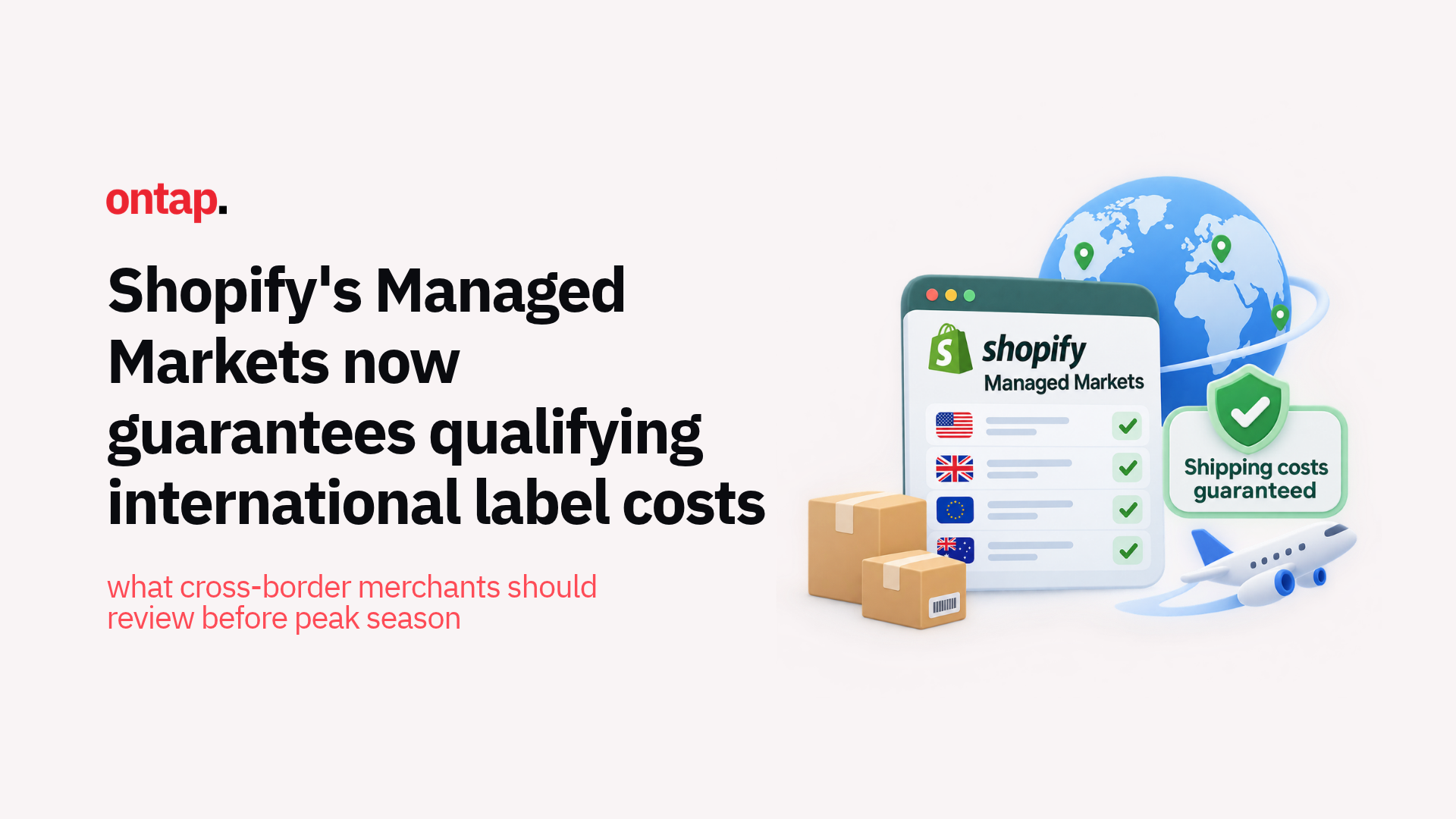
International shipping can be one of the hardest parts of cross-border eCommerce to model accurately. You calculate your landed costs, set your prices, and then a later carrier adjustment eats into the profit you expected to make. For eligible Shopify merchants using Managed Markets, that problem just got meaningfully smaller.
On 24 October 2026, Shopify added guaranteed flat-rate international shipping to Managed Markets alongside its existing duty-inclusive pricing. Merchants can now let Managed Markets manage their international shipping rates and preview product prices, checkout totals, and expected payouts before turning the feature on.
What actually changed
Previously, Managed Markets already supported international pricing, duties, and shipping services, but merchants configured their own flat or carrier-calculated shipping rates.
Now, Managed Markets can set Standard and Express rates by destination. Part of the shipping cost is incorporated into the product price, with the remainder shown as a shipping charge at checkout. International buyers see a clear product price and a predictable shipping charge.
The most significant operational improvement is the label-cost guarantee. When an order uses Managed Markets flat rates, and you purchase its qualifying prepaid FedEx or DHL Express label through Managed Markets, you will not be billed for later carrier cost adjustments. The guarantee does not apply if you purchase a different label.
For merchants who have experienced post-purchase carrier adjustments eating into already-thin international margins, this is a meaningful change.
Why the preview capability matters
Shopify’s preview lets you see international product prices, checkout totals, and expected payouts for each market before activating flat rates.
This gives you a useful basis for comparing your current shipping setup with the managed approach:
-
Customer pricing: check how the combination of product prices and shipping charges compares with your existing offer;
-
Expected payouts: assess what you expect to receive against your product costs, fulfilment expenses, and other operating costs;
-
Market differences: compare destinations separately, since shipping options and costs can vary.
For merchants selling into several countries, that market-by-market view matters. A setup that works well for one destination may be less attractive elsewhere.
The preview helps you evaluate the transaction, but it does not calculate your full profit margin. Your own costs still need to be part of the decision.
The trade-off merchants need to understand
Managed Markets sets and updates these flat shipping rates automatically. You cannot edit them directly. The trade-off is more predictable qualifying label costs in exchange for less control over the exact shipping rate customers see.
For merchants who have spent years optimising international shipping through negotiated carrier contracts or third-party shipping apps, this deserves careful comparison.
Before switching, review the main flat-rate settings and conditions:
-
Duty-inclusive pricing: duties and taxes must be included in product prices. This pricing setup also requires guaranteed exchange rates rather than manually set rates;
-
Shipping contribution: activating flat rates automatically enables a predefined amount for you to absorb on qualifying orders. You can switch this off, but cannot change the set amount;
-
Existing shipping setup: stores using Shopify’s shipping options by market feature cannot use Managed Markets flat rates at the same time;
-
Market-level choice: you can turn flat rates off for individual markets and return to your own rates, but the label-cost guarantee then no longer applies.
That flexibility means you can use flat rates where the economics work and maintain your existing approach elsewhere.
What this means for peak season
Peak season makes shipping costs harder to ignore. As international order volumes grow, even a small gap between what customers pay and what fulfilment costs can have a larger impact on margins.
Protection against later adjustments on qualifying labels removes one source of uncertainty during a busy trading period. It does not make every international order profitable or eliminate other fulfilment costs.
If you are considering the feature, evaluate it while there is still time to test the customer and fulfilment experience. The preview lets you compare the economics before committing, without making an immediate change to your live markets.
What merchants should do this week?
Managed Markets is available to eligible businesses in the continental US and certain stores in Canada and the UK. It does not support B2B orders, so merchants selling both wholesale and direct to consumers should assess it for their eligible consumer orders.
For stores with access, the next steps are straightforward:
-
Review your markets: go to Markets in Shopify admin, open the relevant market, and find the Managed Markets section. Check the available flat-rate options and how much shipping cost you would absorb;
-
Compare the economics: use the preview to compare customer prices and expected payouts with your current setup, taking your own costs into account;
-
Choose where to start: prioritise markets where carrier adjustments have been a persistent problem or your existing shipping charges create checkout friction;
-
Test before scaling: place representative orders and check the checkout, fulfilment and payout experience. Review the promotional banner added to your storefront when flat rates are first activated.
You do not need to activate the feature everywhere. Start where the combination of predictable rates and qualifying label protection offers a clear benefit.
The bigger picture
This update is part of a broader pattern in how Shopify is simplifying international commerce. Alongside Managed Markets’ duty-inclusive pricing, recent updates to automated store policies and right-to-left language support reduce some of the work involved in serving customers across markets.
For merchants evaluating their international strategy, the question is how these capabilities fit their existing operations. Managed Markets flat rates offer another way to balance shipping-cost predictability against direct control.
Review the economics and test selected markets before peak season to decide where that trade-off is worthwhile.
About On Tap
On Tap helps eCommerce merchants develop and improve their Shopify stores through development, consultancy, and systems integration.
Contact us to discuss your international Shopify setup ahead of peak season.