
Walmart released its Q2 FY27 earnings on 20 August 2026, and the numbers tell a story that every eCommerce merchant should read carefully. Not because they need to match Walmart's scale, but because the results reveal where the competitive bar is being set.
As the Walmart Q2 FY27 earnings release confirms, US eCommerce sales grew 24%, with store-fulfilled delivery up over 40% and approximately one-third of orders expedited. Marketplace sales surged 52%. Walmart Connect advertising revenue climbed 43% (excluding VIZIO). Total revenue reached $187.9 billion, up 5.9% year over year, with net income of $6.4 billion exceeding guidance. The company raised its full-year outlook.
These are not just impressive numbers from a large retailer. They are evidence that the retailers pulling ahead in 2026 are the ones that have stopped treating eCommerce as a channel and started treating it as an operating system connecting every part of their business.
The store is not dying; it is being repurposed
Walmart CFO John David Rainey told CNBC the company was eligible to receive roughly $2.9 billion in tariff refunds and described eCommerce economics as continuing to improve. As the earnings transcript from Walmart's investor relations site confirmed, growth in Q2 showed "over 40% sales growth in store-fulfilled deliveries, 20% growth in average weekly customers, and over 50% growth in marketplace sales."
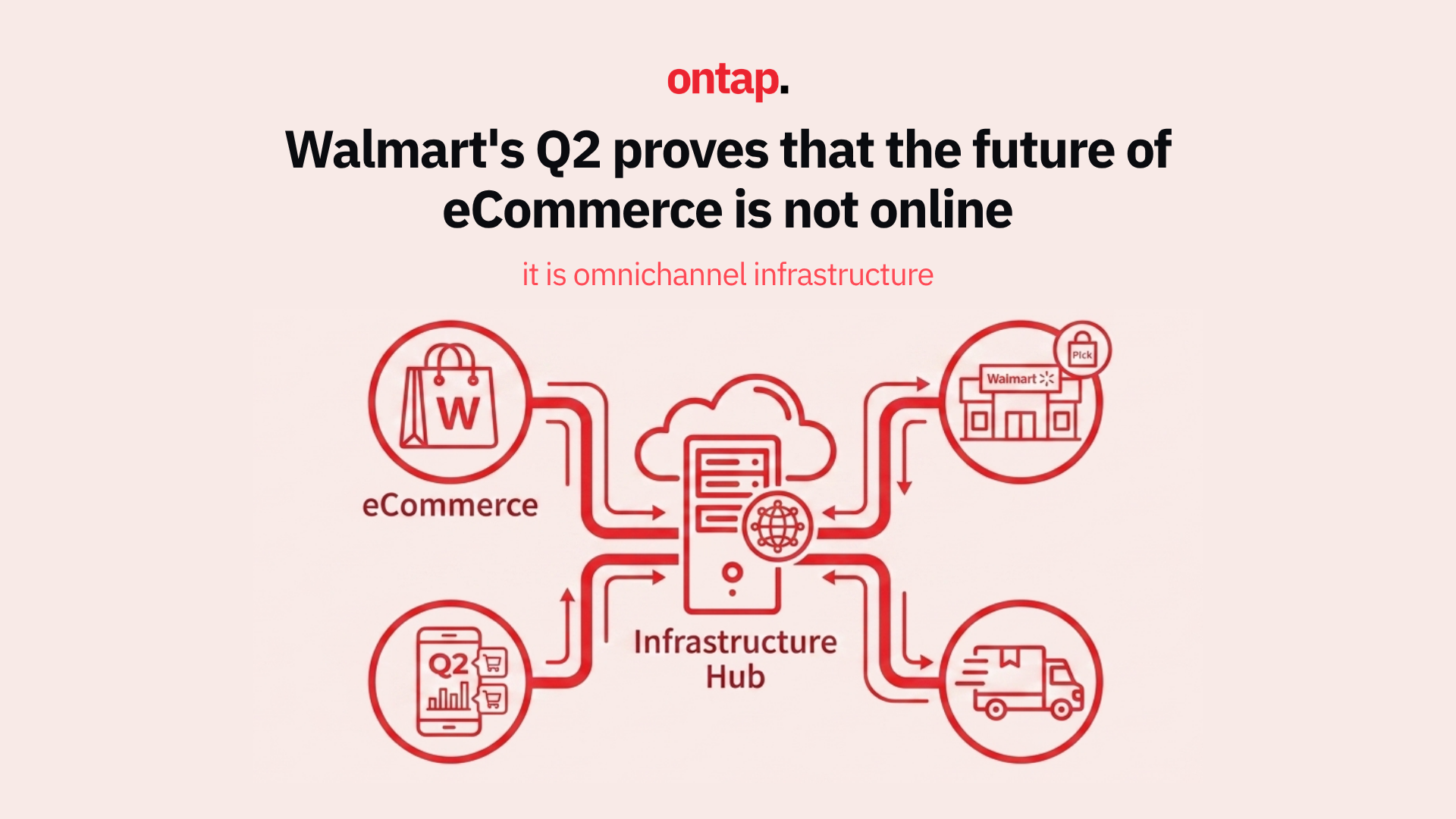
This is a fundamental shift in what a "store" is. When a significant portion of eCommerce growth comes from orders fulfilled by stores rather than warehouses, the store is not competing with eCommerce. It is enabling it. As Forbes noted in its Q2 coverage, CEO John Furner called the results "unprecedented in two decades."
For eCommerce merchants watching from the sidelines, this raises an uncomfortable question: if the world's largest retailer is using thousands of physical locations as same-day delivery infrastructure, what does that do to customer expectations for every other merchant?
The marketplace play compounds the advantage
Walmart's marketplace sales growing 52% is perhaps the most strategically significant number in the earnings release. A marketplace does something that no amount of owned inventory investment can do: it expands selection without expanding risk.
When Walmart adds marketplace sellers, it broadens its product catalogue without taking on inventory, warehousing, or markdown risk. The customer sees a wider selection. The seller gets access to Walmart's traffic and fulfilment network. Walmart earns a commission and, increasingly, advertising revenue from sellers who pay to promote their products within the marketplace.
This three-sided business model- customer, seller, advertising- is what Amazon has been running for years. Walmart is now replicating it at scale, and the 52% growth rate suggests it is working.
What smaller merchants can learn from this
Several of the strategic principles behind the numbers are scale-independent.
-
Your physical presence is fulfilment infrastructure, not just a sales channel: If you have physical locations, whether retail stores, showrooms, or warehouses, evaluate whether they could serve as local fulfilment nodes for online orders. Shopify's recent DoorDash integration and Shopify Collective make this operationally feasible for merchants with even a single physical location.
-
Marketplace participation is a strategic question, not just a revenue question: Selling on Walmart's marketplace, Amazon, or category-specific marketplaces gives you access to traffic you cannot generate independently. The trade-off is margin and data ownership, but for many merchants, marketplace revenue complements DTC sales rather than cannibalising them.
-
Advertising and commerce are converging: Walmart Connect growing 43% confirms what Amazon Ads, Google Shopping, and Meta have already demonstrated: product discovery increasingly happens through paid surfaces within shopping environments. Merchants who treat advertising as separate from their commerce strategy will find themselves at a structural disadvantage.
-
Speed-to-customer is becoming table stakes: When the two largest US retailers are investing billions in getting products to customers faster, "standard shipping in 5 to 7 business days" becomes a competitive liability. Evaluate your delivery promises and fulfilment partners before peak season.
The bigger picture
Perhaps the most important takeaway from Walmart's results is the compounding effect. Store-fulfilled delivery makes same-day delivery affordable. Same-day delivery attracts more eCommerce traffic. More traffic attracts more marketplace sellers. More sellers expand selection. More customers generate more advertising revenue. More advertising revenue funds more fulfilment investment.
This is a flywheel, and once it is spinning, the gap between retailers who have omnichannel infrastructure and those who do not widens with every quarter. eCommerce merchants do not need to build a flywheel at Walmart's scale. But they do need to understand that the landscape is being reshaped by retailers who have stopped thinking about online and offline as separate strategies.
The future of eCommerce is not online. It is connected.
About On Tap
On Tap is a growth-focused eCommerce consultancy helping mid-market and enterprise merchants build omnichannel strategies that connect platform, fulfilment, and marketplace capabilities. From operational roadmap planning and marketplace evaluation to delivery strategy and advertising integration, On Tap helps merchants build the connected infrastructure that compounds over time.
If Walmart's results have you thinking about your own operational roadmap, get in touch.