
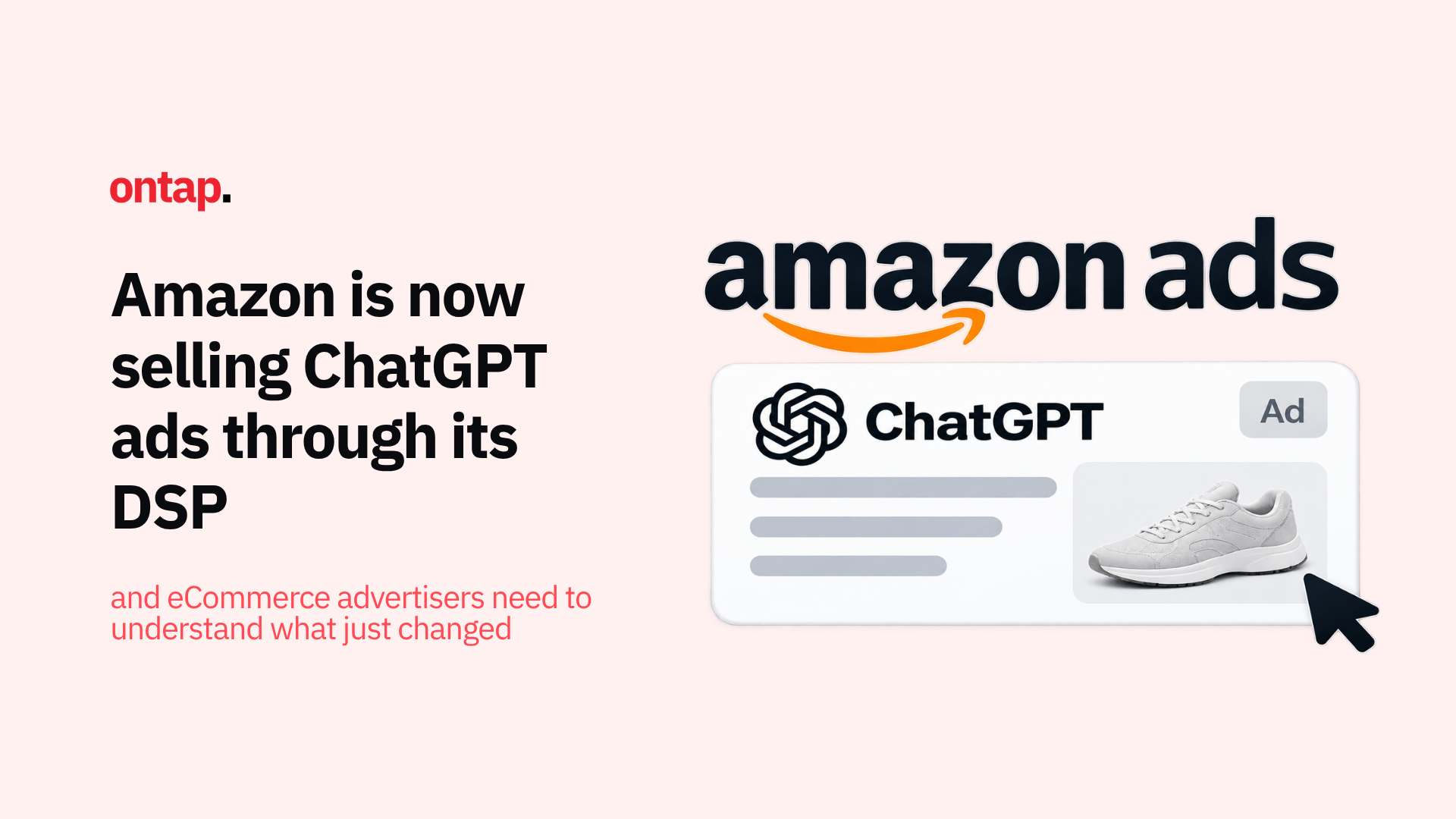
The two most powerful forces in digital advertising just connected. Amazon is now piloting access to ChatGPT Ads through Amazon DSP, letting US advertisers extend their campaigns into conversational AI surfaces directly from their existing Amazon media buying workflows.
This is not a partnership announcement. It is an infrastructure integration that changes how eCommerce advertising works.
What actually happened
As reported by Search Engine Land on 10 September, Amazon DSP advertisers can now access ChatGPT's ad inventory alongside Amazon's existing programmatic surfaces. In practical terms, this means the same campaign that serves ads across Amazon-owned properties, Fire TV, Twitch, and third-party exchanges can now extend into ChatGPT conversations.
For eCommerce merchants, this creates the first unified buying pathway between the world's largest retail media network and the fastest-growing AI ad surface. You do not need a separate OpenAI advertising account. You do not need to learn a new platform. You extend your existing Amazon DSP campaigns into ChatGPT through the tools you already use.
Why this matters more than it looks
Three reasons this integration is strategically significant for eCommerce advertisers.
1. It follows the shopper, not the screen: Bain & Company's holiday research found that 24% of holiday shoppers now plan to begin their discovery process using AI tools, including ChatGPT, Google Gemini, and Claude. That is up from 17% in 2025. When a shopper asks ChatGPT "what is the best noise-cancelling headphone under £200?" and your Amazon DSP campaign serves a relevant ad within that conversation, you are reaching them at the moment of consideration, not interrupting them during something else.
2. It leverages Amazon's first-party purchase data in a new context: Amazon DSP's competitive advantage has always been its access to actual purchase data, not inferred intent, but real buying behaviour. When that targeting data meets conversational AI context, you get ads served to shoppers who have demonstrated purchasing intent in your category, appearing at the exact moment they are actively researching a purchase in ChatGPT. No other advertising platform currently offers this combination.
3. The timing creates a pre-peak-season testing window: Deloitte's 2026-27 holiday forecast, released 10 September, projects eCommerce holiday sales will grow between 7.5% and 8.4% year over year, reaching $316 to $319 billion. Total holiday retail sales are expected to hit between $1.7 and $1.71 trillion. Advertisers who test ChatGPT Ads through Amazon DSP in September and October, when CPMs are lower and competition is lighter, will have performance data to inform their peak season allocation. Those who wait until November will be bidding blind against established competition.
The convergence pattern you should be watching
This integration is part of a broader pattern reshaping eCommerce advertising infrastructure:
-
OpenAI opened ChatGPT Ads to all US businesses through self-serve in May 2026
-
Google is testing Search campaigns inside AI Mode with exact and phrase match targeting
-
Microsoft Advertising rolled out AI Max globally for Search campaigns
-
Amazon is now extending its DSP into ChatGPT's conversational surfaces
Each move individually is significant. Together, they signal that the separation between traditional ad platforms and AI conversation platforms is dissolving. The question for eCommerce advertisers is not whether to advertise in AI environments. It is how quickly you can build the measurement infrastructure to evaluate whether the spend delivers genuine incremental value.
What you should actually do
-
If you already use Amazon DSP: ask your agency or media buyer whether your account has been flagged for the ChatGPT Ads pilot. If it has, allocate a small test budget, around 5 to 10% of your DSP spend, to conversational placements and run it for at least two weeks before concluding. Measure new-to-brand customer acquisition, not just ROAS, since the conversational context may attract different customer profiles from standard display.
-
If you do not use Amazon DSP, this integration strengthens the case for evaluating programmatic advertising through Amazon's infrastructure. The ChatGPT extension gives DSP advertisers access to ad surfaces that are not available through standard Sponsored Products or Sponsored Brands. If your products compete in categories where shoppers research before buying, including electronics, home goods, beauty, and fitness equipment, the conversational discovery channel is directly relevant.
-
Regardless of platform: start tracking how much of your traffic and revenue comes from AI-referred sessions. Shopify provides this data natively. If you are on other platforms, work with your analytics team to identify and segment AI-referred traffic. You cannot evaluate whether to advertise in AI environments if you do not understand how much commerce those environments already drive to your store.
The measurement challenge you need to solve now
The biggest risk with ChatGPT Ads through Amazon DSP is not the spend. It is the attribution. Conversational ad interactions do not fit neatly into click-based attribution models. A shopper who sees your ad during a ChatGPT conversation does not click immediately, but searches for your brand on Amazon two days later will likely be attributed to organic or branded search rather than the conversational ad that created the awareness.
Before you scale spend, establish how you will measure incrementality. Compare new-to-brand customer rates, branded search volume changes, and overall Amazon revenue during test periods versus control periods. If ChatGPT Ads drive genuine new customer acquisition, the investment is worth scaling. If they recapture existing demand at higher CPMs, they are not.
The bigger picture
Amazon selling ChatGPT Ads through its DSP is the most significant eCommerce advertising infrastructure change since Performance Max. It connects purchase-intent data with conversational discovery at scale, and the timing, eight weeks before peak season, creates a testing window that closes fast.
The eCommerce advertisers who build measurement capability for conversational advertising now will have a structural advantage. Everyone else will be catching up.
About On Tap
On Tap is a growth-focused eCommerce consultancy helping mid-market and enterprise merchants build advertising strategies that account for where customers actually discover products, not just where they click. From media mix evaluation and incrementality testing to AI advertising strategy and peak season planning, On Tap helps merchants stay ahead of a rapidly evolving advertising landscape.
If you are evaluating your media mix ahead of peak season, get in touch.