
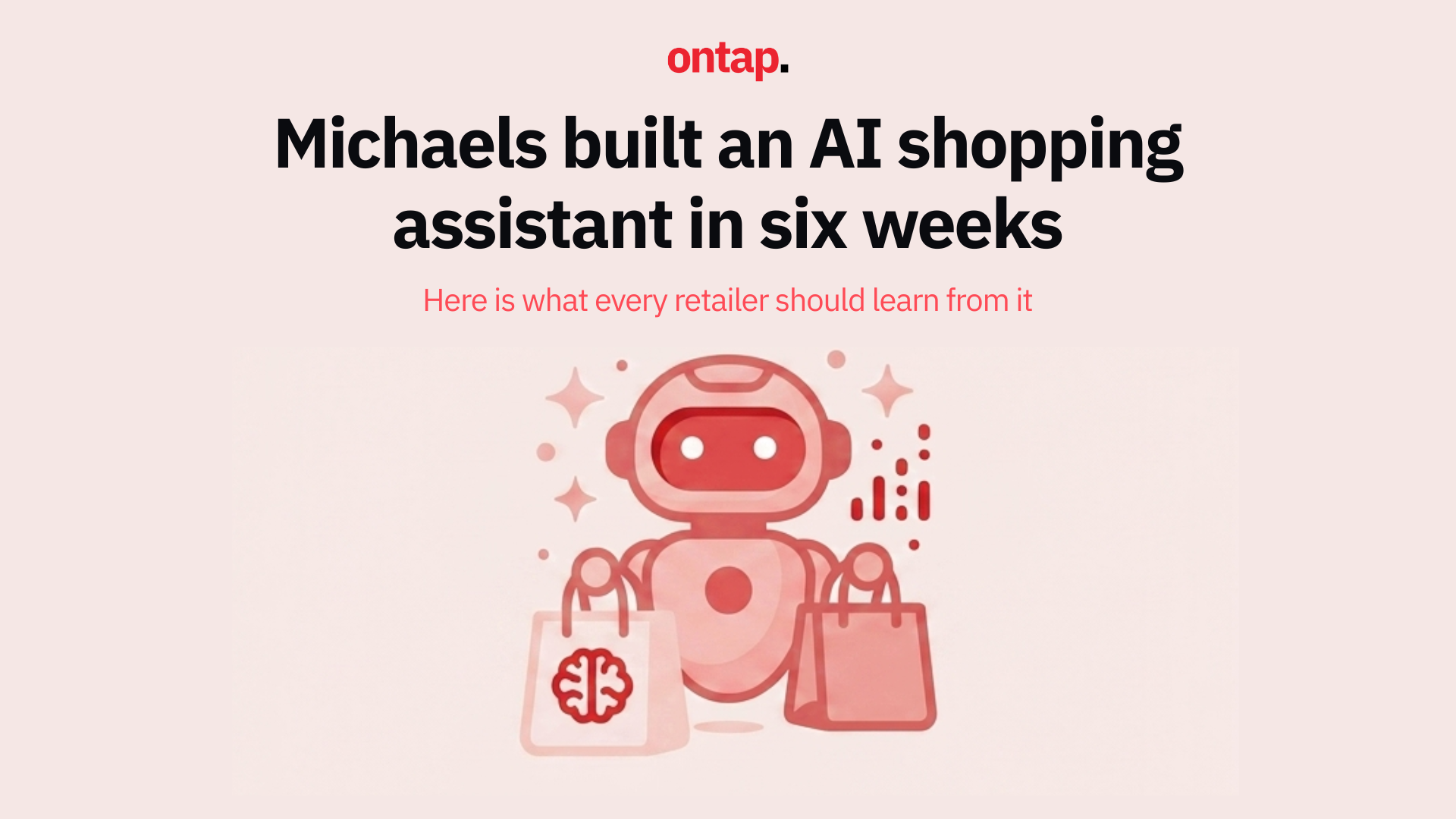
Michaels, North America's leading arts and crafts retailer, just launched "Ask Mike," an AI-powered shopping assistant built with Google Cloud's Gemini Enterprise for Customer Experience. What makes this story noteworthy is not the technology itself. It is the speed, the approach, and the early results, all of which carry practical lessons for eCommerce merchants of any size.
From concept to production in six weeks
As Paul Tepfenhart, Google Cloud's Global Director of Retail Industry Strategy, stated in the joint announcement: "Seeing a retailer move from concept to a production-grade AI in just six weeks is a signal of where the industry is heading. Michaels is showing what it looks like to put AI at the centre of the shopping experience, not just as a service tool, but as a true driver of discovery and conversion."
That is not a proof-of-concept or a demo. That is a fully deployed, customer-facing tool handling real shopping interactions on Michaels.com, the mobile site, and the iOS and Android apps. Two years ago, building something like this would have required months of development, custom model training, and significant infrastructure investment. The fact that a retailer can deploy a production AI assistant in a six-week sprint tells you exactly how fast the barriers to AI adoption are falling.
What Ask Mike actually does
Ask Mike goes beyond traditional site search. Instead of keyword filtering, where customers type "birthday party supplies" and get a grid of filtered products, Ask Mike accepts natural language queries and provides personalised recommendations with creative guidance.
As Heather Bennett, Michaels' President and Chief Customer Officer, said: "In just a few weeks, Ask Mike has fueled nearly 75,000 conversations, with our community using the tool for everything from party planning to finding the right materials for their first punch-needle pillow."
According to Chain Store Age and Digital Commerce 360, the tool was first released in May 2026, with over 60% of interactions focused on product discovery across Michaels' online assortment. Customers are asking things like "help me plan my child's birthday party" and "I need a fabric for DIY curtains." These are not product searches. They are project descriptions. Ask Mike interprets the intent and recommends products that fit the customer's actual need.
Michaels plans to expand the tool with AI-generated product overviews and contextual prompts on product detail pages.
Why this matters beyond Michaels
Michaels is not alone. As Retail Dive reported, Ulta Beauty and Macy's have also tapped Google's Gemini platform for similar AI assistant deployments. The pattern is clear: major retailers are rapidly moving from experimental AI to production AI, and they are doing it through platform partnerships rather than building from scratch.
For eCommerce merchants, this creates both an opportunity and a competitive pressure. The opportunity is that the same platforms powering Michaels' deployment are available to merchants of all sizes. The competitive pressure is that customer expectations are being set by these early deployments. Once shoppers experience conversational, context-aware product discovery at Michaels, they will expect something similar elsewhere.
The product data foundation
Here is the part that does not make the press release but matters enormously: Ask Mike only works because Michaels has its product data in good shape. An AI assistant that recommends products for a "DIY curtain project" needs rich, structured catalogue data that includes use cases, materials, and project context, not just product names and prices.
If your product catalogue is a collection of sparse descriptions and inconsistent attributes, no amount of AI sophistication will produce good recommendations. The AI is only as good as the data it can access.
This connects directly to what we are seeing across the industry. Google's AI Max requires rich product feed data. AI search engines such as ChatGPT and Gemini recommend brands based on structured entity data. And now AI shopping assistants need comprehensive product information to power conversational discovery.
Product data quality is no longer just an SEO or feed optimisation concern. It is the foundation for every AI-powered commerce experience.
Practical takeaways for eCommerce merchants
1. Start with your product data, not the AI. Before evaluating AI assistant tools, audit your product catalogue. Are descriptions comprehensive? Are attributes complete and consistent? Do products have use-case information, not just specifications? This foundation determines everything else.
2. Understand how your customers describe what they want. Ask Mike succeeds because it matches natural language queries to products. Study your site search logs, customer service transcripts, and social media conversations to understand how customers actually talk about your products. Build that language into your product data.
3. Evaluate platform-native AI tools first. If you are on Shopify, explore Sidekick and the AI features built into the platform. If you are on Adobe Commerce, look at the Commerce Intelligence tools and Sensei integrations. If you are on a custom stack, Google Cloud and AWS both offer commerce-ready AI services. You do not need to build from scratch.
4. Start small and measure. Michaels did not launch with every feature. They started with conversational recommendations and are expanding to product overviews and contextual prompts. Pick one high-value use case, such as project-based product discovery or gift recommendations, and deploy a focused AI experience around it.
5. Track conversion impact, not just engagement. 75,000 conversations is an impressive engagement number, but the metric that matters is whether those conversations lead to purchases. Set up proper attribution before you launch so you can measure real business impact.
The bigger picture
The speed of Ask Mike's development signals something important about where AI in commerce is heading. We are past the experimentation phase. The tools are mature enough for production deployment, the timelines have compressed dramatically, and the results are measurable.
The retailers who move now, even with modest initial deployments, will build the data, the institutional knowledge, and the customer expectations that become competitive advantages. Those who wait will find themselves trying to catch up to competitors who already understand how their customers talk, what they need, and how to help them find it.
Six weeks. That is all it took for Michaels.
About On Tap
On Tap is a growth-focused eCommerce consultancy helping mid-market and enterprise merchants implement AI-powered commerce experiences that drive measurable business results. From product data audits and catalogue enrichment to AI assistant evaluation and conversion attribution, On Tap helps merchants build the data foundation that makes AI investments deliver.
If you want to explore what an AI-powered shopping experience could look like for your store, get in touch.