
In fashion, conversion depends on whether customers can evaluate key aspects. The same product can be perceived differently depending on body type, styling, and personal preference. As a result, the purchase decision is more uncertain and harder to resolve.
This guide combines benchmark data with On Tap’s hands-on experience working with fashion brands to help you:
-
Benchmark conversion rate within fashion eCommerce
-
Understand the key drivers specific to this category
-
Identify where conversion breaks down
-
Translate these insights into targeted, fashion-specific optimisation strategies
What is the average conversion rate for fashion eCommerce?
A large-scale research (2025) reports a 2.4% median conversion rate across 500 fashion brands. However, this average hides wide variation across fashion verticals, where product type and purchase complexity can lead to materially different conversion outcomes.
Conversion rate benchmarks by fashion vertical
The industry report shows clear differences in conversion performance depending on the type of product:
|
Fashion vertical |
Conversion rate |
|
Accessories |
7.4% |
|
Women’s fashion |
3.6% |
|
Sportswear |
2.8% |
|
Footwear |
2.2% |
|
Baby / Childwear |
2.1% |
|
Health & Beauty (fashion-adjacent) |
2.1% |
|
Home & styling |
1.5% |
|
Men’s fashion |
0.8% |
Key insights:
Conversion rates vary across fashion verticals due to product characteristics and the consumer decision process; for example:
-
Accessories (7.4%) are low-cost, often impulse buys with minimal fit or styling concerns, making them easier to convert.
-
Men’s fashion (0.8%) is more complex, requiring higher decision effort due to fit uncertainty, styling preferences, and lower purchasing frequency, which results in longer decision cycles and lower conversion.
How to use this benchmark:
When benchmarking conversion rates, always consider the product type and customer journey complexity in your specific vertical. For instance, a 2.5% conversion rate in men’s fashion can still be strong, while the same rate in accessories may indicate missed opportunities.
Conversion rate trends across the year
Fashion eCommerce conversion rates vary across the year rather than staying at a fixed level.
Based on Dynmic Yield’s monthly data (2025-2026), the monthly conversion rates for fashion eCommerce are:
|
Month |
Conversion rate |
|
Apr 2025 |
2.89% |
|
May 2025 |
3.00% |
|
Jun 2025 |
2.72% |
|
Jul 2025 |
3.09% |
|
Aug 2025 |
3.12% |
|
Sep 2025 |
2.89% |
|
Oct 2025 |
2.73% |
|
Nov 2025 |
3.31% |
|
Dec 2025 |
3.36% |
|
Jan 2026 |
2.63% |
|
Feb 2026 |
2.41% |
|
Mar 2026 |
2.45% |
Key insight:
Fashion eCommerce is highly sensitive to seasonal demand. Conversion typically peaks during promotions and gifting seasons like November and December, where urgency and special offers drive higher conversion rates. This is why November - December sees conversion rates of 3.3%, while January - February typically falls to 2.4–2.6% post-peak.
How to use this benchmark:
Compare like-for-like periods (peak vs peak, off-peak vs off-peak). Avoid cross-period comparisons, as they reflect changes in intent, not necessarily performance. A drop from 3.3% to 2.5% post-holidays is not a cause for concern; it's a normal seasonal dip.
What actually drives conversion in fashion eCommerce
Size and fit certainty
Size and fit are among the most persistent sources of friction in fashion because customers cannot verify how a product will behave on their body before purchase.
This uncertainty directly affects decision confidence, with research showing that 52% of customers hesitate to complete a purchase when unsure about fit.
The core challenge is that size is not a fixed input. Its outcome varies depending on factors such as cut, fabric, and garment construction, and is further complicated by the lack of standardisation across brands.
Conversion, therefore, depends on whether the customer feels they can predict the final fit outcome with sufficient confidence. If that confidence is not reached, the decision is delayed, compared, or abandoned.
Visual and sensory uncertainty
Fashion decisions rely heavily on sensory evaluation, which is only partially replicated online.
Customers cannot:
-
feel fabric weight, texture, or quality
-
observe how materials move or behave in real use
-
fully assess elements such as fabric thickness, softness, or how a garment sits on the body
This creates a gap between how products are presented and how they are experienced in reality, which introduces uncertainty into the purchase decision.
Identity alignment and style relevance
Fashion purchases are not purely functional. Customers are evaluating whether a product aligns with their personal style, identity, and how they want to present themselves.
This creates a second layer of decision-making beyond fit. Even when a product is suitable in terms of size, price, and use case, it may still be rejected if it does not feel personally relevant.
Research shows that a majority of fashion shoppers consider style and personal preference as a primary factor in purchase decisions, often outweighing purely functional attributes. This reflects how fashion operates as a form of self-expression rather than a purely utilitarian purchase.
Brand relevance and pre-existing intent
In many cases, fashion products are brand-originated and not directly comparable across retailers, meaning customers are not always choosing between equivalent items.
Instead, they often choose between distinct design languages, aesthetics, and cultural positions defined by each brand.
Customers therefore arrive with a pre-filtered consideration set, based on the brands they already recognise or feel aligned with. The industry research shows that original fashion brands tend to achieve higher conversion rates, particularly when users visit with clear brand intent.
If the brand is already relevant, the path to purchase is short. If not, the site must first establish that relevance before product evaluation can take place.
Localisation and contextual relevance
Fashion is highly context-dependent, so customers evaluate products based on how well they fit into their local environment and expectations, not just how they are presented.
This goes beyond language. It includes factors such as climate, cultural norms, sizing standards, pricing, payment methods, delivery expectations, and visual representation. For example, a heavy wool coat may feel relevant to customers in Northern Europe, but not to customers in Southeast Asia, where climate and use cases differ significantly.
For global fashion brands, product relevance varies by region, leading to different merchandising approaches across markets.
Where fashion eCommerce conversions break down - and how to identify the root cause
In fashion eCommerce, drop-off reflects different unresolved decisions as customers move from recognising relevant products, to evaluating fit and suitability, to committing to a purchase.
Analysing these stages separately allows you to identify the specific constraint driving conversion loss.
Note: This analysis focuses on fashion-specific causes of conversion drop-off, rather than general eCommerce factors that apply across all categories.
For a broader view of general friction points across the eCommerce funnel, read our detailed guide: https://www.ontapgroup.com/blog/ecommerce-conversion-funnel
1. Can customers quickly recognise products that match their style?
At the beginning of the journey, customers are not yet evaluating specific products. They are scanning the catalogue to determine whether anything matches their style, intent, or expectations. This stage is highly visual and fast-paced, with decisions made in seconds rather than minutes.
|
Metric |
What it signals |
What may be causing this |
|
Product click-through rate (PLP → PDP) |
Whether users recognise products as relevant at first glance |
- Thumbnails (Product images/ videos) do not clearly communicate style, silhouette, or use case, making it difficult to assess relevance quickly. |
|
Product views per session |
How broadly users explore the catalogue |
- Users do not find a clearly relevant product early, leading to continued scanning without forming intent. |
|
Bounce rate |
Alignment between expectation and content |
- The visible assortment does not match the expected style, category, or price positioning. |
|
Scroll depth (collection pages) |
Willingness to explore further |
- Lack of clear visual grouping or direction makes it difficult to identify promising products. |
2. Can customers understand how the product will look and fit on them?
Once a product is selected, the customer shifts from browsing to evaluation. The goal is no longer to find something interesting, but to determine whether a specific item will fit, look right, and suit their needs.
|
Metric |
What it signals |
What may be causing this |
|
Low time on PDP |
Immediate rejection after entry |
- Mismatch between product listing (style, fit, context) and actual product presentation. - Price or value mismatch, weak first impression. |
|
High time on PDP + low progression |
Active evaluation without resolution |
- Users cannot confidently predict fit or appearance based on available information. |
|
Size chart open rate |
Need for additional fit validation |
- Size labels alone are insufficient to predict fit, requiring additional interpretation. |
|
Variant interaction (size/colour switching) |
Effort spent resolving options |
- Users test multiple combinations because the outcome depends on the size, cut, and styling interaction. |
|
High image/video interaction |
Attempt to visualise product outcome |
- Visual content does not provide enough evidence of how the product looks on the body or in context. |
3. Do customers feel confident enough to commit to the purchase?
At this stage, the product decision has largely been made. The remaining question is whether the customers are comfortable committing to the purchase, given the full context of cost, delivery, and potential downside.
While return policies and delivery information are often visible earlier in the journey, their impact typically becomes more pronounced here, where customers evaluate the total cost and risk of the purchase.
Drop-off at this stage reflects hesitation around committing, rather than uncertainty about the product itself. In fashion, this is often driven by perceived risk, particularly around fit, returns, and whether the product will meet expectations in real use.
|
Metric |
What it indicates |
What may be causing this |
|
Add-to-cart rate |
Whether users are confident enough to act on the product decision by selecting an option and adding the product to cart |
- Customers are not confident enough to commit to a specific option (e.g. size), even after reviewing product information. - Lack of validation signals (reviews, UGC) to reinforce decision confidence. |
|
Cart-to-checkout rate |
Whether users are willing to proceed after reviewing order details such as delivery, returns, and total cost |
- Delivery timelines are unclear or do not align with intended use (e.g. event, seasonal need). - Return policy lacks clarity on process, cost, or eligibility. - Users delay commitment to compare alternatives or reconsider the purchase. |
|
Checkout completion rate |
Whether users are comfortable finalising the purchase after entering checkout |
- Return conditions (e.g. paid returns, limited exchange options) increase perceived cost or risk when evaluating the final purchase. - Final cost (including shipping or potential return cost) becomes less acceptable at checkout. - Limited payment options or a lack of trust signals reduce confidence at the point of payment. |
Identifying where conversion breaks down is not always straightforward. The same performance pattern can be caused by very different underlying issues, whether in product-market alignment, merchandising, or how the site supports customer decision-making. Without a structured approach and hands-on experience, it is easy to optimise the wrong areas, leading to incremental improvements that do not address the root cause.
|
On Tap brings over 20 years of hands-on eCommerce experience, working with brands to improve conversion by identifying where performance breaks down across product, merchandising, and the customer journey. Our approach focuses on diagnosing the underlying constraint, whether in product-market alignment or in how effectively the site supports key customer decisions. This methodology applies across visually driven categories, including fashion and beauty. For brands such as TEMPLESPA, our optimisation work delivered an 18% uplift in mobile conversion rate, with the project also recognised with a Silver award at the 2025 eCommerce Awards. Explore our digital marketing services |
Strategies to improve conversion rate for your fashion stores
Improving conversion in fashion eCommerce requires addressing the specific decision barriers that are unique to this category, from fit uncertainty to visual evaluation and contextual relevance.
The strategies below focus on resolving these fashion-specific barriers by improving how customers evaluate products, interpret brand signals, and commit to a purchase. They also reflect how leading brands are evolving their approach, using technologies such as predictive sizing, richer product visualisation, and personalised merchandising to enhance customer experiences more effectively.
Make sizing easier to act on, not just available
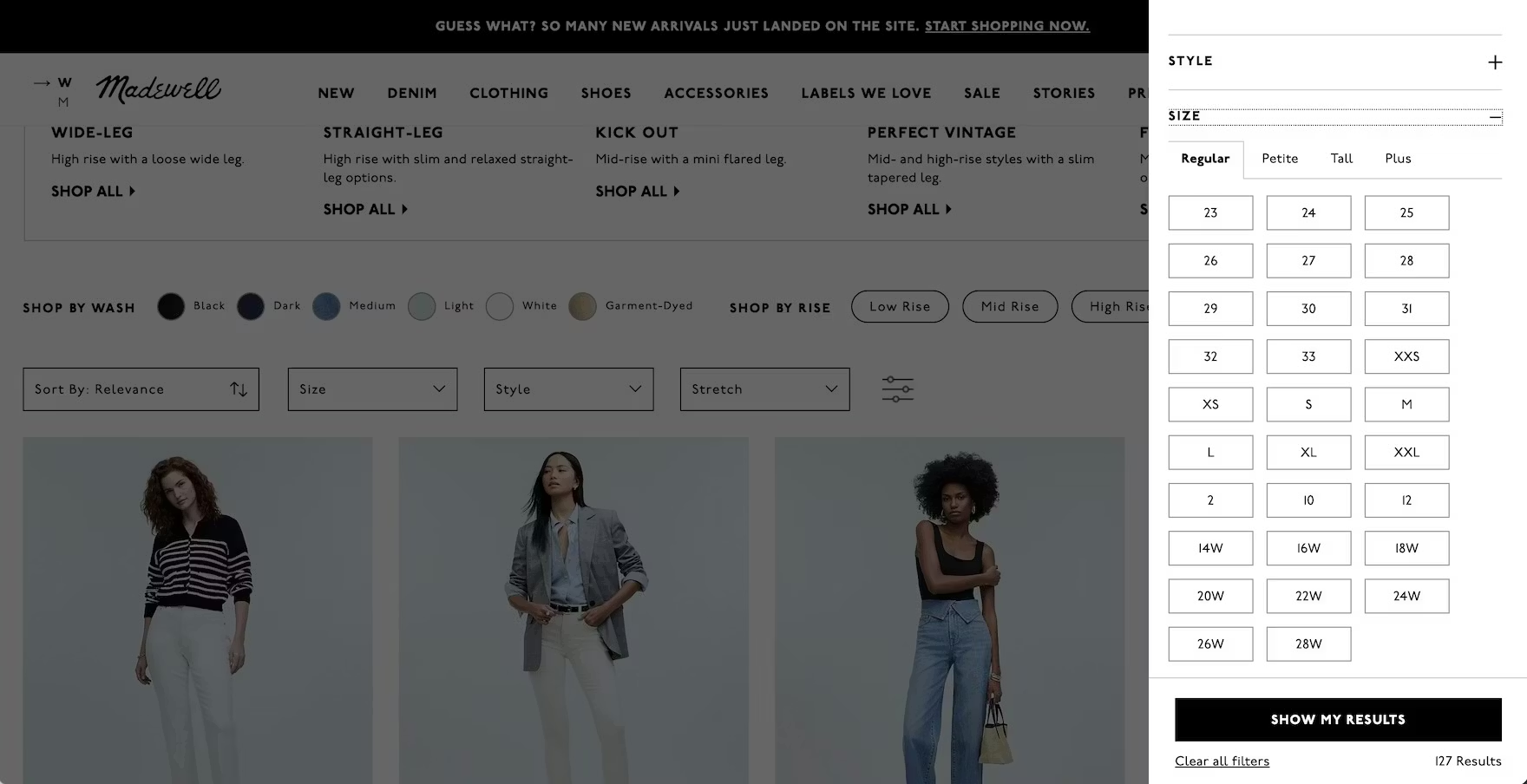
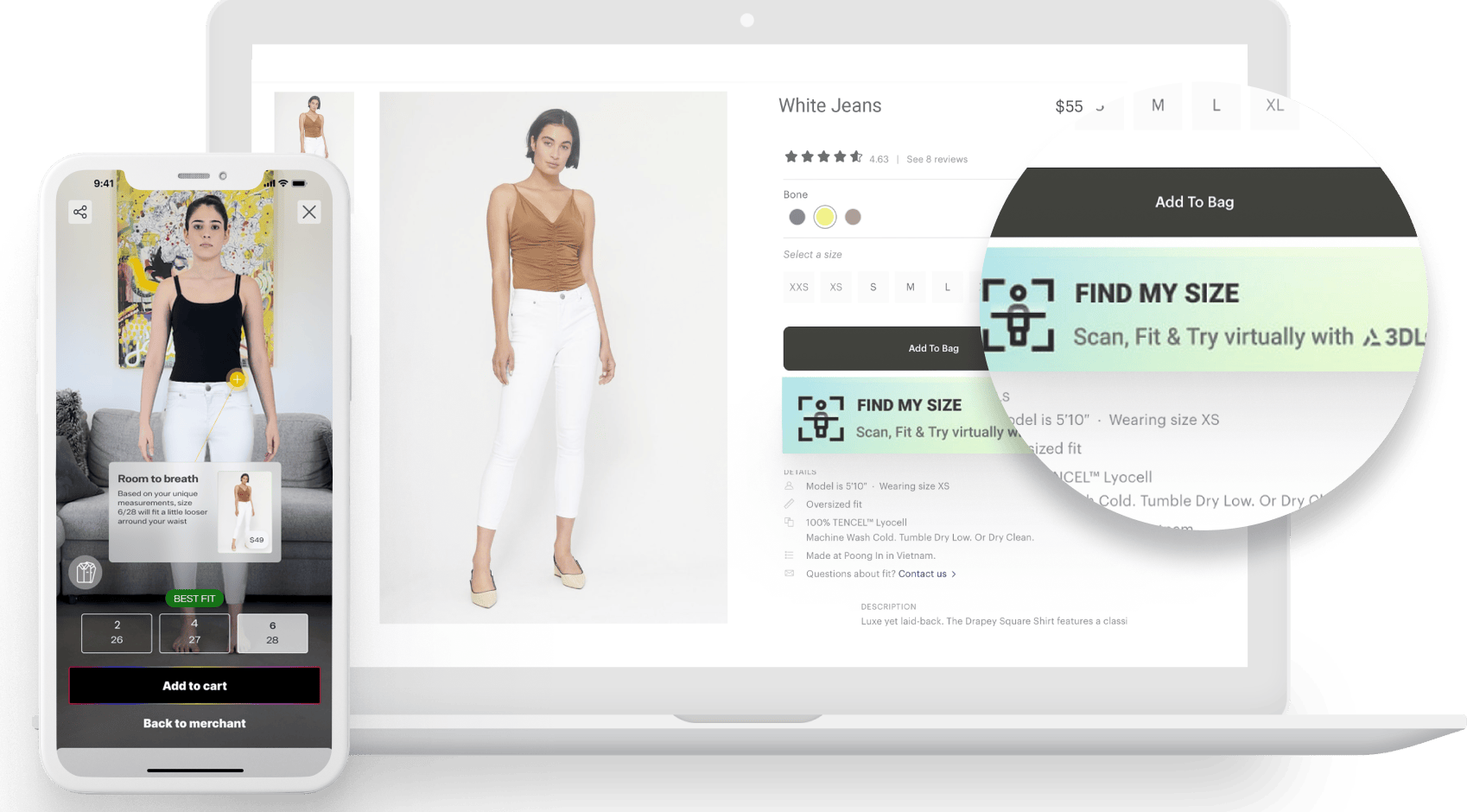
For most fashion stores, sizing breaks down not because information is missing, but because it is not reliable enough to act on confidently.
To improve conversion, focus on making sizing predictable, trustworthy and easier to act on.
-
Standardise sizing logic and make product-level variation explicit: Use a consistent method to measure all products across your catalogue, and ensure size labels reflect actual garment measurements rather than brand conventions.
Where fit varies due to cut, fabric, or production (e.g. stretch materials, washed denim), communicate this at the product level instead of presenting sizing as fixed. This reduces inconsistency across products and makes sizing more predictable for customers. -
Show how the same product fits across different body types: Use multiple models with different heights and body shapes wearing different sizes of the same item, alongside clear model measurements where relevant. This allows customers to anchor their decision through comparison, rather than interpreting abstract size information.
-
Implement AI-powered size recommendation (e.g. Fit Finder / Size Advisor): Use a size recommendation system that suggests the best-fit size based on customer inputs or behavioural data such as past purchases and returns. These systems reduce size switching and help customers commit faster by narrowing the decision to a single, confident choice.
Enable realistic and outcome-based product visualisation

To improve conversion, focus on helping customers visualise the product in motion, in context, and on the body, without requiring imagination.
-
Use video to show movement, fit, and fabric behaviour: Add short product videos that demonstrate how the garment moves, drapes, and reacts to motion. This is especially important for materials where behaviour cannot be inferred from images, such as flowy fabrics, structured tailoring, or stretch garments.
-
Show the product in real-life contexts, not just studio setups: Include imagery or video that reflects how the item is worn in everyday situations, such as walking, sitting, or styling with other pieces. This helps customers understand how the product fits into actual use, not just how it looks in isolation.
-
Provide multiple on-body angles that reflect how customers evaluate products: Show front, side, and back views of the body, rather than relying on a single hero shot. Customers mentally reconstruct how a product looks from different perspectives, and missing angles increase uncertainty.
-
Implement virtual try-on or 3D product visualisation for high-impact categories: For categories where appearance is critical (e.g. dresses, eyewear, footwear), use tools that allow customers to preview how products look on their own body or face. These technologies reduce reliance on imagination and improve confidence in the visual outcome.
Design merchandising around style and identity alignment

Customers decide within seconds whether a catalogue feels relevant. If they cannot recognise alignment quickly, they continue browsing without intent or leave.
-
Structure collections around clear style directions or use cases, not just product types: Build entry points based on how customers think, such as workwear, minimal, oversized, or occasion-based collections, instead of relying only on categories like dresses or tops. Keep each collection visually and stylistically consistent, avoiding mixed styles, fits, or price positioning. This allows customers to recognise relevance immediately rather than scanning or interpreting a broad assortment.
-
Shift from fixed collections to dynamically personalised merchandising: Rather than presenting the same product order to every user, brands are increasingly adapting collections and ranking based on individual behaviour. AI-driven merchandising enables real-time reordering, surfacing products that each customer is more likely to engage with. This shortens the path to relevance and shifts discovery from browsing to guided selection.
Build brand clarity and relevance for first-time visitors
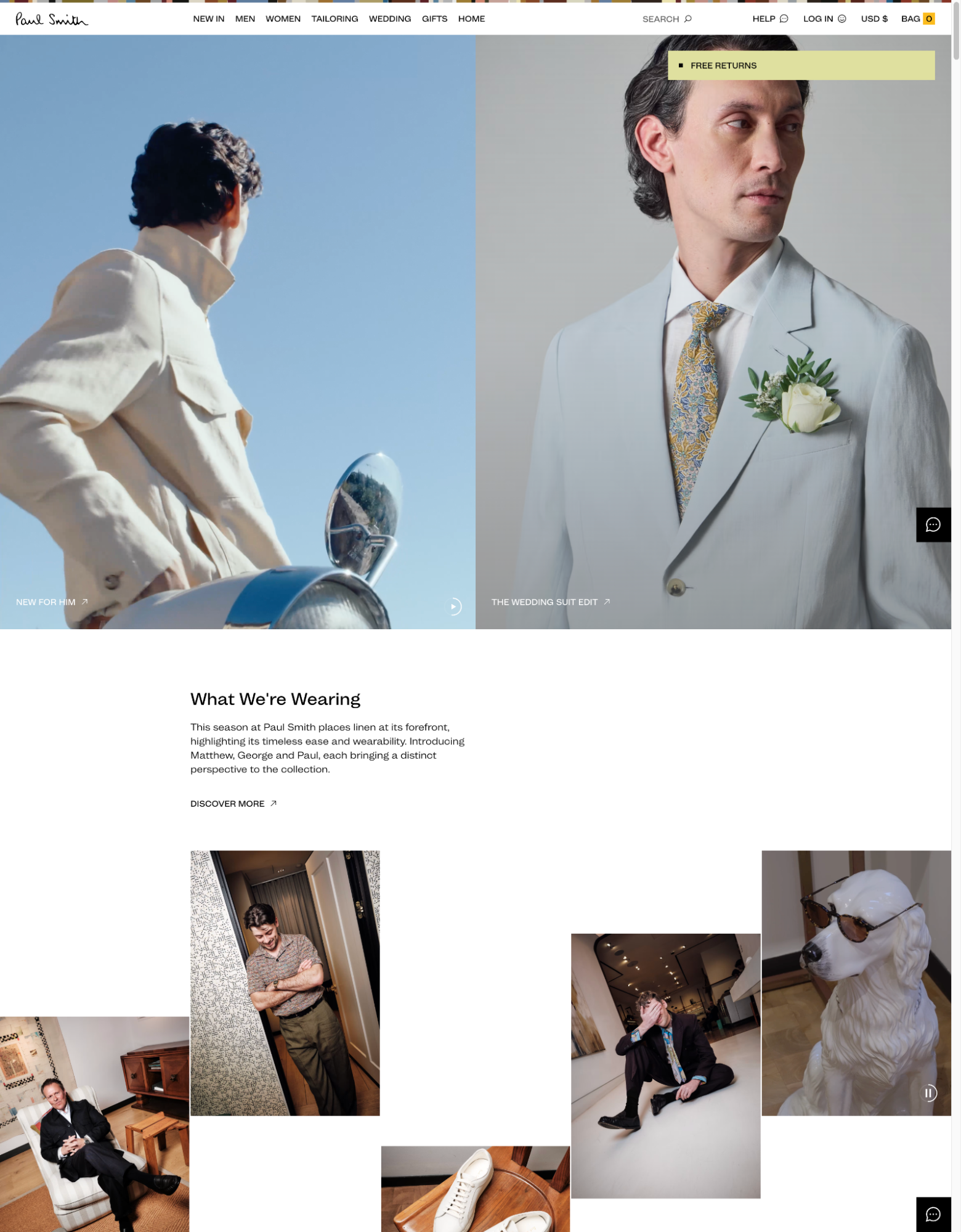
For first-time visitors, the decision is whether the brand is relevant enough to explore. This is especially critical for traffic from paid social and discovery channels, where users arrive without prior brand context.
-
Use imagery and styling to clearly define what your brand stands for: New visitors interpret the brand through what they see first, including how products are styled, who wears them, and in what context. These choices signal whether the brand is premium, trend-led, minimalist, or functional. That direction needs to be applied consistently across key pages so users can form a clear and stable understanding of the brand.
-
Use content and narrative to make your value proposition explicit: Visuals signal what the brand looks like, but content explains what it represents. Campaign messaging, collection themes, and editorial content should clearly communicate the brand’s purpose, audience, or use context, helping users understand why the brand exists beyond the products themselves.
Localise product, experience, and expectations by market

Customers evaluate products against local expectations, including sizing standards, climate, pricing, and fulfilment norms. When these do not align, otherwise suitable products may still underperform.
-
Adjust product exposure to reflect regional demand and seasonality: Rather than treating all products equally across markets, prioritise or deprioritise items based on local demand, climate, and seasonal relevance. This can be done through merchandising, filtering, or collection curation, ensuring customers encounter contextually relevant products earlier in their journey.
-
Localise pricing, delivery, and messaging by market: Adapt how products are presented in each market by adjusting elements such as local currency and price anchoring, delivery timelines and costs, return policies, and promotional messaging. Many brands are increasingly using geo-targeting and personalisation technologies (e.g. IP-based location detection or personalisation engines) to dynamically adjust pricing display, delivery information, and promotional messaging based on location. This allows the same catalogue to be presented in a way that feels locally relevant, without requiring separate sites for each market.
Strengthen real-world product validation beyond brand presentation
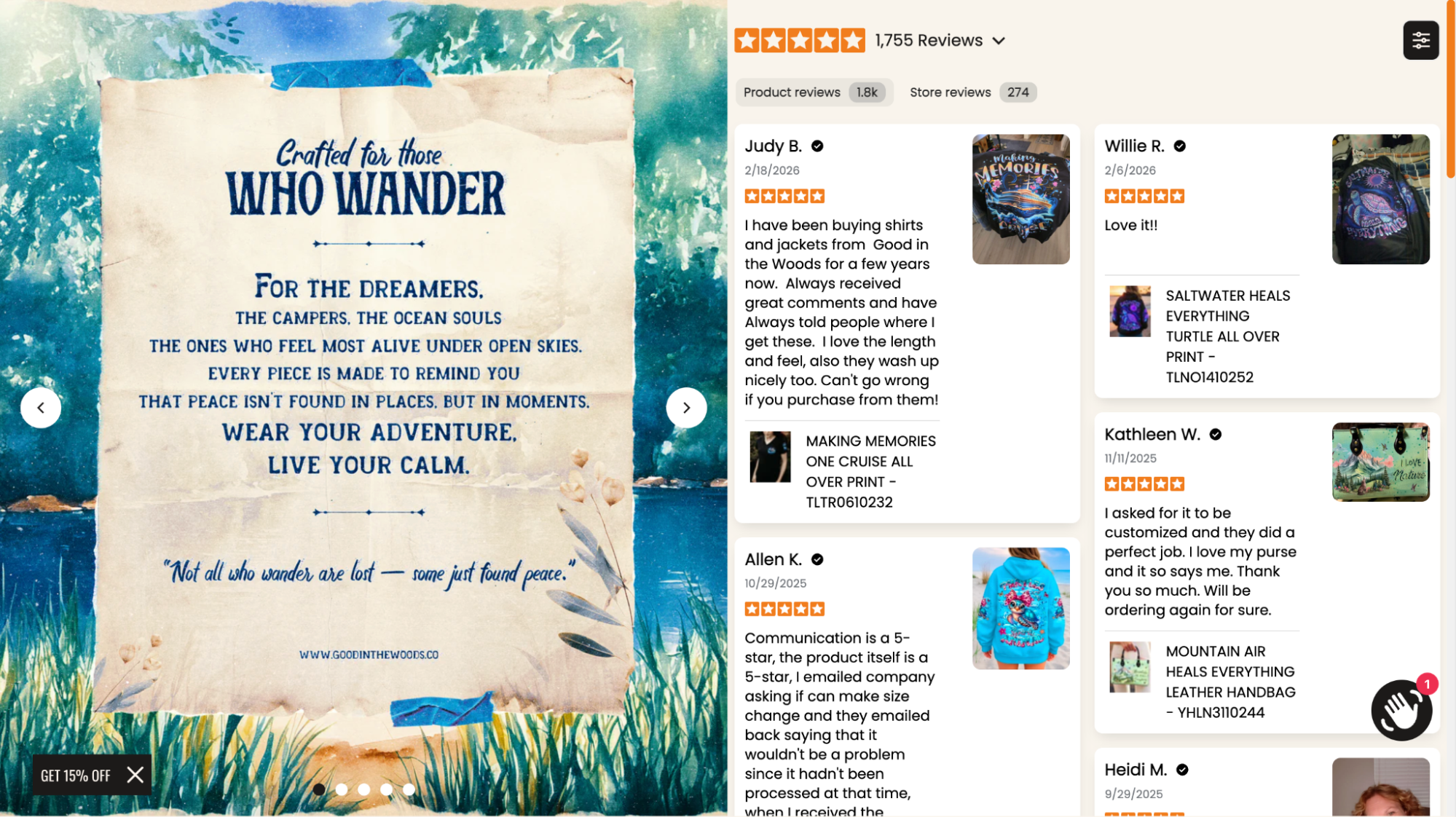
Customers do not rely on product pages alone. They look for external validation before committing.
-
Integrate user-generated content (UGC) directly into product evaluation: UGC includes customer photos, videos, and reviews showing how the product looks and fits in real use. Embedding this content within the PDP allows users to validate the product without leaving the site and reflects a broader shift where peer content increasingly influences purchase decisions more than brand-controlled visuals.
-
Reinforce product credibility through structured validation signals: Surface signals such as volume of reviews, consistency of feedback, and product popularity (e.g. bestsellers or frequently purchased items) can help reduce perceived risk and help customers assess whether the product is widely accepted.
Reduce perceived purchase risk at the point of decision
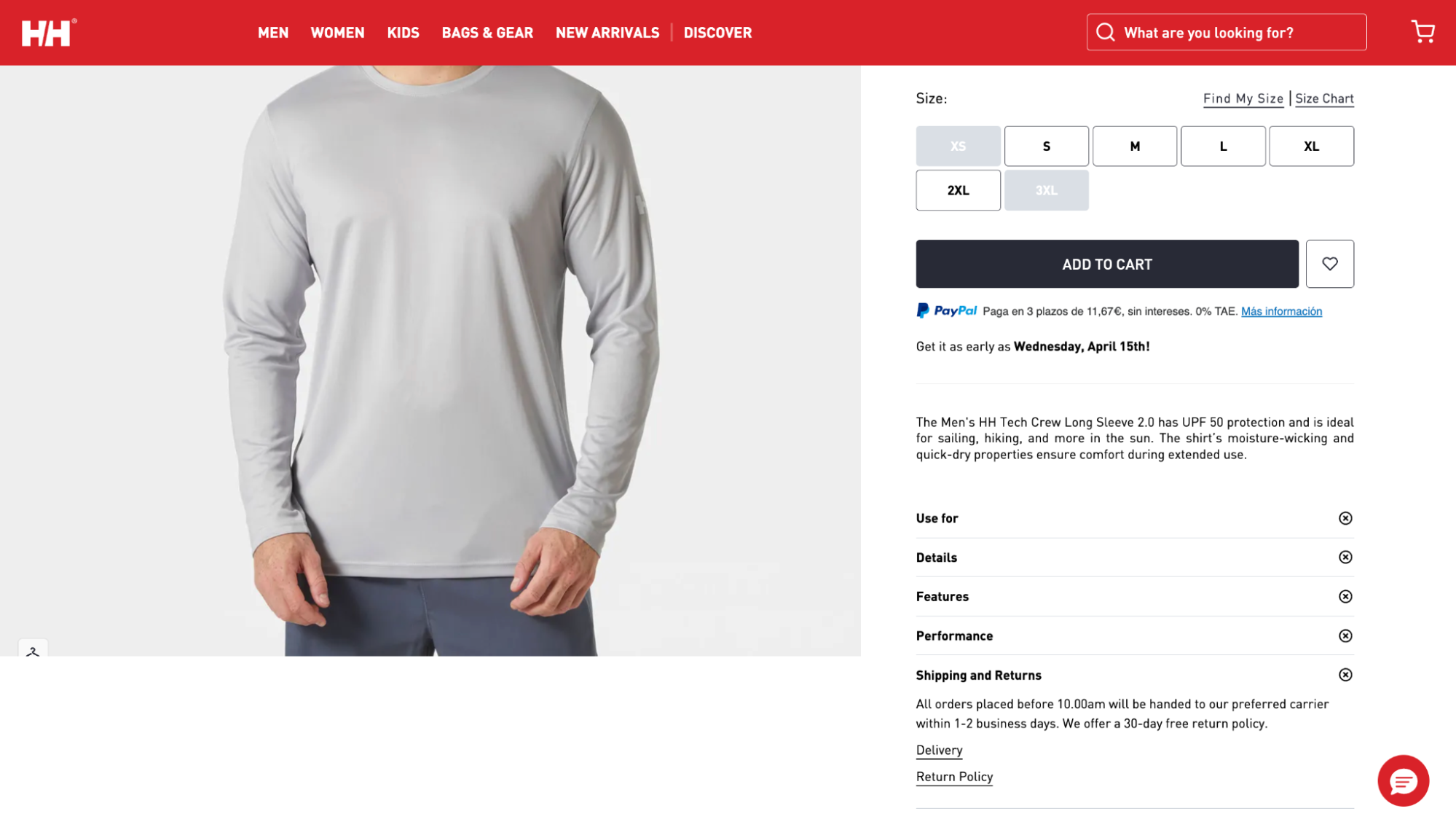
Even after product evaluation is complete, conversion often fails due to residual risk, especially around fit and returns. To address this, design the purchase experience to actively reduce uncertainty:
-
Structure return and exchange policies around fit-related returns: Many fashion returns are driven by sizing and fit issues rather than product defects. Policies should therefore make it straightforward to correct an initial choice, whether through exchanges, store credit, or clearly defined return options, depending on the business model. When customers can see a predictable path to resolving a mismatch, they are more likely to commit.
-
Surface return and delivery conditions where the decision is made: Customers evaluate the downside of a purchase while selecting size and reviewing the order. Return costs, exchange options, and delivery timelines should be visible on the product page and carried through to the cart, so users can assess the full implications of the purchase without needing to search for it.
-
Make delivery timing relevant to how the product will be used: Fashion purchases are often tied to specific use cases such as events, travel, or seasonal needs. Delivery information should reflect whether the product will arrive in time for that use, not just provide a generic timeframe. Clear cut-offs or options help customers make that judgment.
These strategies focus on resolving the decision barriers that are specific to fashion, where customers must evaluate fit, appearance, and relevance before committing to a purchase. For a more comprehensive set of tactics that apply across eCommerce categories, see our guide on how to improve the eCommerce conversion rate.
Conclusion
Conversion in fashion eCommerce depends on how effectively your store helps customers resolve the uncertainties that are specific to this category, especially around style relevance, fit confidence, product visualisation, and purchase risk.
This article has explored how conversion is shaped by multiple factors, from product-market alignment to how effectively your store supports decision-making throughout the customer journey.
It has also outlined how conversion data can be used to identify where drop-off occurs, and presented a set of strategies focused on resolving the specific decision barriers that drive conversion in fashion.
By combining accurate diagnosis with targeted improvements, brands can move beyond surface-level optimisation and focus on the changes that meaningfully improve conversion performance.
If your store is experiencing inconsistent conversion or unclear drop-off patterns, contact us to identify the root cause and implement the changes needed to improve performance.