

eCommerce conversion performance is shaped by the cumulative experience across the buying journey, not by any single page or tactic in isolation. Improvements made without understanding how shoppers move through that journey often deliver limited impact and can waste time, budget, and internal effort.
An eCommerce conversion funnel provides a structured way to understand this journey in practice. In this guide, we break the funnel down into five core stages: Awareness, Interest, Consideration, Conversion, and Retention, and illustrate how each stage functions in an eCommerce store using real-world examples. We then explain how performance at each stage should be measured, and how funnel insights can inform optimisation decisions.
Whether used early to bring structure to how teams think about conversion, or later to diagnose underperformance in an existing journey, this article uses the conversion funnel as a practical framework to help teams focus effort where it genuinely improves conversion and customer experience, rather than spreading resources across low-impact changes.
If you are reviewing your current conversion performance or looking for a clearer way to approach optimisation, On Tap offers a free consultation to help teams assess their funnel and identify where focus will have the greatest impact.
What an eCommerce conversion funnel is and what it looks like in a real online store
At its core, an eCommerce conversion funnel describes the progressive stages a shopper goes through before completing a purchase. While real buying journeys are not perfectly linear, most eCommerce activity still fits into four fundamental stages:
-
Awareness
-
Interest
-
Consideration
-
Conversion
-
Retention
This funnel structure allows you to:
-
Break conversion into manageable, diagnosable parts
-
Understand where revenue is being lost
-
Focus optimisation efforts on the stage that matters most
Instead of asking “Why is conversion low?”, the funnel helps you ask the better question: “At which stage are shoppers failing to move forward, and why?”
The sections below illustrate how funnel stages can be applied in practice within an eCommerce store, using TEMPLESPA as a real-world example.
Awareness: Shoppers discover your store
What this stage represents
The awareness stage is when a potential customer first encounters your brand or offering. At this point, they are not trying to choose a product or compare options.
They are forming an initial understanding of what you are, who you are for, and why you might be relevant to them. The shopper's mindset here is exploratory, not evaluative.
How to map customer behaviour to the awareness stage
To determine whether a shopper is still in the awareness stage, focus on what they are trying to establish, not where they navigate.
A shopper is in the awareness stage if they are primarily:
-
Trying to understand what your brand stands for
-
Learning what type of problems or needs you address
-
Deciding whether your store is relevant to them at all
At this point, they are not evaluating alternatives, comparing products, or considering a purchase. Their behaviour is focused on orientation and recognition, rather than selection or decision-making.
This typically includes behaviours such as:
-
Engaging with high-level brand or category content without narrowing down to a specific product
-
Interacting with messaging about brand positioning, philosophy, or outcomes, rather than product features or specifications
-
Moving between top-level pages to understand the overall scope of the offer, rather than comparing options
-
Leaving the site once an initial impression has been formed, without attempting to evaluate or purchase a product
As long as the shopper's actions remain focused on understanding who the brand is and whether it is relevant, their behaviour belongs to the Awareness stage.
Examples of what belongs in this stage
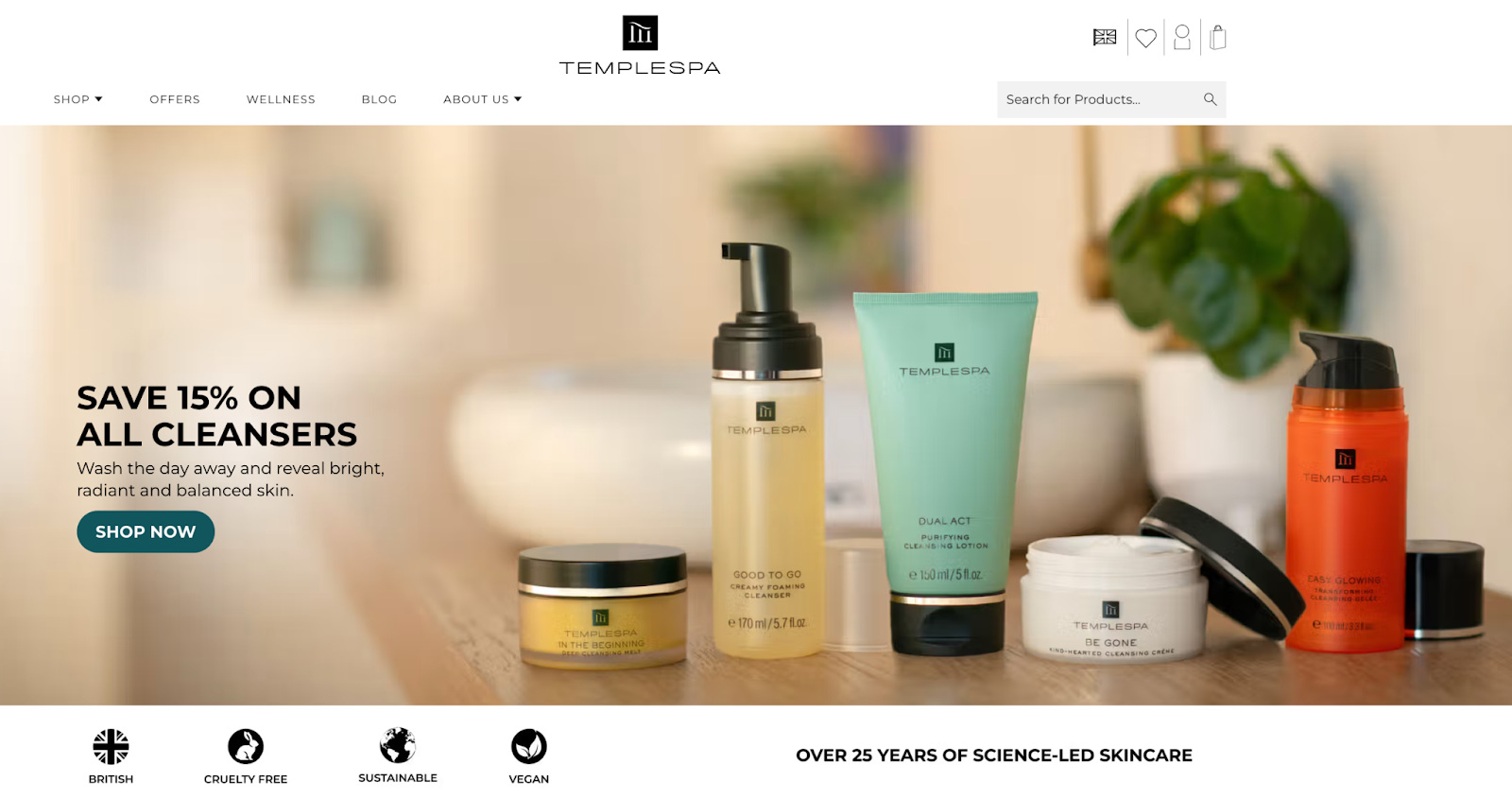
On TEMPLESPA’s homepage, the hero banner reflects Awareness-stage intent. Messaging such as “Save 15% on all cleansers” is paired with outcome-led copy like “bright, radiant and balanced skin”, alongside credibility cues including “British”, “cruelty-free”, “vegan”, and “Over 25 years of science-led skincare”.
This helps first-time visitors quickly understand what the brand offers, who it is for, and whether it is relevant to them, supporting early-stage orientation before deeper exploration elsewhere on the site.
Interest: Shoppers explore your products
What this stage represents
The interest stage is when a shopper explores the products or solutions available in the store. At this stage, the shopper has accepted that the store is relevant and is directing attention toward the product range.
How to map customer behaviour to the interest stage
Customer behaviour should be mapped to the Interest stage when it shows the shopper is actively exploring products, but not yet decided whether to buy.
A shopper's behaviour belongs to the Interest stage if they are primarily:
-
Exploring what products or solutions are available
-
Narrowing attention from broad categories to specific items
-
Learning what different products do, without deciding which one to choose
This typically includes behaviours such as:
-
Browsing category pages to discover products
-
Viewing multiple product pages to learn what is available
-
Moving between products or collections without focusing on one option in depth
-
Leaving product pages to continue browsing, rather than progressing toward checkout
As long as the shopper's actions focus on product discovery and exploration rather than evaluation or commitment, their behaviour belongs to the Interest stage.
Examples of what belongs in this stage
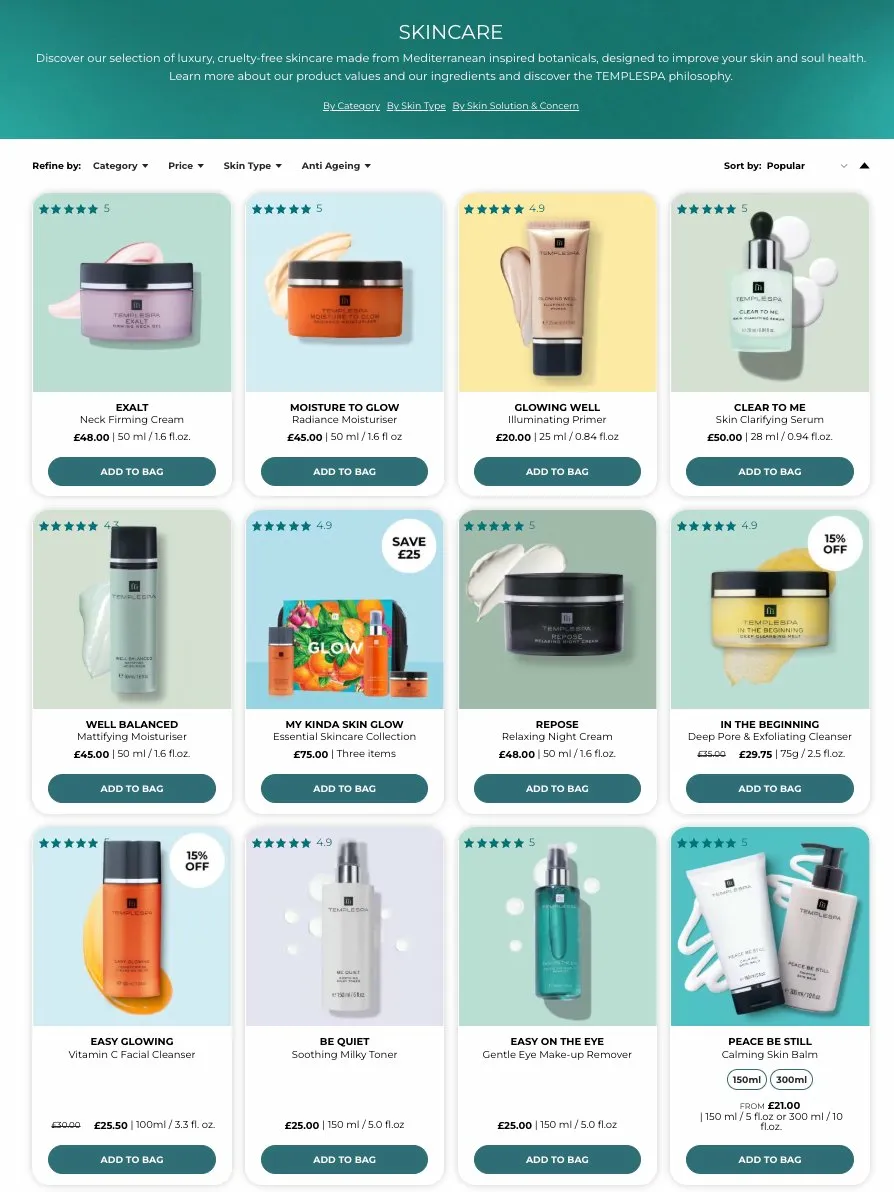
Within the Skincare category, TEMPLESPA uses the product listing grid to guide shoppers into the Interest stage. Products such as “Clear to Me Skin Clarifying Serum” are displayed with star ratings, price, and concise naming that signals purpose and benefit at a glance.
By surfacing this information directly in the listing, shoppers can scan and compare options, gaining an overview of what is available without committing to a specific product, which supports exploration and narrowing of attention.
Consideration: Shoppers show buying intent
What this stage represents
The consideration stage is when a shopper decides whether a specific product is the right choice.
At this stage, attention is focused and deliberate. The shopper is evaluating suitability, value, and confidence, and resolving uncertainty before committing to a purchase.
How to map customer behaviour to the Consideration stage
Customer behaviour falls within the consideration stage when it focuses on evaluating and validating a specific product, rather than on discovering options or completing a purchase.
A shopper's behaviour belongs to the consideration stage if they are primarily:
-
Assessing suitability, value, or confidence for a particular product
-
Deciding whether they feel comfortable buying this product from this store
-
Looking for reassurance before making a purchase decision
This typically includes behaviours such as:
-
Spending extended time on a single product or a small set of products
-
Engaging with content that helps confirm a decision, such as detailed descriptions, usage information, or reviews
-
Reviewing delivery, returns, or other purchase-related information
As long as the shopper is still deciding whether to proceed, rather than attempting to complete a transaction, their behaviour belongs to the consideration stage.
Examples of what belongs in this stage
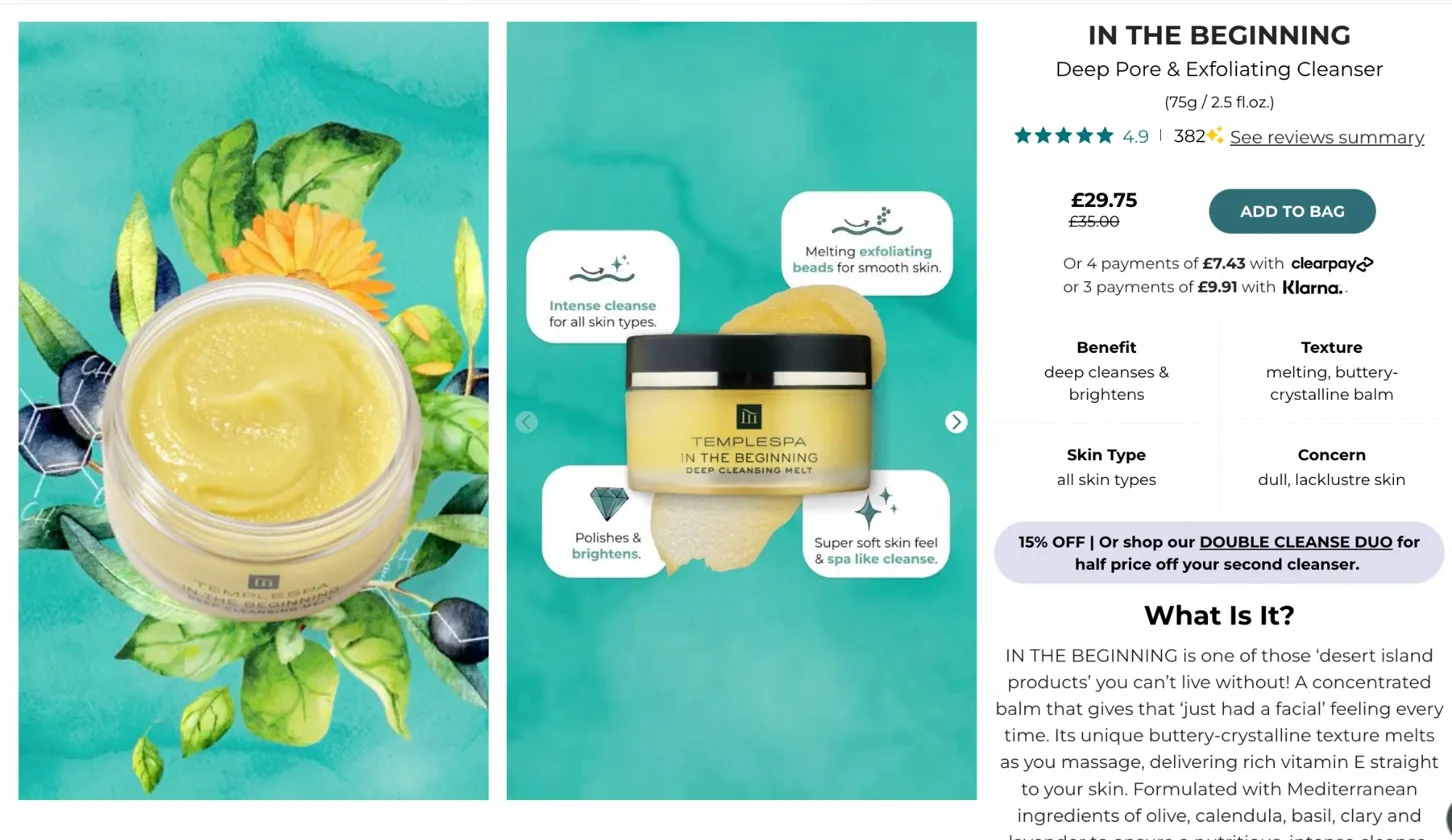
On product pages, specific elements support Consideration-stage behaviour. TEMPLESPA highlights customer reviews (for example, “4.9 | 382 reviews” with visible rating distribution), alongside structured information such as key benefits, skin type, and skin concern.
Additional cues like “Or 4 payments of £7.43 with Clearpay” help address affordability questions during evaluation. Together, these elements support shoppers as they assess whether a particular product is the right choice for them.
Conversion: Shoppers complete the purchase
What this stage represents
The conversion stage is when a shopper executes a purchase decision that has already been made. At this stage, the shopper is no longer choosing or validating options. Their focus is on completing the transaction and placing the order.
How to map customer behaviour to the Conversion stage
Customer behaviour is considered within the conversion stage, which focuses on finalising a transaction, not on deciding whether to buy.
A shopper's behaviour belongs to the conversion stage if they are primarily:
-
Acting on an already-made buying decision
-
Providing the information required to place an order
-
Completing the steps necessary to finalise the transaction
This typically includes behaviours such as:
-
Proceeding from the cart to checkout
-
Entering delivery or payment information
-
Reviewing order details with the intention of placing the order
-
Attempting to complete payment
Once a shopper's actions are focused on finalising the purchase, their behaviour belongs to the conversion stage, regardless of how they reached that point.
Examples of what belongs in this stage
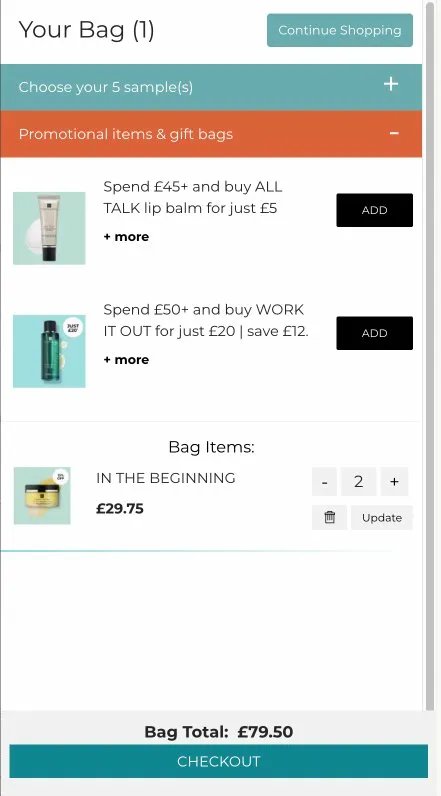
During checkout, TEMPLESPA uses the order summary component to support Conversion-stage behaviour. Selected products, quantities, and pricing remain visible as shoppers progress through checkout.
This helps shoppers confirm their order details while completing required steps, supporting purchase execution once a decision has already been made.
Retention: Customers return and buy again
What this stage represents
The retention stage occurs when a customer's behaviour happens after a completed purchase.
At this stage, behaviour is shaped by prior experience with the brand, products, and purchase process. Retention is defined by post-purchase context, not by repeat visits alone.
How to map customer behaviour to the Retention stage
Customer behaviour belongs to the retention stage only if it occurs after at least one completed order.
A shopper’s behaviour should be mapped to retention when it is primarily driven by:
-
Prior purchase experience
-
Familiarity developed through product ownership or usage
-
Knowledge of the store gained through completing a transaction
This typically includes behaviours such as:
-
Returning to the site to reorder or repurchase a product
-
Exploring additional products based on previous ownership
-
Logging into an account created during an earlier purchase
-
Engaging with post-purchase or loyalty-driven communication
Examples of what belongs in this stage
On TEMPLESPA, the customer account area is a clear Retention-stage element. It exists specifically for customers who have already completed a purchase and returns value only in a post-purchase context. Through login access, order history, and saved details, this part of the site assumes prior experience with the brand and the buying process. Its purpose is to support repeat purchasing and ongoing engagement based on an existing customer relationship.
|
If you need support applying funnel thinking to real business decisions, On Tap’s eCommerce consultancy services help translate funnel thinking into clear strategic and structural decisions. With over 20 years of hands-on eCommerce experience, including work with brands such as TEMPLESPA, we work with teams to assess their current journey, identify where conversion is being constrained, and define clear priorities for improvement. |
How to optimise each funnel stage
This section explains how to use the eCommerce conversion funnel to guide optimisation decisions. It shows how to assess how each stage is performing, use data to determine which stage requires optimisation, and apply practical tips to improve that stage, so changes contribute meaningfully to conversion performance and customer experience rather than being spread across the entire funnel.
How to measure performance at each stage
This section outlines how performance should be measured at each funnel stage and how those measurements should be interpreted consistently over time, so they can be used as a reliable input for later optimisation decisions.
|
Funnel stage |
What to measure |
Why it matters |
Typical tools |
|
Awareness |
Traffic by channel and campaign |
Shows which channels drive visibility and whether growth relies on high- or low-intent traffic |
Web analytics platforms, ad platforms |
|
Traffic by intent (brand vs non-brand, commercial vs informational) |
Indicates whether visitors are likely buyers or early-stage researchers, helping diagnose intent mismatch |
Search query reports, ad search term reports |
|
|
Landing page engagement by channel |
Reveals whether entry pages meet expectations set by ads or search results |
Web analytics platforms |
|
|
% of sessions that reach category or product pages |
Shows whether visitors continue exploring beyond the entry page or exit early due to weak relevance |
Web analytics platforms |
|
|
Interest |
Category → product page transition rate |
Indicates how easily shoppers find products and whether the catalogue structure supports exploration |
Journey analysis tools, behaviour analytics |
|
Product discovery rate per session |
Measures how effectively shoppers discover multiple relevant products during browsing |
Web analytics platforms |
|
|
Pages per session (before PDP) |
Reflects willingness to browse and whether navigation encourages further exploration |
Web analytics platforms |
|
|
Click behaviour on navigation and filters |
Shows whether shoppers understand how to navigate and refine choices without confusion |
Heatmaps, session replay, interaction analytics |
|
|
Consideration |
Add-to-cart rate (per product view) |
Measures whether products and pricing trigger purchase intent |
Web analytics platforms |
|
Add-to-cart attempts vs successes |
Distinguishes hesitation from blocked actions caused by execution issues |
Behaviour tracking, error monitoring |
|
|
Cart view rate |
Confirms whether shoppers review pricing, delivery, and purchase details |
Web analytics platforms |
|
|
Cart abandonment patterns |
Highlights where confidence drops due to price, delivery, or trust concerns |
Commerce platform analytics |
|
|
Conversion |
Checkout completion rate |
Shows how reliably existing intent turns into completed purchases |
Web analytics platforms |
|
Step-level checkout drop-off |
Identifies friction points that prevent shoppers from completing checkout |
Funnel and journey analytics |
|
|
Payment attempt vs success rate |
Reveals silent payment failures that directly impact revenue |
Payment gateway reports |
|
|
Revenue per visitor |
Connects conversion performance to overall commercial outcomes |
Web analytics platforms, commerce analytics |
|
|
Retention |
Repeat purchase rate |
Indicates whether customers return after their first purchase |
Commerce platform analytics |
|
Time to second purchase |
Reflects the strength of the post-purchase experience and loyalty |
CRM, customer data platforms |
|
|
Revenue per returning visitor |
Measures long-term value creation beyond the first transaction |
Commerce analytics |
|
|
Retention by acquisition source |
Shows which channels bring higher-quality, longer-term customers |
Web analytics platforms, CRM |
Funnel and analytics reports are effective at showing where shoppers drop out of the journey and which funnel stage is underperforming. However, they are not designed to explain what is happening behind those numbers, particularly when experience or technical factors are involved. This limitation creates two common blind spots:
First, many technical issues surface too gradually to trigger immediate changes in funnel metrics. Performance degradation, frontend errors, or third-party script failures can disrupt the experience while remaining within acceptable thresholds, delaying clear signals in engagement or conversion data.
Second, funnel metrics lack session-level context. Even when performance changes become visible, aggregated data cannot show what individual shoppers actually experienced, such as stalled interactions, repeated clicks, incomplete page loads, or silent errors. Without this context, it is difficult to understand what went wrong within real customer journeys.
As a result, traditional analytics can indicate where performance changes occur, but they rarely provide early or unified visibility into the technical conditions quietly disrupting the funnel.
|
AuditIQ is built specifically to close this gap. It is the only eCommerce-focused tool that consolidates all critical site health dimensions into one continuous monitoring layer, including frontend errors, performance, SEO integrity, uptime, security, and server health. By monitoring these layers together rather than in isolation, AuditIQ detects silent issues while they are still small, often before they surface as drops in funnel metrics. This allows teams to distinguish behavioural friction from underlying technical constraints, understand cross-layer impact instead of disconnected symptoms, and act before “everything looks fine” turns into a conversion or revenue problem. |
How to use funnel data to identify the real constraint
Funnel measurement is most useful when it helps teams decide where to intervene and how to prioritise effort. Many eCommerce funnels show uneven performance across stages, with certain stage-to-stage transitions having a greater impact on overall progression at a given time. For this reason, teams often achieve more consistent results by identifying where progression is most constrained and optimising sequencing accordingly, rather than attempting to improve every stage in parallel.
-
Locate the weakest transition: Look for the stage-to-stage drop-off that's bleeding the most potential revenue. A funnel with strong traffic but 80% cart abandonment has a different problem than one with low product page views. The data points you toward where intervention matters most.
-
Find out what's causing the friction: Drop-offs generally stem from three sources: clarity issues (users don't understand the value or can't find what they need), confidence issues (uncertainty around pricing, shipping, or trust), or execution issues (slow pages, broken buttons, payment errors). Each requires a different fix.
-
Form a single, testable hypothesis: Avoid broad conclusions like "the checkout needs improvement." Instead, identify something specific and measurable: "Users abandon at shipping selection because delivery costs appear higher than expected." One clear hypothesis allows you to validate whether your fix actually worked.
-
Sequence changes around the constraint: Once the primary bottleneck has been identified, changes should be sequenced so that the constraint is addressed first, before any other stage is adjusted. Improvements made outside the constraint do not compound and often have little effect until the bottleneck itself is relieved. By sequencing changes in this order, teams avoid premature optimisation and ensure that later improvements build on, rather than compete with, earlier ones.
Example: How TEMPLESPA improved funnel progression
TEMPLESPA demonstrates what happens when execution, not strategy, becomes the problem.
The brand already had strong fundamentals in place: clear premium positioning, solution-led navigation organised by customer concern, and compelling product storytelling with high-quality imagery. From a funnel perspective, Awareness, Interest, and Consideration were all functioning well. Shoppers could discover products, understand their relevance, and show clear purchase intent.
The problem occurred at the final transition: Consideration to Conversion, specifically on mobile. Site speed and interaction responsiveness were preventing existing intent from translating into completed purchases. Shoppers wanted to buy, but the site made it harder than it needed to be.
The solution was not to introduce new messaging, incentives, or CRO tactics. Instead, the focus was on removing execution friction at the point of purchase.
Through work delivered by On Tap, TEMPLESPA addressed the constraint across three connected areas:
-
Frontend architecture overhaul: The legacy frontend was replaced with a lightweight Hyvä implementation, reducing complexity and enabling faster page loads across key templates.
-
UX and interaction refinement: Page structure and component behaviour were optimised to make core actions, browsing, cart updates, checkout steps, clearer and easier to complete.
-
Mobile-first prioritisation: Navigation, product selection, and checkout interactions were rebuilt for stability and responsiveness on smaller screens, where friction had the greatest conversion impact.
The proven outcome: an 18% increase in mobile conversions within 3 months of launch.
The project also earned external recognition for being the Silver winner in Best B2C UX in eCommerce at the eCommerce Awards 2025. TEMPLESPA's case reinforces a key principle: when earlier funnel stages are performing well, removing execution constraints at the point of purchase often delivers the highest-impact gains.
Targeted optimisation tactics for each funnel stage
The tactics below are grouped by funnel stage and provide a practical reference for improving the buying journey in a structured and intentional way, rather than applying changes indiscriminately across the site.
Awareness stage: Capture high-intent traffic early
At the awareness stage, users are actively researching but have not yet committed to a brand. The primary objective is to attract relevant demand, not volume alone.
-
Target high-intent keywords that reflect early purchase signals, improving SEO traffic quality and downstream conversion potential.
-
Use retargeting ads to re-engage visitors who interacted with content or landing pages but did not progress further.
-
Optimise landing pages for intent alignment, ensuring messaging, content, and CTAs directly match the search query or ad context.
Interest stage: Support exploration and engagement
Once users begin browsing products, the focus shifts to reducing friction and encouraging deeper engagement.
-
Optimise product pages with high-quality images, concise product videos, and detailed descriptions that address key buyer concerns.
-
Simplify site navigation through clear category structures, filters, and logical page hierarchies.
-
Use internal linking strategically to guide users toward related products and supporting content, increasing session depth.
Consideration stage: Build trust and reduce hesitation
At this point, users are comparing options and assessing risk before committing.
-
Streamline the add-to-cart process to minimise interruptions and unnecessary steps.
-
Reinforce trust signals by displaying customer reviews, security badges, shipping information, and transparent return policies.
-
Apply exit-intent tactics selectively, such as reminders or limited incentives, without disrupting the decision flow.
Conversion stage: Eliminate checkout barriers
Conversion optimisation is primarily about operational efficiency and clarity.
-
Simplify checkout with guest checkout options and auto-fill payment details.
-
Reduce the number of checkout steps to shorten time-to-purchase.
-
Offer multiple payment methods to accommodate different user preferences and regions.
-
Optimise mobile checkout performance, where even minor friction can lead to abandonment.
Retention stage: Increase lifetime value through re-engagement
Lastly, retention strategies focus on turning one-time buyers into repeat customers, contributing to increasing repeat sales and growing in the long term:
-
Implement loyalty programs that reward ongoing engagement and repeat purchases.
-
Send personalised follow-ups based on purchase history, usage patterns, or replenishment cycles.
-
Use automated email marketing to re-engage customers with relevant offers instead of generic promotions.
Conclusion
To get the most out of any eCommerce conversion effort, teams need more than a list of tactics. They need a clear and repeatable way of thinking about how user behaviour flows through each stage of the customer journey. This article has shown how the conversion funnel can serve as a practical decision framework for interpreting behavioural signals, prioritising hypotheses, and focusing optimisation where it genuinely moves performance, rather than reacting to isolated metrics or implementing changes indiscriminately.
By grounding decisions in structured insight and reliable data, teams can avoid common pitfalls such as optimising in the dark or spending effort where it has limited impact. Over time, this leads to better alignment between business objectives, customer experience, and measurable outcomes, including higher conversion rates and stronger customer engagement.
If you need support with interpretation, strategy, or execution, On Tap’s Digital Marketing services combine strategic thinking, measurement expertise, and implementation experience to help teams make confident decisions and drive sustainable growth. If you want to discuss your current funnel challenges or understand where your biggest conversion constraint sits, you can reach out directly today.