

Industrial eCommerce is the use of online platforms to market, sell, and fulfil orders for industrial goods, equipment, and maintenance products. As the eCommerce market continues to expand, establishing an online presence has become essential for businesses in the industrial sector.
This article will guide you through everything you need to know about industrial eCommerce: key benefits, challenges, best practices for building your digital store, and real-world case studies you can learn from. By the end, you’ll be fully equipped with the knowledge and confidence to launch your own industrial eCommerce website.
The trend of transitioning to eCommerce in the industrial market
With today’s rapid technological advancements, the shift of businesses toward online channels has become increasingly evident, including in the industrial sector. Let’s uncover the main trends shaping this transition.
The changing digital-first behaviours of industrial buyers
With rapid technological advancement, today’s industrial buyers have transformed their purchasing behaviour. According to OroCommerce, in-person selling is losing relevance, with 64% of B2B buyers now preferring digital B2B channels over traditional methods. Research by MasterB2B further reveals that 44% of B2B buyers prefer eCommerce sites for business purchases, compared to just 23% for face-to-face sales and 3% for telesales.
It’s not just B2B customers; individual consumers have long embraced online shopping, a trend that accelerated after COVID-19. Today, their expectations go beyond convenience, driven by more sophisticated demands such as better pricing, stronger brand connection, and product authenticity. This creates a strong foundation for Direct-to-Consumer (DTC) eCommerce to expand in the industrial sector, as it allows businesses to take full control of their products, pricing, and customer experience. In fact, the DTC eCommerce sector is projected to grow at a CAGR of 17.3% from 2025 to 2033 (IMRC), highlighting the growing preference for buying directly from manufacturers.
Collectively, these figures clearly indicate that industrial customers, across both B2B and DTC, are moving decisively toward digital purchasing, making eCommerce an essential channel for future growth.
The growing accessibility of eCommerce platforms
Building an industrial eCommerce platform that serves both B2B and DTC customers is no longer the complex, resource-intensive task it once was. The market now offers specialised platforms like Carbon, Shopify Plus or BigCommerce designed to meet industrial needs, including custom pricing, bulk ordering, and seamless integration with ERP and CRM systems. These platforms simplify setup and management while enabling manufacturers to deliver modern, digital-first experiences through self-service portals, real-time inventory visibility, and automated quoting. They also support hybrid business models, allowing companies to manage B2B transactions and DTC sales within a single, unified system.
Overall, with the growing accessibility of eCommerce platforms and the increasing demand from customers, more manufacturers are prioritising digital transformation. According to Digital Commerce 360, as of 2024, 66% of manufacturers plan to invest in online eCommerce customer portals. This strong momentum reflects how businesses now view digital stores as essential enablers of customer engagement and long-term competitiveness. With lower barriers to entry and more advanced technologies available, building an industrial eCommerce website has become easier than ever, further driving the widespread adoption of this digital transformation trend.

Benefits and challenges of industrial eCommerce
To gain a deeper understanding, let’s explore the benefits and challenges of industrial eCommerce below.
Benefits of industrial eCommerce
-
Expand market reach: An eCommerce website enables industrial businesses to reach new regions and customer segments without establishing a physical presence. Features such as multi-language and multi-currency support, regional tax and shipping configurations, and 24/7 ordering open up opportunities to engage with global buyers and distributors more efficiently.
-
Diversify sales channel: By adopting eCommerce, businesses can lessen their dependence on traditional offline sales methods such as email, phone, or face-to-face interactions. While these channels provide relationship-based selling, they also bring higher costs, slower sales cycles, and limited visibility into customer behaviour. eCommerce enables industrial businesses to connect directly with B2B buyers and end users, giving businesses a more flexible and customer-centric sales strategy.
-
Enhance customer segmentation: eCommerce systems make it easier to group buyers by industry, purchase frequency, volume, or product usage. This enables personalised pricing, targeted promotions, accurate demand forecasting, and more effective marketing or after-sales support for each customer group.
-
Centralise customer data and enable data-driven decisions: eCommerce platforms consolidate customer information, from purchase history to technical specifications, into one system, making it easier to manage and analyse. With unified data, businesses gain deeper insights to optimise inventory, pricing, and product development for industrial clients.
-
Boost operational efficiency and scalability: An eCommerce website helps industrial businesses streamline order processing, inventory management, and system integration, reducing manual effort and errors. They also enable scalable growth, supporting larger product ranges, regions, and order volumes without increasing operational costs.
-
Strengthen customer experience: With a digital store, buyers can easily access detailed specifications, stock levels, and lead times. Self-service tools for quotations, order tracking, and returns improve convenience, while personalised catalogues, pricing, and content strengthen long-term loyalty among professional buyers.
Challenges of industrial eCommerce
-
Technical and operational complexity: Industrial eCommerce platforms face high technical demands, from managing extensive product catalogues with thousands of SKUs, custom configurations, and certifications, to integrating with ERP, CRM, and supply chain systems. Ensuring accurate product data, pricing rules, and real-time inventory visibility requires strong infrastructure, careful planning, and significant upfront investment.
-
Customer adoption and employee resistance: As in most B2B environments, both internal teams and long-time customers can be hesitant to embrace digital transformation. Traditional sales representatives may fear losing control of customer relationships, while buyers accustomed to offline interactions may prefer familiar processes.
-
Security and compliance: Cybersecurity remains a major concern for industrial eCommerce as businesses handle large transaction values, sensitive client data, and proprietary product information online.
Best practices to start an industrial eCommerce website
After gaining a clear view of both the opportunities and challenges of industrial eCommerce, the next step is putting plans into action. Below are practical best practices to guide you through building and launching your own eCommerce website.
1. Choose a suitable eCommerce platform
The first step in building a digital store is choosing the right eCommerce platform. For industrial businesses, the chosen platform should be capable of meeting several critical requirements:
-
Complex product catalogues: Industrial companies often manage thousands of SKUs with technical specifications. A suitable platform should support rich product data such as dimensions, materials, tolerances, and certifications. It should also provide robust catalogue management to organise and maintain SKUs efficiently across multiple product lines and customer segments.
-
Advanced search: A modern platform should handle compatibility and configuration rules while enabling powerful search and filtering. This helps engineers and procurement teams quickly find the exact products they need from large and complex catalogues.
-
Bulk ordering and reordering system: The system should support bulk ordering and quick reordering for frequently purchased items. These features streamline procurement for repeat orders and save time for B2B buyers managing large or recurring purchases.
-
Custom pricing and contracts: The platform should support tiered pricing, negotiated contracts, and account-specific terms common in B2B sales.
-
Role-based access: A suitable platform should allow different permissions for purchasing managers, engineers, or finance teams within the same customer account.
-
Self-service portal: The platform should enable customers to independently manage accounts, track orders, download invoices, request quotes, and initiate returns. This can reduce reliance on sales teams and improve operational efficiency.
-
Comprehensive inventory management: The platform should offer real-time inventory visibility across multiple warehouses, enabling accurate stock levels, automatic updates, and low-stock alerts.
-
Scalability and flexibility: The platform’s system should be able to handle product line expansions, larger transaction volumes, and potentially expanding business models (depending on each company’s growth strategy) over time.
-
B2B and DTC functionality: The platform should provide the flexibility to serve both business buyers and end users, supporting multiple sales models if the company chooses to expand.
-
Standard security frameworks and compliance certifications: The platform should include built-in security frameworks (SSL, two-factor authentication, and role-based access) and comply with key standards like PCI-DSS, ISO 27001, and GDPR to ensure data protection and regulatory compliance across all transactions.
In addition to these requirements, businesses should also evaluate platform architecture models (e.g., monolithic, headless, composable) and deployment options (SaaS, PaaS, or open-source) to ensure the solution aligns with their IT capabilities, customisation needs, and long-term digital strategy.
Some modern eCommerce platforms to consider:
-
Shopify: Shopify offers a hosted SaaS platform suitable for industrial businesses looking to establish an online presence quickly with minimal technical setup. Its speed, scalability, and integration capabilities make it ideal for managing product catalogues and online inquiries. However, advanced functionalities may require additional apps or custom development, which can increase overall costs.
-
Magento Open Source: Magento provides an open-source, highly customisable solution for industrial manufacturers with strong technical resources. It allows complete control over catalogue structures, customer groups, and complex pricing models - features essential for industrial sales. Yet, managing hosting, maintenance, and system updates internally can demand significant time and budget.
-
Adobe Commerce: Adobe Commerce offers both a fully managed SaaS version for scalability and a customisable PaaS option for complex industrial needs. It supports multi-site, multi-language, and multi-currency operations, with advanced catalogue management, personalisation, and seamless integration. While flexible and powerful, it requires higher investment and technical expertise to develop.
-
BigCommerce: BigCommerce delivers a SaaS-based platform that combines usability with robust B2B features, such as custom pricing lists, company accounts, and quote management. It’s well-suited for industrial businesses seeking scalability without the overhead of managing infrastructure, though design flexibility and third-party app options are somewhat more limited compared to open-source systems.
-
Carbon: Carbon is a high-performance solution for rapid website deployment, often within just a few weeks. It offers scalable, conversion-optimised B2B and B2C functionality out of the box, while certain specialised features may require custom development. What sets Carbon apart is how it unites the clarity and convenience of SaaS pricing (free upgrades and no hidden fees) with the high customisation and flexibility.
Developed by On Tap, an agency with over 400 experts and 19 years of industry experience across both B2B and DTC eCommerce, Carbon stands out as a powerful and reliable solution for industrial businesses. Learn more about Carbon today.
2. Integrate all systems and apps seamlessly
For an industrial eCommerce platform to operate effectively, it must integrate seamlessly with the broader business ecosystem to prevent data silos and operational inefficiencies. Key systems include:
-
CRM (Customer Relationship Management): Manages direct relationships with B2B customers by tracking leads, contracts, and purchase history to enable personalised selling and long-term account management.
-
ERP (Enterprise Resource Planning): Ensures real-time synchronisation of complex pricing models, bulk order quantities, and multi-location inventory management, which are common in industrial supply chains.
-
PIM (Product Information Management): Centralises thousands of SKUs with detailed technical specifications, certifications, and compatibility data, making it easier to display accurate information online.
-
WMS (Warehouse Management System): Streamlines order fulfilment for heavy, bulk, or custom-sized products, while optimising storage, picking, and shipping processes.
-
ESP (Email Service Provider): Enables automated communication such as order confirmations, shipment tracking, and reorder reminders for consumables or spare parts, which are critical in industrial after-sales service.
-
Accounting system: Integrate financial data across bulk orders, invoices, and payment terms to ensure accuracy and compliance, streamlining reconciliation and improving visibility in complex B2B transactions.
-
Advanced delivery and logistics apps: Connects the platform with freight forwarders, 3PLs, and internal logistics apps to manage B2B shipping needs, including palletised, LTL/FTL, or international deliveries. Customers can select the most suitable option during checkout based on cost, speed, or order size. Certain integrations, such as FedEx Freight or DHL Supply Chain, can display estimated delivery times and costs in real time on the checkout page for customers.
Ensure smooth system connectivity with your eCommerce website through our system integration service and API-first Integration Flow, enabling automated and efficient data flow across all channels.

3. Ensure advanced security and compliance
In the industrial sector, eCommerce transactions often involve complex product configurations, high-value orders, and the exchange of sensitive business data. A secure and compliant platform is crucial for protecting data, maintaining trust, and mitigating legal and operational risks.
Most modern eCommerce platforms provide built-in security frameworks and compliance certifications that meet baseline requirements. However, to ensure data remains truly secure, businesses must also be cautious during implementation and ongoing management. Specifically, they should:
-
Configure permissions and access policies properly: Safeguard customer data, pricing information, and proprietary designs through measures such as encryption, multi-factor authentication, and fraud detection systems.
-
Secure payment integration: Use PCI DSS–compliant gateways to protect financial transactions and prevent fraud.
-
Regulatory compliance: Adhere to industry-specific standards (e.g., ISO certifications), export controls, and international trade regulations.
-
Data privacy compliance: Ensure compliance with global privacy laws like GDPR, CCPA, or local equivalents when handling customer information.
-
Audit and reporting: Maintain logs and compliance records to support internal governance and external regulatory audits.
-
Cybersecurity training: Educate employees on safe practices to minimise risks from human error.
4. Support internal and customer adoption
Adopting an eCommerce platform in the industrial sector often requires overcoming resistance from both employees and old customers who are accustomed to traditional methods. A structured strategy should address both groups to ensure smooth adoption and long-term success.
-
For the internal team: Adoption starts with building a dedicated project group to guide the process and ensure smooth implementation. Employees, especially sales and customer service representatives, should receive thorough training to feel confident using the new tools. Clear communication about the benefits, such as higher order volumes, improved tracking, and better customer insights, combined with incentives, can also help overcome reluctance and drive engagement.
-
For customers: The focus should be on demonstrating how the platform directly solves their pain points, from placing orders outside business hours to simplifying bulk purchases and tracking deliveries. Businesses can further encourage adoption through onboarding support, tailored communication, and incentives like introductory discounts or loyalty rewards, making the transition smoother and more appealing.
For deeper insights, explore our Customer adoption guide eBook - a comprehensive resource to help make the customer onboarding and transition process smoother and more effective.
5. Monitor, measure, and optimise continuously
The journey doesn’t end once your eCommerce website is live. Constant measurement and daily optimisation are essential. With market conditions constantly shifting, businesses need to stay proactive, always prepared to improve, upgrade, and refine for optimal results.
-
Track key metrics: Regularly monitor critical indicators such as traffic sources, conversion rates, bounce rates, and average order value. These insights reveal what’s working, what’s not, and where adjustments are needed.
-
Analyse customer behaviour: Leverage analytics tools to understand how users interact with your site, which products attract the most attention, how they navigate product categories, and where drop-offs occur during the purchase process.
-
Refine digital catalogue and pricing strategy: Use data-driven insights to update product specifications, enhance search filters, or adjust tiered and bulk pricing models to better align with customer demand and market trends.
-
Test and enhance user experience: Conduct regular A/B tests on navigation, product layout, and checkout flows to make the purchasing process for industrial products more intuitive, efficient, and user-friendly.
-
Commit to continuous improvement: Optimisation is an ongoing process. By consistently analysing data and applying insights, businesses can drive sustainable growth, maximise ROI, and stay competitive in the ever-changing industrial eCommerce landscape.
Case studies of industrial eCommerce to learn from
For more practical insights, let’s explore leading industrial eCommerce case studies from successful businesses below.
AI Ghandi Electrical & Automation
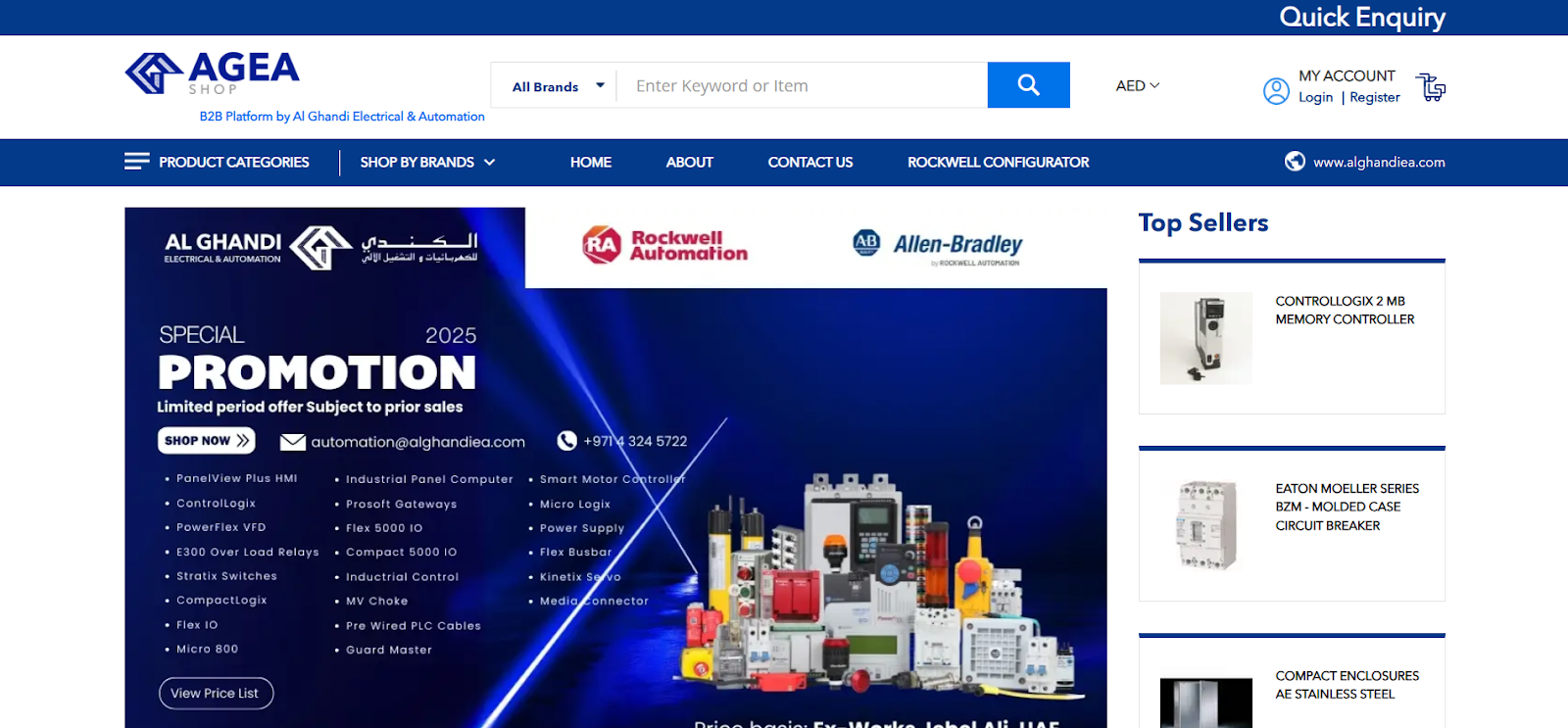
Al Ghandi Electrical & Automation is a leading UAE-based distributor of electrical and automation products. The company serves multiple industrial sectors, including construction, infrastructure, oil and gas, and retail.
The challenges: Al Ghandi relied heavily on in-person sales teams and printed catalogues to manage millions of SKUs across multiple suppliers. This manual process was resource-intensive and slow, with order fulfilment taking up to five weeks. The company needed to digitise its traditional sales model to improve efficiency and meet customer expectations for faster, more convenient purchasing.
The solution: Al Ghandi launched AGEA Shop, a B2B eCommerce website powered by Adobe Commerce, enabling customers to browse, compare, and purchase products online. Key implementations included:
-
ERP integration: Real-time product, pricing, and inventory data synchronised via API.
-
Automated workflows: Streamlined quotation, negotiation, and order management processes.
-
Advanced search and configurators: Helped customers find products and build technical solutions efficiently.
-
Mobile-ready platform: Supported both desktop and mobile purchasing experiences.
-
Headless PWA (progressive web app): Designed for customers with limited digital access.
The results: By having a B2B digital store, the company has achieved remarkable results:
-
2× customer base in the first year (from 1,600 to 3,200 customers).
-
95% of customers shifted to online ordering via desktop or mobile devices.
-
Order processing time reduced by 10 days on average.
-
Improved efficiency, transparency, and customer satisfaction across all B2B segments.
Toolden
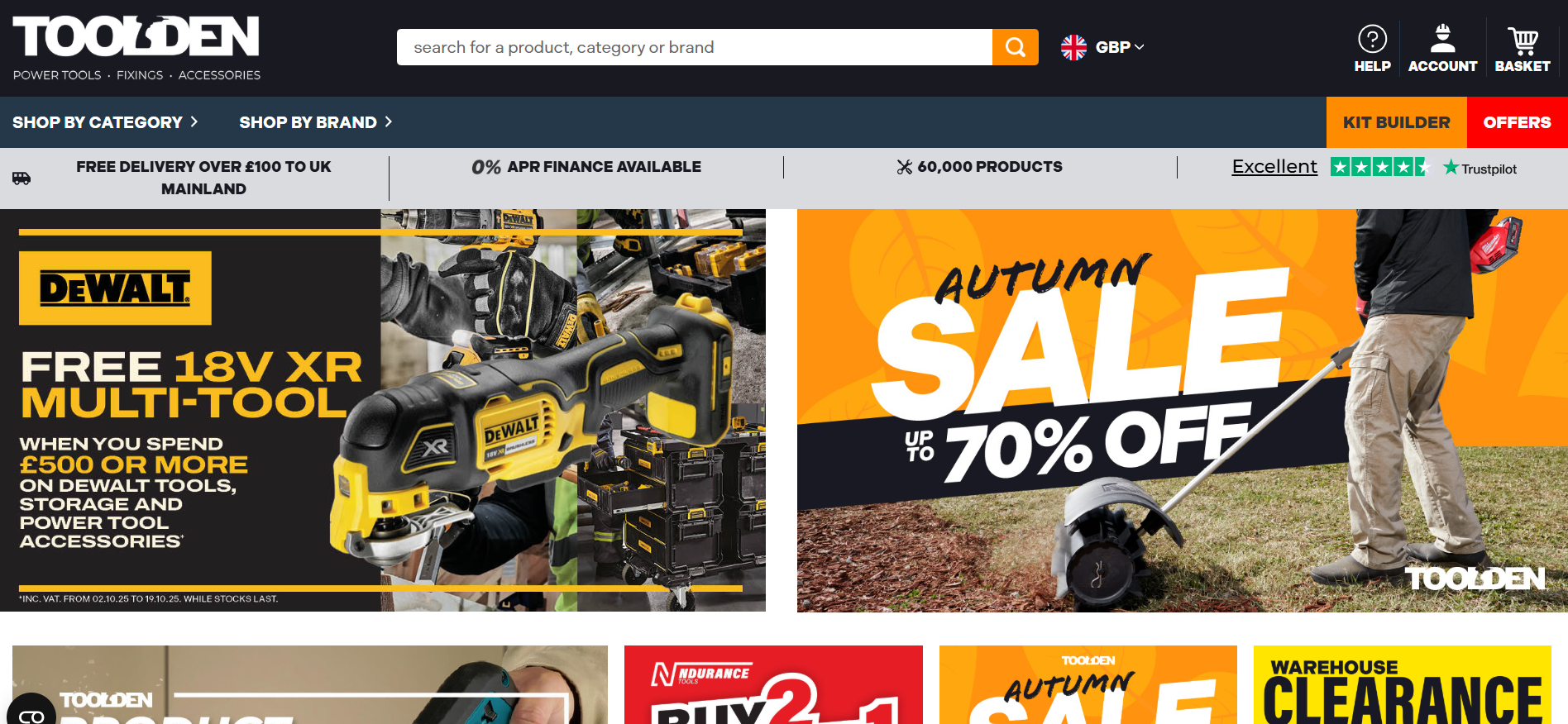
Toolden is a UK-based business with nearly 30 years in the tools and accessories market has grown into a fast-growing global eCommerce company.
The challenge: As the company aimed to strengthen its B2B and B2C digital channels, it needed a modern platform capable of handling large product volumes, supporting seamless integrations, and empowering internal teams to manage operations independently.
The solution: Toolden has chosen BigCommerce B2B Edition to strengthen trade sales with business-specific functionalities like:
-
B2B features: Custom pricing for each account, credit limits, etc.
-
Self-service content management: Empowered internal teams to independently manage site content, add or update products, and scale operations without relying on developers.
-
ERP integration: Enable seamless data flow between eCommerce and backend systems, improving order management and efficiency.
-
Marketing and automation integration: Connected with various systems such as Google Shopping by Sales & Order for product feed management, Klaviyo for email marketing and Trustpilot for customer reviews.
-
API-driven flexibility: Leveraged BigCommerce’s open APIs to connect existing and future tools for marketing, sales, and analytics, ensuring scalability for continued growth.
The results: With BigCommerce, Toolden has achieved impressive growth:
-
200% revenue growth (from £12.6M in 2020 to £36.7M in 2024).
-
32% year-over-year growth sustained in recent years.
-
Efficient handling of 60,000 products listed online.
Conclusion
Overall, this article has provided you with comprehensive insights into the benefits, challenges, practical best practices, and case studies of industrial eCommerce. As the shift toward online business continues to accelerate, these insights provide a strong foundation for long-term success and confident digital store launches.
However, to shorten the launch timeline and ensure a well-structured website from day one, it’s always recommended to partner with an experienced agency. With nearly two decades of experience and a strong portfolio spanning Shopify, Magento, and Carbon, On Tap offers comprehensive eCommerce website development solutions tailored for long-term success. Contact us today to connect with our consultation team and start your digital transformation journey!