
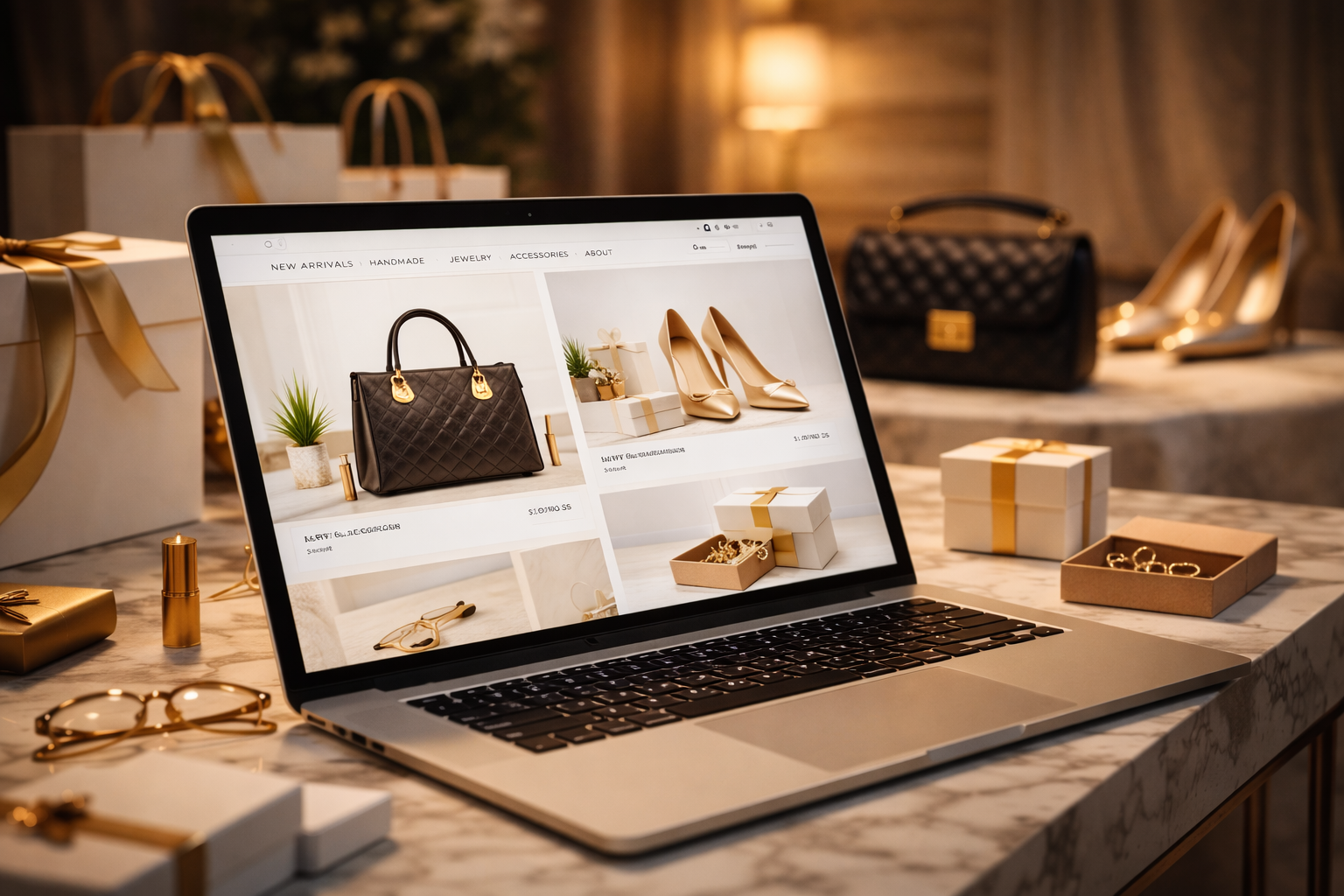
Luxury eCommerce does not follow the rules of mainstream online retail. Customers are not driven by speed, price comparison, or convenience. Customers assess whether the brand aligns with their expectations, values, and sense of identity. Online, this places far greater importance on how convincingly a brand communicates meaning, reassurance, and legitimacy, rather than simply listing product features or benefits.
This article examines the trends shaping luxury eCommerce today and outlines the strategic choices brands must make to design online experiences that support confident decision-making, protect brand standards, and scale without dilution. The perspectives and best practices shared here are distilled from On Tap’s hands-on experience working with luxury brands, drawn from repeatedly solving the practical challenges involved in launching, operating, and evolving luxury eCommerce operations.
Statistics and Trends Shaping Luxury eCommerce 2025
1. Luxury eCommerce adoption is rising
Luxury eCommerce is no longer a supporting channel. It is becoming a core driver of demand capture, with online sales accounting for a growing share of total luxury revenue.
-
Online sales are expected to account for 28–30% of global personal luxury goods sales by 2025, positioning eCommerce as the largest single channel for luxury demand capture.
-
The luxury eCommerce market is projected to reach $174.4 billion by 2034, with a 9.7% CAGR, underscoring the long-term shift toward online luxury buying.
2. Luxury eCommerce is becoming a brand experience, not just a sales channel
Luxury eCommerce is increasingly emphasising immersive, story‑led digital experiences that go beyond product listings, focusing on brand engagement and emotional resonance.
-
54% of connected consumers worldwide say they prefer stores (physical and digital) that provide immersive and engaging experiences, rather than just transactional shopping.
-
Spending on experiences (e.g., travel, culture, curated services) has grown faster than traditional goods, signalling that experiential value now competes strongly with product purchases.
3. Personalisation is becoming the way luxury service works online
Luxury consumers value personalised care, recognition, and continuity of service more than speed or convenience, and they increasingly expect this level of service to work seamlessly across physical and digital touchpoints.
-
72% of luxury consumers say they value personalisation when brands interact with or take care of them, making it the strongest service expectation overall.
-
In digital and omnichannel contexts, 26% of consumers cite targeted recommendations as important, indicating that luxury shoppers want context-aware guidance, not aggressive algorithmic selling.
4. Sustainability and ethical consumption are influencing purchase decisions
Sustainability is no longer a peripheral value signal in luxury. It has become a purchase decision factor, shaping brand choice, willingness to pay, and long-term loyalty.
-
More than half of consumers are willing to pay a premium for sustainable products, and this willingness translates into actual purchasing behaviour rather than mere stated preferences.
-
Consumers increasingly reward brands that provide clear, credible sustainability information, while penalising those that lack transparency or fail to follow through on claims.
5. Exclusivity is shifting from product scarcity to controlled access
Scarcity remains a defining feature of luxury, but it is no longer primarily about owning a rare product. It is increasingly about access, status recognition, and belonging to a privileged group.
-
Top-tier luxury consumers increasingly expect preferential access, private services, and recognition, rather than broader product availability, as core signals of luxury value. Ownership alone is no longer sufficient to sustain differentiation.
-
Luxury consumption is also becoming more identity-led, with status, belonging, and affiliation playing an equal role to ownership in purchase motivation and long-term brand loyalty.
Together, these trends define the key requirements luxury brands must meet as eCommerce becomes a core channel. The strategies that follow translate these requirements into practical ways to build desire, reduce risk, support confident purchase decisions, and reinforce long-term value online.
Effective strategies for luxury eCommerce
Choose a fast and safe go-to-market model for your online launch
At a high level, luxury brands typically choose between two primary go-to-market models: building an owned eCommerce presence or selling through partners and marketplaces.
Build and operate your own luxury eCommerce website
Why brands choose this model:
-
Ability to design journeys that support high-value purchase decisions, not just catalogue browsing
-
Greater control over brand expression, storytelling, and visual identity
-
Direct ownership of the customer relationship and data
-
Greater freedom to evolve service, personalisation, and exclusivity over time
-
Retain control over shipping and fulfilment
-
Full control over pricing and margins, with no intermediary commissions eroding profitability
When a luxury brand chooses to enter eCommerce by building its own website, selecting the right platform is the most critical decision. The platform directly shapes how the business operates on a day-to-day basis, from performance and scalability to flexibility, integration complexity, and the cost of ongoing changes. These structural choices determine not only how well the online channel supports brand experience and growth, but also the long-term operating costs and, ultimately, the profitability of the digital business.
Key considerations for choosing the right platform:
-
Front-end flexibility to support brand value and aesthetic differentiation: Luxury brands don’t just sell products; they offer an experience that reflects their identity, craftsmanship, and exclusivity. The platform should offer robust customisation options for frontend design, enabling you to create a seamless, immersive online experience that reflects your brand's values and heritage.
-
Backend flexibility to support complex business logic: This is essential as it supports the implementation of complex business logic that drives personalised services and exclusive customer experiences. The platform should allow you to customise processes, such as dynamic pricing, tailored workflows, and bespoke service rules, to meet the unique needs of your high-value customers.
-
Speed to market: Luxury brands must stay ahead of trends and swiftly respond to market demands. The platform should allow you to roll out new collections, refine customer experiences, and make updates quickly, without compromising stability or risking disruption to your brand’s reputation.
-
Global readiness and localisation capability: As luxury brands expand internationally, the platform must support multiple languages, currencies, and regional tax regulations. It should allow for seamless localisation of product offerings, pricing, and content, catering to regional preferences while maintaining a consistent brand experience across markets.
-
Security and compliance for high-value transactions: With high-value transactions come higher risks. The platform should provide advanced security measures, including encrypted payments and comprehensive data protection.
-
Long-term scalability and ecosystem support: As luxury brands scale, traffic increases, campaigns become more intensive, and operations grow more complex.
From a platform evaluation perspective, two capabilities are particularly important: -
Ability to handle peak traffic reliably. The platform should support stable performance during traffic spikes, large catalogue interactions, and high levels of concurrent activity, such as during launches, campaigns, or seasonal peaks.
-
Ecosystem support for ongoing growth. The platform should be supported by a mature ecosystem of integrations, partners, and tools that can support ongoing development, operations, and optimisation as the business evolves.
-
Pricing and cost predictability: As luxury businesses scale, platform costs often increase through plan upgrades, add-ons, or ongoing development and maintenance. When evaluating a platform, it’s important to understand what drives these costs and how predictable the total cost of ownership remains as scale and complexity grow.
Comparing the top 4 eCommerce platforms for luxury brands:
The summaries below compare platforms using the rating framework Strong, Moderate, and Limited. These labels do not indicate absolute capability. They reflect the relative strengths of each platform within the context of luxury eCommerce requirements and the platforms compared in this guide.
For clarity, ✓✓ indicates Strong, ✓ indicates Moderate, and ○ indicates Limited.
Note: Carbon is a rapid deployment system built on Adobe Commerce (Magento), designed to combine Magento’s architectural strengths with a managed delivery and operating model provided by On Tap.
Adobe Commerce stands out as the platform with the most robust capability to shape and control the customer experience. That control supports deeper alignment with luxury standards, but requires clearer ownership to maintain consistency as the business becomes more complex.
Platforms such as Shopify and BigCommerce are designed to be easier to operate. They standardise key elements of the experience, which speeds up execution, but also sets clearer limits on how far experience, access, and differentiation can be shaped over time.
Alongside established platforms such as Shopify Plus, BigCommerce Enterprise, and Adobe Commerce, Carbon takes a distinct position.
|
Carbon is designed for luxury brands that need to retain control over customer experience, access, and exclusivity, while avoiding the fragmentation and rework that often come with fully bespoke builds.
What differentiates Carbon in practice:
In this sense, Carbon is a way of delivering a more disciplined, predictable implementation of a highly flexible commerce foundation, aligned with the long-term needs of luxury brands. |

Selling through partners or marketplaces
Some luxury brands choose to launch online through multi-brand partners or marketplaces, particularly in early stages or new regions.
Why brands consider this model:
-
Faster access to established audiences
-
Reduced upfront operational complexity
-
International reach without immediate infrastructure investment
Common examples include platforms such as Farfetch, SSENSE, and Mytheresa, which combine commerce with editorial and curation.
Key criteria for choosing the right option:
When evaluating third-party platforms or partners, assess each option against the following criteria:
-
Brand control: Assess how much control the brand retains over product presentation, pricing consistency, storytelling, and the overall customer experience within the partner’s environment.
-
Customer data ownership: Evaluate who owns the customer relationship and what level of access the brand has to first-party data, including purchase history, behaviour, and the ability to re-engage customers directly.
-
Commission rate and commercial structure: Review how revenue is shared, whether through commissions, wholesale pricing, or concession models, and how this affects margins, pricing flexibility, and cost predictability.
-
Long-term strategic value: Consider whether the partnership supports long-term goals, such as building direct customer relationships, maintaining channel independence, and evolving the brand’s digital strategy over time.
Strategic limitations to consider:
While selling through partners or marketplaces can support short-term discovery and reach, several constraints have emerged:
-
Limited control over brand presentation and storytelling: Marketplaces govern how products and lifestyle content are displayed. This limits the brand’s ability to express its identity consistently in the way an owned store can.
-
Reduced access to customer data and long-term relationship building: In most agreements, the marketplace retains customer relationships and first-party data, making it difficult for brands to cultivate loyalty and embed long-term digital engagement strategies.
-
Economic impact of commission and pricing models: Marketplace and retail arrangements often involve commissions or wholesale margins that are structurally higher than owning a direct channel, with less flexibility for strategic pricing and margin management.
-
Dependence on platforms whose relevance and positioning may change: Some multi-brand luxury retailers have faced significant financial challenges. For example, SSENSE entered bankruptcy protection in 2025 following structural and tariff changes that hit its business model hard. Market pressure has also seen other multi-brand players struggle or exit, as luxury brands tighten control over distribution and invest more in direct channels.
Because of these constraints, multi-brand luxury marketplaces are increasingly viewed as complementary channels rather than core, long-term digital platforms for brand experience and customer ownership.
Attract the right luxury audience and set the right expectations
For luxury brands, acquisition is not about scale. It is about shaping expectations before the click. When this context is set correctly, customers arrive with aligned expectations. The website can then focus on deepening understanding and supporting confident evaluation, rather than correcting mismatched assumptions or overcoming initial resistance.
This makes channel choice a strategic decision, not a reach-driven one.
Choose and use channels to signal relevance, not maximise reach
The criteria below help you decide which channels are suitable for luxury acquisition:
-
Discovery behaviour: Choose channels your target luxury customers already use to discover brands or products in your category. Channels primarily used for entertainment, impulse browsing, or deal-seeking tend to surface customers who are structurally misaligned with luxury buying behaviour.
-
Value communication: The channel must allow you to communicate both brand value (positioning, craftsmanship, design intent) and product value (materials, detail, use context), not just surface-level visuals or price. Channels that compress messaging into short, transactional formats make it structurally difficult to signal luxury positioning
The channels below are commonly used by luxury brands because they allow this kind of signalling and expectation-setting.
|
Channel type |
Examples |
How luxury brands should use them |
|
Search |
Google Search |
Target keywords that reflect intent, use cases, craftsmanship, materials, or brand context. Avoid optimising purely for broad, high-volume category terms that tend to attract price-led or comparison-driven traffic. |
|
Visual social platforms |
Instagram, Pinterest |
Lead with lifestyle, proportion, and context rather than isolated product shots. Show who typically wears or uses the product, and in what situations, so customers can recognise fit early. |
|
Editorial placements & brand-led content |
Vogue Business, Highsnobiety, Hypebeast, FT How To Spend It |
Place products and collections within stories about design, craftsmanship, culture, or lifestyle. Use these environments to show why the product exists and who it is for, rather than pushing features or price. |
|
Selective luxury marketplaces & partners |
Farfetch, SSENSE, Mytheresa |
Curate a focused product selection that reflects the brand’s core aesthetic. Use consistent visual identity and brand descriptions to build recognition and confidence, encouraging customers to seek out the brand directly for deeper exploration. |
For luxury brands, using the right channels effectively requires both clear guidance and disciplined execution. This often means making informed decisions about channel mix, audience targeting, and message depth, then delivering campaigns that remain consistent with brand positioning across paid media, search, and content.
At On Tap, we help luxury brands through expert digital marketing services, combining strategic consultancy with hands-on execution. Our multi-disciplinary team brings deep expertise across SEO, UX, paid media, social, and content, alongside proven experience working with luxury businesses in sectors such as fashion, lifestyle, and premium consumer brands. This allows us to apply strategies grounded in real luxury buying behaviour and brand expectations, not generic growth tactics.
Ensure that acquisition and on-site experience operate at the same level of consideration
One of the most common causes of disengagement in luxury eCommerce is expectation mismatch. If acquisition frames the product as a high-value, considered purchase, the website must immediately reflect the same level of seriousness and intent. When customers arrive and encounter signals that feel misaligned with that framing, confidence drops quickly.
At this stage, the challenge is how the eCommerce website is structured, designed, and governed. At On Tap, our eCommerce consultancy services support luxury brands in shaping their websites to match acquisition intent, ensuring that platform choices, experience design, content structure, and functional logic work together to support confident evaluation.
Luxury brands should ensure consistency across:
-
Visual language and tone: The overall aesthetic and sense of composure implied in acquisition should be recognisable when customers arrive on the site, without a shift toward retail or mass-market cues.
-
Level of consideration: Products positioned as high-value should be supported by depth, clarity, and composure, not pressure or simplification.
-
Value signals: Price, craftsmanship, and service expectations should feel coherent across touchpoints, not reinterpreted or softened on-site.
When acquisition and on-site experience operate at the same level of intent, the website can focus on supporting confident evaluation. When they do not, even well-aligned luxury traffic hesitates or disengages.
Design eCommerce journeys to support confident high-value purchase decisions
Once customers arrive with aligned expectations, the role of the website is to support confidence in a high-value decision.
In luxury eCommerce, this means designing journeys that reduce uncertainty, answer unspoken doubts, and allow customers to move toward commitment at their own pace. This section focuses on how the on-site experience should be structured to support thoughtful evaluation and confident purchase decisions.
Design product pages to express luxury value clearly
The product page is where customers decide whether a product’s aesthetic, presence, and value justify serious consideration at its price point. If this judgment is unclear, interest fades early, regardless of brand strength.
How luxury product pages should do this:
-
Lead with aesthetic and presence: Use visuals that communicate form, proportion, texture, and detail at a glance. The objective is to convey the product’s visual impact and character, not to exhaustively display every angle.
-
Place the product in a meaningful context: Show how the product appears on the body or in use, and in what kind of setting it belongs. This helps customers understand the product’s style and relevance without having to imagine it themselves. For products where appearance, fit, or presence strongly affect perception, tools such as 360° views, 3D visualisation, AR try-on, or AI-assisted styling can reinforce clarity and value.
-
Make value tangible through detail: Communicate value through materials, construction, craftsmanship cues, and design intent. Explain why these elements matter, rather than listing features in isolation.
-
Remove uncertainty around scale and proportion: Ambiguity regarding size, fit, or physical presence is a significant barrier to high-value purchases. Customers hesitate when they cannot confidently judge proportion, weight, or how the product will appear on them or in real use. Clear dimensional information, visual scale references, and comparison cues help alleviate this uncertainty before a commitment is made.
Use exclusivity and scarcity to structure access
In modern luxury, scarcity is no longer defined primarily by owning a rare object. High-value luxury customers increasingly evaluate brands based on:
-
whether access feels selective
-
whether engagement signals recognition
-
whether they belong to a defined, privileged group
How luxury brands should create exclusivity online
-
Reflect who the customer is, not how fast they act: Access should be tied to identity and relationship, rather than speed or competition. This shifts exclusivity from a transactional mechanic to a recognition signal.
-
Use preferential access as a primary luxury signal: Examples include early or private access for logged-in clients, invitation-based viewing for specific releases, or reserved availability for recognised customers.
-
Anchor access to status, history, or affiliation: Eligibility can reflect customer history, account status, geographic market, or participation in brand programmes. This reinforces the sense that access is earned or acknowledged, not accidental.
Use personalisation to support long, considered luxury purchase journeys
Luxury eCommerce purchases are rarely completed in a single visit. Customers often move between devices, sessions, and moments of consideration before committing to a high-value item. In a boutique, this continuity is provided by a sales advisor who remembers the client and their context. Online, the eCommerce journey must fulfil that role.
Your eCommerce journey should therefore use personalisation to preserve decision context over time by:
-
Maintaining continuity of consideration: Previously viewed products, saved configurations, preferred sizes, or materials should persist across sessions so customers can resume evaluation naturally.
-
Supporting extended decision cycles: Personalisation should narrow focus over time, reinforcing relevance rather than reintroducing broad choice or distraction.
-
Reflecting progress in the journey: Subtle cues that acknowledge where the customer left off help sustain momentum without influencing or accelerating the decision.
Remove uncertainty at the moment of commitment
The moment a customer commits to a high-value purchase is where uncertainty concentrates. At this point, customers evaluate whether the brand is commercially prepared to handle the transaction, stand behind the outcome, and resolve issues professionally if expectations are not met.
Luxury eCommerce should remove uncertainty at this stage by:
-
Confirm commercial legitimacy: Luxury customers expect to see that the brand operates as a fully established commercial entity. Clear business identity, disciplined pricing logic, and a composed checkout experience signal that high-value online transactions are intentional, governed, and handled with the same seriousness as in a physical boutique.
-
Set clear expectations for the outcome: High-value purchases require clarity on what will be received and under what conditions. An explicit definition of delivery standards, packaging, authentication, and fulfilment scope ensures the outcome of the transaction is precise and anticipated, not assumed.
-
Retain brand ownership of resolution: Confidence increases when the brand visibly retains responsibility for resolving issues. Clear commitments around defects, damage, exchanges, and after-sales support demonstrate that accountability remains with the brand and that the customer is not exposed if expectations are not met.
Scale luxury eCommerce without diluting value or service standards
As luxury eCommerce scales, the challenge shifts from generating demand to absorbing growth. More orders, broader reach, and greater complexity put pressure on fulfilment, service, and decision-making.
At this stage, success is defined by whether your operation can absorb growth without visible strain. Delays, inconsistent handling, or reactive service quickly undermine confidence, even when demand remains strong.
Tailor workflows by fulfilment complexity and brand exposure
Instead of one monolithic order process, luxury operations define different fulfilment workflows based on complexity.
Typical workflows include:
-
Standard fulfilment flow: For straightforward, in-stock shipments with predictable delivery windows.
-
Crafted / made-to-order flow: Includes additional coordination steps such as atelier confirmations, bespoke production tracking, and specialised packaging checkpoints.
-
Time-sensitive delivery flow: Integrates date commitment verification and logistics prioritisation to ensure deliveries are aligned with celebrations or events.
Such a design prevents service flattening by ensuring that contextually sensitive transactions get the right handling without implying hierarchy. This preserves discretion without sacrificing efficiency and avoids blanket rules that dilute service quality.
How this is enabled in practice:
This setup typically relies on:
-
An Order Management System (OMS) to route orders into the correct workflow
-
real-time inventory sync to keep availability accurate across locations
-
production or supplier status tracking for made-to-order items
-
carrier integration to validate and protect time-sensitive deliveries
What matters at scale is not just having these systems, but how well they are connected. This is where Integration Flow comes in. Integration Flow is a managed integration framework from On Tap that automatically connects your eCommerce platform with any systems you need, such as OMS, ERP, inventory, production, or logistics. It keeps data flowing reliably between systems, without manual intervention, so orders always follow the correct fulfilment workflow as complexity increases.
This approach allows you to apply different fulfilment controls consistently, protect sensitive deliveries, and scale without introducing operational friction or visible service tiers.
Combine automation and human judgment to scale without losing control
As order volume increases, luxury eCommerce operations must handle more checks, more constraints, and more edge cases without slowing down or flattening service. This requires automation for consistency and speed, alongside human judgment for discretion and exceptions.
You should:
-
Automate predictable, low-judgement steps: Automation should handle checks where outcomes are clear and repeatable, so your teams are not consumed by routine verification. This includes:
-
-
Address validation and delivery feasibility checks
-
Compliance and regulatory validation for cross-border orders
-
Real-time inventory confirmation across warehouses or suppliers
-
Fraud screening calibrated for luxury order values and buying patterns
-
-
Use automation to support decision-making: Automation should support decision-making, not replace it. Its role is to bring the right information to the surface so your teams can apply judgment where it matters. In practice, AI and rules engines can be used to:
-
Flag risk signals or unusual order patterns
-
Highlight delivery complexity or fulfilment constraints
-
Surface relevant order and customer context to internal teams
-
Monitoring and integrity tools such as AuditIQ provide an additional layer of assurance by detecting anomalies, unauthorised changes, or operational risks across the live environment, giving teams early visibility before issues escalate.
-
Trigger human review only when judgment is required: Define clear conditions that require review, such as bespoke orders, complex delivery staging, cross-border constraints, or exception requests. These cases should pause automatically and route to experienced teams before confirmation.
This approach allows your business to scale without turning service into a rigid rules engine or overloading teams with routine decisions. Judgement is preserved because it is applied selectively, not universally.
Conclusion
Choosing the right platform and setting strategies is only part of a long process. For luxury brands, execution determines whether the store actually protects brand value over time.
Through our eCommerce consultancy services, we help luxury brands evaluate their requirements objectively and select a platform that fits both current ambitions and long-term evolution.
Our role then extends into designing, building, and maintaining luxury eCommerce stores on the chosen platform with eCommerce development services. We focus on disciplined execution, clear governance, and long-term maintainability, ensuring the store continues to reflect brand standards and support the business as complexity grows, rather than becoming a constraint that needs repeated rework.
If you are evaluating your luxury eCommerce strategy or planning a new build or replatform, contact us to discuss your requirements and explore the right approach for your brand.