

The B2B eCommerce market is experiencing unprecedented growth and transformation. Straits Research reports that the UK’s B2B eCommerce market was valued at USD 371 billion in 2021 and is expected to grow significantly, reaching USD 2,364 billion by 2030. This explosive expansion underscores the critical importance for businesses to adopt the right digital platforms to capture this opportunity effectively.
Choosing the best B2B eCommerce platform is essential not only to meet the evolving expectations of buyers but also to streamline complex purchasing processes, enhance customer experience, and drive sustainable growth. In this blog, we will explore the top B2B eCommerce platforms available in 2026, highlighting their key features, strengths, and shortcomings to help you make an informed decision for your business.
What to consider when opting for a B2B eCommerce platform
When choosing a B2B eCommerce platform, it’s essential to align your selection with your company’s size, operational preferences, unique requirements, and long-term objectives. To find a solution that genuinely supports your business, keep these key considerations in mind:
-
Advanced B2B features: Does it meet the needs of your buyers? B2B buyers expect tailored experiences, so your platform should support specific B2B features like custom pricing and contract terms, bulk ordering and quick reordering, multi-user accounts with role-based permissions, flexible payment options, personalised catalogues and AI-driven product recommendations.
-
Customisation and integration: Can you customise your store or integrate with other systems effortlessly? The platform should offer flexible customisation options to tailor workflows, user interfaces, and features to your unique business processes and customer expectations. To further enhance your store’s functionality, look for platforms offering pre-built integrations with common enterprise software like ERP, CRM, and inventory management systems. Open APIs and automated data syncing reduce manual work and errors, ensuring your eCommerce system fits smoothly into your broader technology ecosystem.
-
Scalability: Can the platform grow with your business? Your platform should support increasing order volumes, expanding product catalogues, and multi-brand or multi-store operations. If you plan to enter new markets, the platform must also handle multiple currencies, languages, and tax regulations seamlessly, enabling global expansion without disruption.
-
Multi-site/Multi-brand support: Can the platform centrally manage multiple brands or international operations? If you have multiple brands or international operations, ensure the platform can manage them centrally with localised content and pricing.
-
Cost-effectiveness: Does the total cost of ownership and implementation align with your budget? When evaluating a B2B eCommerce platform, it’s important to carefully assess the pricing model, particularly the licensing fees, as these often form the core of your ongoing costs. Additional expenses such as extensions, custom development, and maintenance vary depending on the platform’s built-in features, level of customisation required, and update frequency.
-
Security and compliance: Can you trust the platform with your data? Data protection is paramount, especially with high-volume transactions and sensitive customer information. Ensure the platform complies with standards such as PCI DSS for secure payments and GDPR for data privacy. Features like two-factor authentication and regular security audits provide ongoing protection against breaches.
10 best B2B eCommerce platforms for your business
With a wide array of B2B eCommerce platforms available from robust enterprise solutions to agile options for small and medium businesses, choosing the right fit can be challenging. Here are 10 top B2B eCommerce platforms to consider, each reviewed for their standout features, pricing structures, strengths, and potential drawbacks.
| Platform | Licence fees | Customisation & flexibility | Time-to-market | Scalability | Support & community |
| Adobe Commerce | $22,000 to $125,000+ per year, plus hosting | Deep code-level customisation, extensive third-party integrations | Longer due to complex customisation | Highly scalable, multi-store, global-ready | Strong enterprise support, large global community |
| Shopify Plus | Starts at $2,300/month, variable by sales | Strong customisation with Liquid and APIs, but has limits on checkout, URLs, and catalogue complexity, requiring apps for some advanced features | Rapid deployment (weeks) | Supports multiple stores, high transaction volume | 24/7 priority support, active partner ecosystem |
| BigCommerce | Starts $39/month; Enterprise custom pricing | Flexible APIs, headless support, custom themes | Fast deployment (weeks) | Scales well, multi-store support | 24/7 support, partner network, documentation |
| Shopware | Free Community; Paid plans from ~€2,400/month | Open-source, modular, API-first, headless support | Fast deployment with prebuilt functions, but complex customisations may increase implementation time | Handles high-order volumes, multi-store | Strong developer community, certified partners |
| SAP Commerce Cloud | Custom pricing, generally high | Modular, headless, API-first, deep SAP ecosystem integration | Longer due to complexity | Enterprise-grade scalability, multi-region | Enterprise-grade support, global partner network |
| OroCommerce | Free Community; Enterprise by quote | Open-source, flexible workflows, multi-channel support | Faster than many enterprise solutions | Scales for mid-market and enterprise | Dedicated support, active open-source community |
| B2B Wave | Pro plan $350/month; Enterprise custom | Custom branding, API, bulk import/export, limited front-end flexibility | Very rapid (under 48 hours typical) | Best for small to mid-sized businesses | Responsive support, smaller user community |
| Pepperi | Pro $500/month; Corporate $1,500+; custom | DIY configuration, modular, ERP integrations, mobile-first | Rapid deployment (weeks) | Enterprise SaaS, supports thousands of users | 24/7 support, global partners, knowledge base |
| nopCommerce | Free open-source; paid support & plugins | Open-source, unlimited customisation, API-first, headless | Fully customised B2B stores can take weeks to months to deploy | Scales well with cloud hosting and integrations | Large active community, paid premium support available |
| Znode | Custom pricing, typically enterprise-level | API-first, headless, multi-catalog, rich customisation | Several months typical | Enterprise-grade scalability, multi-region | Enterprise support, certified partners, smaller community |
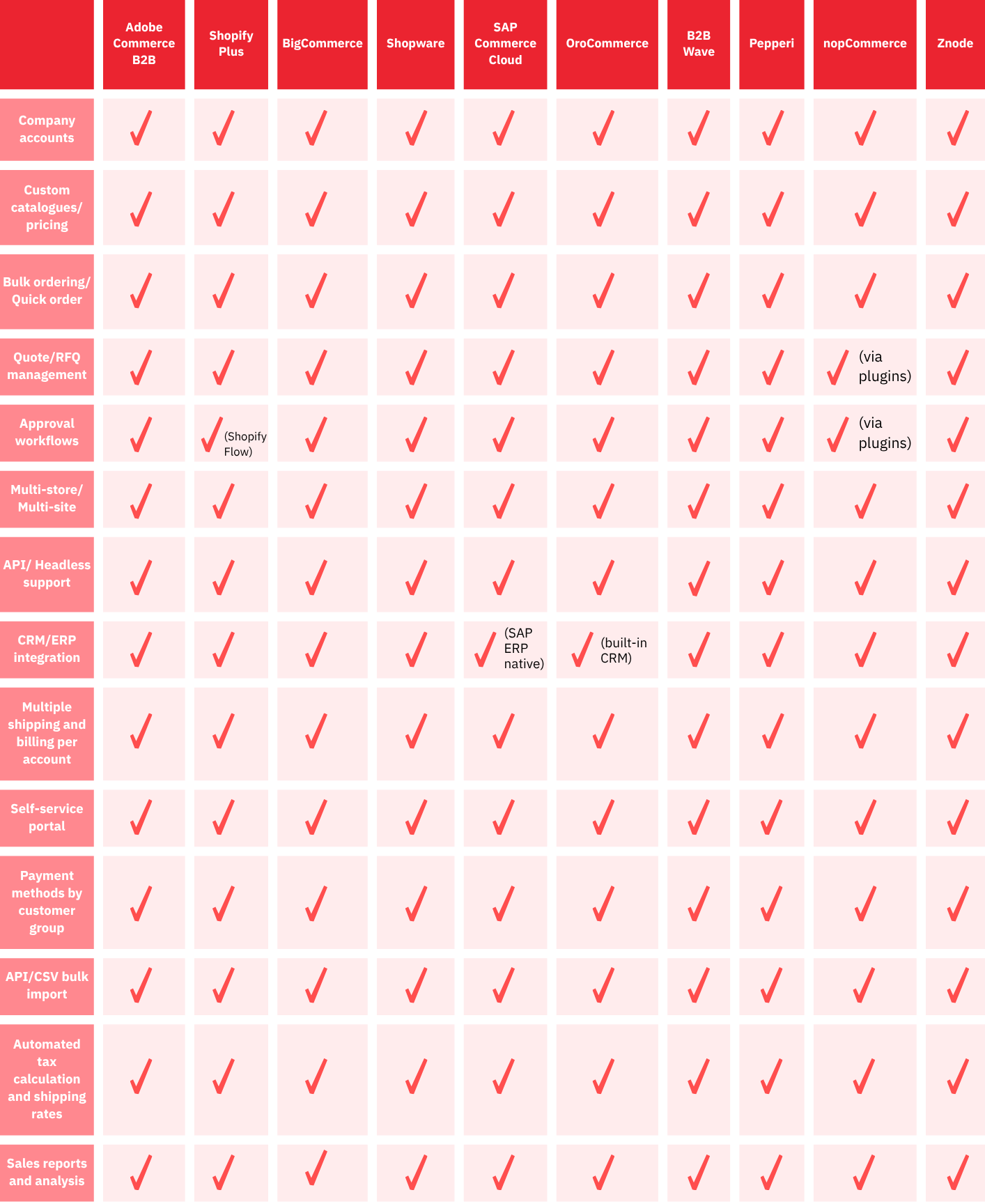
Let’s have a closer look at the details of each platform to help you make a more informed decision.
1. Adobe Commerce B2B
Overview
-
Adobe Commerce, formerly known as Magento Commerce, stands as a prominent leader in eCommerce solutions, offering deep customisation and advanced workflow controls, such as purchase order approvals and AI-driven product recommendations, making it especially well-suited for large enterprises seeking scalable, end-to-end B2B solutions.
-
Edition: Adobe Commerce offers flexible B2B solutions, including a fully managed Adobe Commerce Cloud Service (SaaS) for scalability, a customisable cloud platform Adobe Commerce on Cloud (PaaS) for complex needs, and Commerce Optimizer to enhance performance and personalisation.
-
Leading B2B businesses using Adobe Commerce B2B: Rubik’s, HP, Sunbelt Rentals
Licence fee
The licence fee for Adobe Commerce as a Cloud Service and Adobe Commerce on Cloud ranges from $22,000 to over $125,000 per year, depending primarily on your business’s Gross Merchandise Value (GMV) and Average Order Value (AOV). Businesses that do not opt for Adobe Commerce Cloud will incur additional costs for hosting, as these are not included.
Adobe Commerce Optimizer is built to handle massive catalogues, supporting over 250 million SKUs and up to 30,000 price points per SKU, with pricing tailored and negotiated based on the scale and specific requirements.
Customisation and flexibility
Adobe Commerce offers exceptional flexibility and customizability to meet diverse business needs. Its modular architecture allows merchants to tailor every aspect of their online stores, from themes and page layouts to product configurations and checkout processes. Users can customise product options extensively, such as creating configurable products with multiple attribute combinations, each with unique images and pricing.
Adobe Commerce’s advanced API-first approach facilitates integration with third-party systems like email marketing, analytics, ERPs, and CRMs, allowing businesses to extend functionality and personalise the user experience. Security features such as SSL configuration, tokenised payments, two-factor authentication, and customisable authentication flows offer robust protection that can be tailored to business requirements. Additionally, Adobe Commerce supports sophisticated product personalisation, enabling tailored product recommendations, dynamic catalogue presentations, and customer segmentation. AI-powered tools help deliver personalised storefront experiences based on customer behaviour and preferences, boosting engagement and conversion.
B2B capabilities
Adobe Commerce Cloud provides a highly customisable, enterprise-ready eCommerce platform that supports company accounts with hierarchical structures, role-based permissions, and multi-user management. It enables personalised B2B experiences through shared catalogues, customer-specific pricing, and advanced quoting and negotiation tools. Its multi-site, multi-currency, and multi-language capabilities help businesses operate globally while supporting purchase approvals, requisition lists, and flexible payment options like credit lines.
Adobe Commerce as a Cloud Service, designed as a fully managed SaaS solution, offers elastic scalability and automatic updates with the same comprehensive B2B feature set. It includes company account management, custom catalogues, quoting workflows, and payment on account, streamlining complex corporate purchasing. This platform emphasises ease of use and rapid deployment while supporting integrations with ERP and CRM systems, enabling businesses to personalise pricing and promotions with minimal IT overhead.
Adobe Commerce Optimizer enhances existing Adobe Commerce installations by delivering AI-powered product recommendations, advanced search, and dynamic merchandising tailored for vast catalogues with millions of SKUs. It supports large B2B operations requiring fast, scalable storefronts and helps improve conversion and customer engagement without re-platforming. Optimizer seamlessly integrates with backend workflows, ensuring high performance during peak sales periods and complex B2B transactions.
Time-to-market
Due to its robust feature set and high degree of customisation, the implementation timeline for Adobe Commerce can be longer compared to more out-of-the-box solutions.
Find out more: Our Carbon solution to get your Adobe Commerce site live in weeks, not months.
Scalability
Adobe Commerce is built to support global operations and multi-store management, making it highly scalable for businesses with expanding or complex sales channels. Adobe Commerce on Cloud offers enterprise-level scalability with auto-scaling infrastructure, supporting massive catalogues and high traffic while enabling global multi-site and multi-currency operations. It features real-time performance monitoring and a modular architecture for seamless growth. Adobe Commerce as a Cloud Service automatically scales resources to handle demand spikes, delivers continuous updates, and supports fast, global storefronts through edge deployment. Adobe Commerce Optimizer enhances performance for large-scale catalogues with up to 250 million SKUs, providing AI-driven, headless storefronts that scale in real time and integrate smoothly with existing Adobe Commerce setups to handle peak traffic without re-platforming. Together, these solutions provide flexible, scalable environments designed to support complex B2B operations and rapid business growth.
Support and community
Adobe Commerce provides strong enterprise-level support and benefits from a large global user community, which helps ensure continuous improvements and reliable assistance.
2. Shopify Plus
Overview
-
Shopify Plus is the enterprise-level version of Shopify that includes native, fully integrated B2B functionality within the same platform, unlike standard Shopify plans, which rely on third-party apps for B2B features. Shopify Plus stands apart from other B2B eCommerce platforms by offering a fully hosted, SaaS-based solution that prioritises speed, ease of use, and scalability.
-
Example of B2B commerce using Shopify Plus: Dalfilo, Dermalogica
Licence fee
Shopify Plus charges a monthly licence fee starting at $2,300 per month for a standard setup on a 3-year term or $2,500 per month for a 1-year term. For more complex or high-volume businesses, the fee may shift to a variable platform rate based on sales volume, typically 0.18% of B2B sales volume or a minimum monthly fee, whichever is higher.
Additional costs can include transaction fees (if not using Shopify Payments), app subscriptions, custom development, and partner services. The transparent, predictable pricing structure is designed to scale with your business, but it’s important to budget for third-party apps and customisations as your needs evolve.
Customisation and flexibility
Shopify Plus offers significant customisation options compared to standard Shopify plans. Users have access to advanced tools like Liquid, Shopify’s templating language, which allows for deep modifications of storefronts, product pages, and even the checkout process. The platform supports custom themes, branding, and scripts for dynamic pricing and discounts. It also offers APIs and webhooks for integration with external systems like ERP, CRM, and fulfilment providers.
However, as a hosted platform, Shopify Plus has inherent limitations compared to open-source solutions. For example, customisation is constrained by fixed URL structures, limited checkout modification capabilities, and restrictions on product variants and catalogue complexity. These factors mean that while skilled developers can create tailored experiences, some advanced customisations may require workarounds or third-party apps, which can add complexity and costs.
B2B capabilities
Shopify Plus includes a suite of native B2B features designed for wholesale and business customers. Key capabilities include:
-
Company profiles with multi-user accounts and role-based permissions.
-
Customer-specific catalogues and pricing, allowing tailored product assortments and discounts for each business client.
-
Flexible payment terms (e.g., net 30, deposits, instalment plans).
-
Purchase order workflows and support for PO numbers.
-
Minimum order quantities, volume-based pricing, and custom order rules.
-
Self-serve B2B portals for easy reordering, order tracking, and account management.
-
Integration with backend systems (ERP, CRM) for streamlined operations.
These features enable businesses to manage both B2B and B2C operations from a single admin, providing a unified experience for all customer types.
Learn more: Discover detailed insights into Shopify’s B2B capabilities, limitations, and suitability for various businesses.
Time-to-market
One of Shopify Plus’s standout advantages is its rapid time-to-market. Businesses can typically launch or migrate to Shopify Plus in a matter of weeks, not months, thanks to its fully hosted infrastructure, pre-built integrations, and extensive partner ecosystem. The platform’s intuitive admin and ready-made B2B tools mean less time spent on setup and more time focusing on growth.
Scalability
Shopify Plus supports up to 9 expansion stores, over 200 inventory locations, and can process thousands of orders per minute. Advanced APIs, robust security (Level 1 PCI DSS compliance), and global multi-currency/language support allow businesses to scale internationally with confidence.
Support and community
Shopify Plus merchants receive priority 24/7 support via dedicated Plus Support Advisors, phone, email, and chat. This includes access to a launch engineer during onboarding, ongoing technical assistance, and troubleshooting. The Shopify Plus Partner Program connects merchants with vetted agencies and experts for development, design, and strategy. Additionally, Shopify’s global community is active and resource-rich, offering forums, documentation, and peer support.
3. BigCommerce B2B Edition
Overview
-
BigCommerce is a versatile eCommerce platform that caters to businesses of varying sizes, including B2B enterprises. The platform combines usability with scalability and supports integrations with external systems, allowing businesses to manage and grow their B2B sales while maintaining operational efficiency. B2B functionality is available across all BigCommerce plans, including Standard, Plus, and Pro. However, the most advanced B2B capabilities are exclusive to the Enterprise plan.
-
Example of B2B brands using BigCommerce B2B Edition: Lekker Home, Glass Craft Door Company
Licence fee
B2B functionality is included across all BigCommerce plans, with basic features available starting at $39 per month for the Standard plan, $105 per month for the Plus plan, and $399 per month for the Pro plan. However, the most advanced B2B capabilities—such as custom price lists, unlimited API calls, and priority support—are exclusive to the Enterprise plan. Pricing for the Enterprise plan is customised and negotiated individually based on the specific needs of each business.
Customisation and flexibility
BigCommerce provides a flexible platform with support for custom themes, APIs, and integrations. It allows for product filtering, faceted search, and custom SSL certificates on higher-tier plans, enabling businesses to tailor the shopping experience. The platform supports headless commerce architectures, allowing businesses to use BigCommerce as a backend while building custom frontends with frameworks like React or Next.js. While not open-source, BigCommerce offers extensive APIs and webhooks for integration with ERP, CRM, and other systems, balancing customisation with the convenience of a hosted solution.
B2B capabilities
BigCommerce includes several native B2B features, particularly in its Plus, Pro, and Enterprise plans.
Standard plan, Plus plan and Pro plan
- Multiple storefronts (with added fees from $30/mo)
- Customer groups for segmentation
- Includes product filtering (faceted search) for better product discovery
- Supports up to 8 storefronts
Enterprise plan
- Unlimited API calls for seamless integrations
- Custom price lists and customer-specific pricing at SKU level
- Priority support and account management
- No limits on gross merchandise value (GMV)
- Advanced quoting and negotiation tools
- Multi-storefront, multi-currency, and multi-language capabilities
- Enhanced security and compliance features
- Pricing is negotiated case-by-case basis based on business needs and sales volume
Time-to-market
BigCommerce enables relatively fast deployment compared to fully customisable, self-hosted platforms. Its hosted infrastructure, prebuilt integrations, and user-friendly admin interface allow businesses to launch within weeks, depending on complexity. The availability of ready-made B2B features and a large app marketplace further accelerates setup. For enterprises requiring extensive customisation or multi-storefront configurations, implementation timelines may extend but generally remain shorter than open-source alternatives.
Scalability
BigCommerce is designed to scale with growing businesses, supporting large product catalogues, multiple storefronts (up to 8 on Pro, more on Enterprise), and numerous inventory locations (up to 2,000 products or variants per request). It handles high traffic volumes and transaction spikes efficiently, making it suitable for medium to large B2B operations. API rate limits increase with higher-tier plans, facilitating integrations and automation at scale. The platform also supports internationalisation with multi-currency and multi-language capabilities.
Support and community
BigCommerce offers 24/7 support across all plans, with priority support, dedicated account management, and customer success teams available for Enterprise clients. The platform maintains a robust partner ecosystem, including agencies, developers, and technology providers specialising in B2B implementations. Its online community forums, documentation, and training resources provide additional support channels. While the community is smaller compared to open-source platforms, the professional support and partner network help businesses navigate technical challenges and optimise their stores.
4. Shopware
Overview
-
Shopware is an eCommerce platform developed in Germany, known for its flexible, API-first architecture and strong focus on both B2B and B2C business models. Shopware offers a modular design that enables extensive customisation and seamless omnichannel sales management. Its strong emphasis on data privacy and GDPR compliance makes it particularly suited for international businesses operating in regulated markets, especially across Europe. Additionally, Shopware integrates AI-powered features and automation tools that help optimise customer experience and operational efficiency, distinguishing it as a platform tailored for enterprises with complex, evolving requirements.
-
Example of B2B companies using Shopware: Lüning 24, REIFF Technische Produkte
Licence fee
Shopware offers different editions, including a free Community Edition and paid versions such as Shopware Rise, Evolve, and Beyond, with pricing tailored to business size and needs. The Evolve plan, starting at approximately €2,400 per month, and the Beyond plan, starting at around €6,500 per month, are designed for large enterprises, possessing comprehensive B2B features such as roles and permissions management, quoting, quick ordering, and sales agent functionality. Additional costs may arise from licensing, hosting options (cloud or on-premise), and fees for premium plugins or custom development.
Customisation and flexibility
Shopware offers robust customisation options alongside powerful out-of-the-box features. Its modular architecture lets businesses adapt order processing, product management, and workflows to their unique requirements. With an API-first and headless design, it easily integrates with different frontends, marketplaces, and internal systems. Features like the Rule Builder enable users to automate complex business processes without any coding, while flexible product streams and dynamic catalogues provide precise control over how products are displayed and priced.
B2B capabilities
Shopware supports sophisticated B2B features including company accounts with role-based permissions, custom catalogues, and pricing tailored to different customer groups. The platform enables multi-warehouse and inventory management, purchase order workflows, and streamlined supplier and partner collaboration. Its omnichannel approach allows businesses to manage multiple sales channels from one interface, ensuring consistent customer experiences across web, marketplaces, social media, and physical stores.
Time-to-market
Shopware’s combination of out-of-the-box functionality and modular extensibility allows for relatively rapid deployment compared to fully custom-built solutions. The availability of prebuilt integrations and a large ecosystem of extensions can accelerate setup, though complex customisations or multi-store configurations may extend implementation timelines. Its user-friendly content management and drag-and-drop page builder help reduce the need for technical resources during launch.
Scalability
Shopware is designed to handle high order volumes (over 4,000 orders per minute) and large product catalogues (140,000+ SKUs) without performance degradation. Its architecture supports multi-storefront setups, multiple warehouses, and internationalisation with multi-language and multi-currency capabilities. The platform’s cloud and on-premise deployment options provide flexibility to scale according to business growth and infrastructure preferences.
Support and community
Shopware benefits from a strong developer community and a global network of certified partners and agencies. Enterprise customers receive dedicated support, including technical assistance and consulting services. Comprehensive documentation, forums, and training resources are available to all users, fostering knowledge sharing and problem-solving. Shopware’s European roots ensure compliance with strict data protection laws and close alignment with international merchants’ needs.
5. OroCommerce
Overview
-
OroCommerce is a B2B eCommerce platform specifically developed to address the needs of manufacturers, distributors, and wholesalers. The platform also offers a Community Edition that is open-source and features a modular design, enabling seamless integration with CRM and marketplace tools. This flexibility supports a variety of business models—including B2B, B2C, and hybrid approaches—within a single unified system.
-
B2B enterprises operating online stores on OroCommerce: Saltworks, Azelis
Licence fee
- Community edition: Free, open-source, and suitable for small businesses or developers evaluating the platform.
- Enterprise edition: Priced by quote, depending on factors such as Gross Merchandise Value (GMV), number of admin users, and hosting requirements. Additional costs may apply for OroCloud hosting or extra admin users.
Customisation and flexibility
OroCommerce’s open-source foundation allows for deep customisation of workflows, user roles, and business processes without the limitations of many SaaS platforms. The platform supports:
- Flexible workflow engine for modifying business processes.
- Customisation of corporate account structures, permissions, and hierarchies.
- Sophisticated product catalogue personalisation, including customer segments, pricing tiers, and multi-store management from a single backend.
- Extensive API coverage and modular architecture enable integration with external systems and support for headless commerce or composable setups.
B2B capabilities
Both the Community Edition and Enterprise Edition possess comprehensive B2B-specific features:
Community Edition (CE) features
- Corporate account management: Supports managing hierarchical corporate accounts with multiple business units and divisions, enabling tailored access and experiences within a single organisation.
- Access controls, roles & permissions: Basic role management to assign appropriate access levels to users, ensuring they see relevant information and functionalities.
- Personalised B2B catalogue management: Ability to customise product catalogues for specific companies, divisions, or individual buyers to provide relevant offerings.
- Multiple price lists: Supports creating and managing multiple price lists with tiered and volume-based pricing tailored to customer segments.
- Multiple shopping lists: Buyers can create and manage multiple shopping lists or baskets, facilitating complex purchasing workflows and repeat orders.
- Request for quote (RFQ) management: Enables buyers to submit quote requests and sellers to respond with customised pricing, shipping terms, and lead times.
- Basic tax management: Set tax rules per customer, product, or jurisdiction, with support for third-party tax system integration.
- Quotes & orders digitisation: Supports online quote requests, negotiation, and order placement.
- Workflow management: Basic workflow capabilities to automate processes like approvals and order handling.
- Quick order and bulk ordering: Features like CSV/XML upload and quick order forms to facilitate large or repeat purchases.
- Native CRM integration: Provides a multi-channel CRM system for a 360-degree customer view across marketing, sales, and support.
Enterprise Edition (EE) features
Includes all Community Edition features plus advanced capabilities designed for mid to large enterprises:
- Multi-organisation support: Manage multiple distinct organisations within a single platform, each with separate catalogues, pricing, and workflows.
- Multi-site & multi-currency: Operate multiple websites and support multiple currencies, enabling global commerce and localisation.
- Advanced inventory management: Real-time inventory tracking across multiple warehouses and locations to optimise fulfilment and stock availability.
- Enhanced access controls & permissions: Granular role management with feature toggles per organisation or website, supporting complex user hierarchies.
- Advanced approval workflows: Multi-step, rule-based approval processes tailored by purchase amount, user role, or product category.
- Punchout catalogues & procurement integration: Seamless integration with external procurement systems like SAP Ariba or Coupa to support enterprise buyers.
- Marketplace functionality: Supports multi-vendor marketplaces with vendor onboarding, product approvals, commission management, and seller-specific promotions.
- Big data & search optimisation: Enhanced search capabilities powered by Elasticsearch and optimised for handling large catalogues and high traffic volumes.
- Workflow automation & customisation: More sophisticated workflow creation tools for automating complex business processes.
- Dedicated enterprise support & services: Access to professional support, consulting, and managed hosting via OroCloud.
- AI-Driven personalisation & recommendations: Integration with AI tools like Google Recommendations AI for personalised product suggestions.
- Mobile-optimised responsive design with theme configurator: Advanced storefront customisation and mobile-friendly design for enhanced user experience.
Time-to-market
OroCommerce offers many B2B features out of the box, reducing the need for custom development and enabling faster project completion compared to platforms that require extensive add-ons. The platform is available in both cloud and on-premise deployments, allowing businesses to choose the setup that best matches their infrastructure and speed requirements.
While initial configuration can be complex for highly customised projects, businesses benefit from a lower total cost of ownership and quicker return on investment due to the platform’s B2B focus.
Scalability
Designed for mid-market and enterprise companies, OroCommerce supports:
- Multi-tenant architecture for managing multiple brands, regions, and languages from a single backend.
- Handling of millions of SKUs, high order volumes, and global expansion without performance loss.
- Flexible deployment options (cloud or on-premise) and robust APIs for integration with business-critical systems.
- The platform’s architecture and features are built to scale with business growth and evolving requirements.
Support and community
OroCommerce offers dedicated support for enterprise clients, including technical assistance and consulting. A strong developer and user community contributes to the platform’s open-source codebase, documentation, and translations.
Community resources include forums, Slack channels, GitHub repositories, and extensive documentation, enabling collaborative problem-solving and knowledge sharing. Regular updates, a network of certified partners, and a focus on best practices ensure ongoing support and platform evolution.
6. SAP Commerce Cloud
Overview
-
SAP Commerce Cloud, formerly known as SAP Hybris Commerce Cloud, is a comprehensive e-commerce platform engineered to deliver consistent, personalised, and seamless customer experiences across all touchpoints, supporting both B2C and B2B commerce models. The platform stands out from other eCommerce platforms by offering a solution specifically designed for complex, large-scale B2B operations. Unlike many platforms that retrofit B2B features onto a primarily B2C core, SAP Commerce Cloud is built to handle intricate B2B requirements natively.
-
Example of B2B commerce using SAP Commerce Cloud: Euronis, Milk & More
Licence fee
SAP Commerce Cloud’s licence fee is not publicly listed and is typically quoted on a case-by-case basis, depending on transaction volume, business complexity, and required integrations. Additional expenses may include implementation, customisation, hosting, and ongoing maintenance, making the total cost of ownership higher than many SaaS competitors.
Customisation and flexibility
- The platform offers extensive customisation through its modular, headless architecture and API-first approach.
- Businesses can tailor storefronts, workflows, and product catalogues and integrate with both SAP and third-party systems for unique business processes.
- Support for headless commerce allows for custom frontends and omnichannel experiences.
- While highly flexible, customisation can be complex and often requires specialised development resources.
B2B capabilities
-
SAP Commerce Cloud provides a robust suite of B2B features out of the box:
-
Company account management with hierarchical structures and role-based permissions.
-
Customer-specific catalogues, individualised pricing, and tailored promotions.
-
Bulk ordering, reordering, and advanced approval workflows.
-
Integrated order and product content management for complex catalogues.
-
Omnichannel commerce support, allowing seamless experiences across web, mobile, and offline channels.
-
Deep integration with SAP’s Customer Data, Sales, and Service Clouds for unified customer and sales management.
-
Integration with SAP solutions: One of the most significant advantages of SAP Commerce Cloud is its seamless integration with other SAP solutions like ERP, CRM, and SAP S/4HANA. This allows businesses to synchronise their eCommerce operations with back-end systems for better decision-making and streamlined processes.
-
AI-powered functionality:
-
Intelligent Selling Services: Leverages AI for real-time personalisation, tailored product recommendations, and dynamic merchandising to boost relevance and conversion.
-
AI Toolkit for Commerce: Includes tools like visual search to enhance product discovery and generative AI for improved product tagging and descriptions.
-
Smarter Search: AI-driven search delivers more accurate results by analysing customer behaviour and intent, improving the overall shopping experience.
-
SAP Commerce Marketplace Management by Mirakl.
-
Fast Onboarding: Automates and accelerates seller onboarding with drag-and-drop catalogue mapping and streamlined approval/rejection workflows, enabling scalable growth.
-
Scaled Control: Enforce SLAs, automatically manage non-compliant sellers or inventory, and maintain product data quality across high volumes of sellers and SKUs.
-
Complex Order Management: Supports order splitting across sellers or channels, enables omnichannel options like click-and-collect, and provides granular control over pricing, tax, and payment for advanced B2B transactions.
Time-to-market
SAP Commerce Cloud provides prebuilt industry accelerators and modular components intended to accelerate deployment. Despite this, the platform’s inherent complexity and customisation requirements generally result in longer implementation timelines compared to SaaS platforms that emphasise rapid rollout. Launching new storefronts or executing significant updates often takes several months, particularly for enterprises with complex needs.
Scalability
Built on a cloud-native, modular infrastructure, SAP Commerce Cloud can scale horizontally and vertically to accommodate high traffic, large product catalogues, and global expansion. The platform supports multi-region, multi-language, and multi-currency operations, making it suitable for international enterprises. Automated resource scaling and high availability ensure consistent performance during peak periods.
Support and community
SAP provides enterprise-grade support with dedicated technical assistance, regular updates, and a global network of partners and certified consultants. The SAP Community offers forums, documentation, and peer support, though the ecosystem is more enterprise-focused than some open-source alternatives. Ongoing maintenance, updates, and knowledge sharing are facilitated through SAP’s established support infrastructure and active user community.
7. B2B Wave
Overview
-
B2B Wave is a cloud-based eCommerce platform designed specifically for wholesale, manufacturing, and distribution businesses. Unlike many eCommerce solutions that adapt B2C features for B2B use or require significant customisation to support wholesale workflows, B2B Wave is purpose-built for B2B transactions.
-
Example of B2B commerce brands using B2B Wave: Farm Direct, Fence Materials
Licence fee
B2B Wave offers transparent, subscription-based pricing. The Pro plan begins at $350 per month, which includes a 14-day free trial and a 15% discount for annual payments. For larger businesses or those with more advanced needs, custom Enterprise plans are available. Pricing is based on features, user count, and support level. Pricing depends on the features included, the number of users, and the level of support required.
Businesses looking to scale beyond 20,000 SKUs, unlimited customers, and 10 users can also opt for add-on plans that include services such as additional users, expanded product and price list capacity, priority support (with SLA), sandbox environments, premium API support, and more.
Customisation and flexibility
The platform allows businesses to personalise their storefronts with custom branding, logos, and colour schemes. Admins can modify interface terminology to match industry-specific language and adjust layouts to reflect their brand identity. B2B Wave provides an open API for integrations and supports bulk import/export of product data. While customisation is robust for B2B workflows, such as setting up price lists, customer groups, and catalogues, front-end design options are more limited compared to open-source or heavily customizable platforms. This approach prioritises operational efficiency and simplicity over deep design flexibility.
B2B capabilities
B2B Wave delivers a comprehensive suite of B2B features out of the box:
- Customer-specific catalogues and pricing, including quantity-based pricing and private product groups.
- Multi-level user permissions for both customers and sales reps, with dedicated portals for each.
- Bulk ordering, reordering, and enforcement of minimum order quantities and values.
- Integrated quote generation, order tracking, and invoice management.
- Support for multiple price lists, private pages, and workflow automations.
- Seamless integrations with accounting, ERP, and payment systems (e.g., QuickBooks, Xero, Shopify).
Time-to-market
B2B Wave is recognised for its rapid deployment capabilities. Businesses can typically launch a fully functional B2B portal in less than 48 hours, thanks to its cloud-based infrastructure, intuitive admin dashboard, and guided onboarding. The low learning curve and prebuilt integrations further accelerate setup, making it ideal for companies seeking a quick transition to digital ordering without lengthy implementation projects.
Scalability
The platform is designed to support growing businesses, with features for managing large product catalogues, multiple customer groups, and complex pricing structures. Its modular, API-driven architecture enables integration with external systems and automation of workflows. However, as a specialised B2B solution, scalability is best suited for small to mid-sized enterprises rather than huge, multinational organisations with highly unique requirements. B2B Wave’s cloud infrastructure ensures reliable performance and security as order volumes increase.
Support and community
B2B Wave offers support via email, phone, and live chat, with coverage across multiple time zones. Users have access to onboarding assistance, help guides, webinars, and blogs for ongoing training. The platform’s support team is noted for responsiveness and willingness to implement requested changes at little or no cost. While the user community is smaller compared to major open-source platforms, B2B Wave maintains a strong focus on customer service and continuous product improvement.
8. Pepperi

Overview
-
Pepperi is a mobile-first B2B eCommerce platform designed to consolidate sales operations, data, and business logic into a single platform, aiming for a cohesive internal and external buying experience.
-
Example of B2B stores operating on Pepperi: Orgreen Optics, Indaba
Licence fee
Pepperi operates on a subscription-based pricing model with several tiers.
-
The Pro plan starts at $500 per month
-
The Corporate tier offers advanced capabilities, beginning at $1,500 per month
-
For organisations with more complex needs, an Ultimate tier is available by custom quote.
Pepperi does not charge per-order fees; instead, subscriptions include a generous pool of annual transactions, with the option to purchase additional transactions if needed. Pricing is flexible, allowing businesses to add modules as requirements evolve. Support and product updates are included in the subscription, with enhanced support available for an additional fee.
Customisation and flexibility
Pepperi provides extensive customisation options through a DIY configuration approach. Businesses can adapt workflows, forms, business rules, dashboards, and user-defined fields without requiring development resources. The platform’s modular architecture allows for the addition or removal of features as needed. Branding, catalogue layouts, and interface terminology can be tailored to match specific industry requirements. Integration with over 60 ERP and accounting systems is supported via pre-built connectors and a robust API, enabling seamless data synchronisation and process automation. Pepperi’s mobile and web apps are fully configurable and operate both online and offline.
B2B capabilities
All plans support integration with ERP and accounting systems, and Pepperi enables flexible module purchases tailored to business needs.
- Pro Plan: Delivers core B2B commerce essentials such as catalogue/order management, debt tracking, geo-location services, and unlimited product/customer support. Suited for businesses needing foundational B2B sales and catalogue tools.
- Corporate Plan: Adds advanced sales operations like mobile merchandising, multi-catalogue support, enhanced CRM, up-sell/cross-sell, ePayment, and sales analytics for companies scaling their digital sales processes.
- Ultimate Plan: Targets enterprises requiring route accounting, advanced logistics, replenishment logic, configurable discounting, and integration through webhooks and rule automation. Useful for businesses managing complex, multi-channel, or high-volume B2B environments.
Time-to-market
Pepperi is designed for rapid deployment. Its cloud-based infrastructure, pre-built modules, and intuitive admin interface allow businesses to launch B2B portals and sales tools quickly, often in a matter of weeks. The platform’s flexibility enables organisations to adapt processes and workflows without lengthy development cycles. Pre-built integrations with leading ERP and accounting systems further accelerate implementation and reduce reliance on custom development.
Scalability
Built as an enterprise-grade SaaS solution, Pepperi supports thousands of users and millions of transactions annually. It enables businesses to manage multiple sites, warehouses, catalogues, languages, and currencies from a single backend. Automated upgrades, disaster recovery, and performance monitoring are included, ensuring high availability and consistent performance as business needs grow. The platform’s modular design allows for seamless scaling as transaction volumes and operational complexity increase.
Support and community
Pepperi provides 24/6 global support as part of its subscription, with enhanced support options available. Customers have access to a comprehensive knowledge base, online training, webinars, and detailed documentation. The company is noted for its responsive customer service and willingness to implement requested changes. While the user community is smaller than some open-source platforms, Pepperi maintains a strong focus on customer success and continuous product improvement, supported by a global network of partners and certified consultants.
9. nopCommerce

Overview
-
nopCommerce is an open-source eCommerce platform that stands out by offering a comprehensive set of B2B features within a free edition that includes multi-vendor and multi-store support capabilities that many competitors reserve for paid plans. Built on Microsoft technologies, it emphasises security, scalability, and compliance with standards like PCI and GDPR.
Licence fee
nopCommerce is available as a free, open-source platform with no transaction fees or monthly licensing costs. Businesses can use the core platform and its B2B features without charge, which includes multi-store and multi-vendor capabilities. However, some additional services, such as premium support packages and optional plugins like the Web API for headless commerce incur extra fees. This pricing model allows companies to control costs while scaling and customising their eCommerce operations.
Customisation and flexibility
The platform’s open-source codebase offers unlimited customisation potential, enabling businesses to adapt the system to any business model, process, or supplier-customer relationship. nopCommerce supports modifications to workflows, storefront design, product attributes, and integrations with external systems. Its API-first design facilitates headless commerce implementations, allowing the separation of front-end and back-end for dynamic user experiences. This flexibility requires technical expertise but provides the freedom to build tailored solutions that precisely meet B2B requirements.
B2B capabilities
nopCommerce includes a broad range of B2B features out of the box. It supports complex product catalogues with unlimited quantities, tiered pricing, “call for price” options, and multi-warehouse inventory management. The platform allows creation of customer roles and access control lists, enabling fine-grained permission management. Features such as bulk ordering, recurring payments, quote management, and comprehensive shipping options help streamline B2B sales processes. Integration with tax automation, payment gateways, and business analytics tools further supports operational efficiency.
Time-to-market
As an open-source solution, nopCommerce’s time-to-market depends largely on the availability of in-house or contracted development resources. While the platform provides many built-in features and a large ecosystem of plugins, deploying a fully customised B2B store may require several weeks to months. However, prebuilt themes, extensions, and a supportive developer community can accelerate implementation compared to building from scratch.
Scalability
nopCommerce is designed to scale with growing businesses, supporting multi-store and multi-vendor configurations, large product catalogues, and high transaction volumes. Its compatibility with CRM, ERP, WMS, and PIM systems ensures it can integrate into complex enterprise environments. The platform’s support for cloud hosting and web farms enables horizontal scaling to handle traffic spikes and expanding operations globally.
Support and community
While the core platform is free, nopCommerce offers paid premium support plans providing technical assistance and updates. The platform benefits from a large and active global community of developers, partners, and users who contribute plugins, themes, and documentation. Official forums, GitHub repositories, and third-party resources provide additional support channels. This ecosystem helps businesses troubleshoot issues and continuously improve their eCommerce implementations.
10. Znode

Overview
-
Znode is a headless B2B eCommerce platform designed to simplify the complexities of B2B eCommerce for manufacturers, distributors, and wholesalers. Znode offers a highly extensible, API-first, headless architecture with over 1,200 API endpoints, enabling deep customisation and seamless integration with existing systems. Its native product information management (PIM), multi-store capabilities, and advanced pricing and inventory management distinguish it from competitors by providing a unified solution for managing diverse catalogues and complex B2B workflows.
-
Example of B2B eCommerce site using Znode: MacGregor Schoolwear, Land & Coates
Licence fee
Znode’s pricing is typically customised based on the size and needs of the business, and exact figures are not publicly disclosed. It is positioned as an enterprise solution, which generally involves a significant investment relative to smaller SaaS platforms. Costs include licensing fees, implementation, hosting, and ongoing support. The pricing model reflects the platform’s extensive capabilities, multi-store support, and API-driven architecture, which cater to businesses with complex B2B requirements and multiple sales channels.
Customisation and flexibility
Znode offers extensive customisation through its API-first, headless architecture, allowing businesses to tailor storefronts, workflows, catalogues, and pricing models to their unique needs. Its flexible data structures enable the creation of unlimited product attributes, multiple catalogues, and personalised shopper experiences. The built-in content management system and digital asset management tools support rich brand experiences across channels. While the platform provides powerful out-of-the-box features, it also allows deep integration with ERP, CRM, and other enterprise systems, enabling businesses to automate complex processes and adapt quickly to changing market demands.
B2B capabilities
Znode includes a comprehensive suite of B2B features designed to support complex sales processes. These include multi-store and multi-catalogue management, customer-specific pricing and catalogues, advanced pricing rules with unlimited tiers and currencies, and multi-warehouse inventory control. The platform supports B2B workflows such as quote management, order approvals, budget controls, and list management for project-based ordering. Its enterprise site search, powered by Elasticsearch, improves product discoverability, while integrated order management streamlines order processing and tracking. Znode’s features enable efficient handling of large product assortments and diverse customer segments.
Time-to-market
While Znode provides prebuilt modules and a flexible architecture to accelerate deployment, its enterprise focus and customisation options mean implementations typically require several months. The complexity of multi-store setups, integrations, and tailored workflows can extend timelines compared to more out-of-the-box SaaS platforms. However, businesses benefit from a highly configurable system that can evolve with their needs, reducing the need for frequent platform changes.
Scalability
Znode is built to scale with growing enterprises, supporting thousands of users, multiple storefronts, and millions of SKUs across various regions and languages. Its cloud-ready architecture and extensive API support allow horizontal scaling and integration with global ERP and fulfilment systems. Automated upgrades, disaster recovery, and performance monitoring ensure reliability and uptime during peak demand. The platform’s ability to handle complex pricing, inventory, and order workflows makes it suitable for businesses with expanding product lines and sales channels.
Support and community
Znode offers enterprise-grade support, including dedicated account management, technical assistance, and consulting services. The vendor provides regular updates and security patches, with a focus on maintaining platform stability and compliance. While the user community is smaller than some open-source platforms, Znode maintains a network of certified partners and developers to assist with implementations and customisations. Documentation, training resources, and customer forums support ongoing user engagement and knowledge sharing.
Conclusion
Choosing the right B2B eCommerce platform is a critical step for businesses aiming to streamline operations, enhance customer experience, and scale effectively in today’s digital marketplace. Each platform reviewed has distinct strengths and trade-offs, whether it’s the customisation depth of Adobe Commerce, the rapid deployment of Shopify Plus, or the B2B-specific focus of OroCommerce. To find the best fit, companies must consider their unique needs, including budget, technical resources, scalability, and desired features.
If you’re ready to explore how these platforms can transform your B2B sales or need expert guidance to select and implement the right solution, On Tap can help. As a trusted member of the B2B eCommerce Association, and a B2B eCommerce agency with extensive experience across leading platforms like Adobe Commerce, Shopify Plus, Big Commerce, and more, On Tap offers tailored consulting and development services to ensure your eCommerce strategy aligns with your business goals. Reach out today to start your journey toward a more efficient and profitable B2B eCommerce operation.