

Many Magento merchants reach a breaking point where maintenance feels endless, upgrades consume more resources than innovation, and even small changes require full development cycles, prompting them to question whether staying on Magento still makes sense for their business. If this sounds familiar, you’re not alone.
However, before deciding to move away from Magento, it is crucial to understand what is truly causing friction in your current setup. Many merchants invest heavily in replatforming only to find the same inefficiencies reappearing in a new system. This article gudies you to diagnose the root causes behind your store’s issues and evaluate potential platforms based on long-term business fit, helping you avoid costly replatforming mistakes.
It then provides an honest evaluation of top alternative solutions, including Carbon, Shopware, BigCommerce, Shopify, and Medusa JS, enabling you to make a confident, sustainable decision for your eCommerce future.
Key considerations when choosing Magento alternatives
Diagnose the root cause before you decide
Before committing to a new platform, it is essential to understand what is truly causing friction in your current Magento setup. In many of the stores we have audited, merchants assume Magento itself is the source of their issues, when in reality most problems come from how the site was built and maintained, not from the core platform.
This misunderstanding often comes from Magento’s greatest advantage: its deep customisability. Magento’s open, modular framework allows businesses to tailor nearly every part of their store, from checkout flows to integrations with external systems. That flexibility, however, also means the outcome depends heavily on the quality of implementation. When done well, Magento can scale efficiently and deliver strong performance. When poorly executed, it can become slow, fragile, and expensive to maintain.
Before assuming that switching platforms will automatically resolve your store’s issues, it is worth identifying their true origins. From our experience, most merchant frustrations fall into three scenarios:
-
Performance and stability issues: Sites that constantly experience slow speed, errors, or backend instability usually suffer from weak technical foundations: overlapping third-party modules, inefficient database queries, and missing caching layers. These are symptoms of poor implementation, not Magento’s core limitations.
-
High total cost of ownership: Merchants often cite high upgrade and maintenance costs as the main reason to leave Magento. While it’s true that Magento requires ongoing upgrades to stay secure and compatible, the real driver of cost escalation is technical debt: custom code written without upgrade-safe practices, integrations added without long-term planning, and reliance on outdated modules.
If Magento sites are built with scalability and upgrade planning in mind, they would experience smoother, lower-risk updates and more predictable long-term costs. -
The Magento store no longer supports business growth: As your business scales, Magento can start to feel like a constraint rather than a driver of growth. Each new feature demands development, testing, and integration effort, driving up timelines and cost.
A new platform with richer built-in features may reduce the development effort for common use cases. However, long-term growth inevitably brings new business-specific requirements such as regional variations, bespoke customer journeys, or specialised integrations. No commerce system can cover all of that natively. Over time, even the most feature-rich platform will need custom work and third-party add-ons to keep up.
In these scenarios, replatforming can remove certain constraints, but it cannot compensate for weak technical governance. Without consistent development quality and proactive long-term planning, the same inefficiencies will eventually resurface on the new platform.
That is why your sustainable eCommerce performance does not just depend on choosing a new platform but working with a partner who possesses practical multi-platform understanding and deep technical expertise. Multi-platform expertise allows a partner to evaluate each system objectively and identify the one most aligned with your operational and growth goals. Strong technical capability ensures that the implementation is architected for long-term scalability and cost-efficiency, reducing the risk of repeating past issues.
With 20 years of experience across Magento and other platforms, On Tap provides the clarity and direction needed to make confident technology decisions. Through our eCommerce consulting services, we help merchants diagnose underlying issues and define a clear, data-driven path toward sustainable growth, whether on Magento or other platforms.
In the next section, we introduce five Magento alternatives chosen based on real-world experience helping merchants transition from Magento. Each represents a proven route to overcome its common pain points and build a more scalable foundation for growth.
Be aware of replatforming risks and challenges
Replatforming is not just transferring your store’s data, design and functionalities from one platform to another. In reality, it is much closer to a complete rebuild of your eCommerce ecosystem.
The greater the differences between Magento and the new platform and the deeper your customisations and integrations are, the more redevelopment time will be required. This results in long project timelines, which often take months, and significant costs.
Beyond time and cost, replatforming carries risks that can disrupt your business if not carefully managed. Data loss and downtime during migration can cause business disruption. Even after launch, changes to URL structures, content hierarchy, or user experience may lead to temporary drops in visibility, traffic, and conversion rates until customers and search engines adjust.
In conclusion, replatforming is a complex, resource-intensive process that carries both financial and operational risks. Every decision to replatform should be carefully calculated and supported by measurable objectives such as improved performance, higher conversion rates, or greater scalability for future growth. Equally important, successful execution requires a partner with proven hands-on experience and technical expertise. The right team can anticipate challenges, minimise risks, and optimise the new platform for long-term efficiency.
Choose between different platform types: Open Source vs SaaS
For merchants moving away from Magento, the most practical alternatives fall into two core models: Open Source and SaaS.
-
Open Source platforms retain many of Magento’s strengths, including full code access, ownership, and flexibility over business logic. They appeal to teams that want to keep control over how their store works but prefer a cleaner, more modern architecture that is easier to maintain and upgrade. This model reduces the long-term complexity of version updates and technical debt while preserving deep customisation capabilities.
-
SaaS platforms, on the other hand, remove most of Magento’s technical management burden entirely. Hosting, upgrades, and performance are handled by the platform provider, allowing teams to focus on merchandising, marketing, and growth instead of infrastructure. However, because these platforms operate within a predefined framework, flexibility is limited. Custom business logic, unique data models, or complex integrations may require third-party applications or external systems.
Ultimately, the decision depends on your priorities: whether you prefer control and flexibility with Open Source or simplicity and speed with SaaS.
Evaluate long-term fit to avoid another replatform
To avoid another costly rebuild, assess whether the new platform fixes the pain points that led you to leave Magento as well as supports your long-term business goals. Use your root cause analysis as a starting point, but map those findings to measurable outcomes that support your business objectives.
1. Functionality fit
Begin by evaluating how well the platform meets both your current and future functional requirements. If essential capabilities cannot be adapted, they will need to be adjusted. These changes can negatively impact how customers interact with your site, potentially reducing familiarity and conversion efficiency.
To evaluate functionality fit effectively, look at three key dimensions:
-
Native features coverage: The more features a platform provides out of the box, the less you will depend on third-party solutions.
-
Customisability: No platform will natively meet every business need, so review which areas can be customised and how customisation is achieved, as this impacts development effort and the resources required to maintain and evolve your store.
-
Ecosystem: A platform’s ecosystem, including its supported apps, modules, and technology partners, defines how easily you can extend and enhance its native capabilities.
2. Ease of use
Assess how well the platform enables your team to manage daily operations without heavy technical involvement. A simpler, more intuitive interface reduces reliance on developers, shortens training time, and allows marketing or merchandising teams to make changes independently.
3. Performance and scalability
Evaluate whether the platform can maintain speed and reliability as traffic, catalogue size, and order volume grow. Look beyond current performance and consider whether it can scale sustainably as your operations and customer base expand.
4. Total cost of ownership
Total cost of ownership (TCO) includes every expense involved in running and maintaining your store over time, from licence fees, hosting, and development to upgrades, third-party apps, and transaction costs.
You should go beyond initial setup and evaluate how these recurring expenses will scale with your business. Estimate TCO across several years to understand the platform’s long-term financial impact. Compare this with the long-term cost of maintaining Magento to determine whether the projected value and stability justify the investment.
Top Magento alternative platforms
The following platforms were evaluated based on how well they address Magento’s most common pain points. Each was assessed across five key criteria mentioned above: native feature coverage, customisability, ease of use, performance and scalability, and total cost of ownership. Together, these factors provide a clear view of how each platform supports long-term business growth and operational efficiency.
1. Carbon
Overview
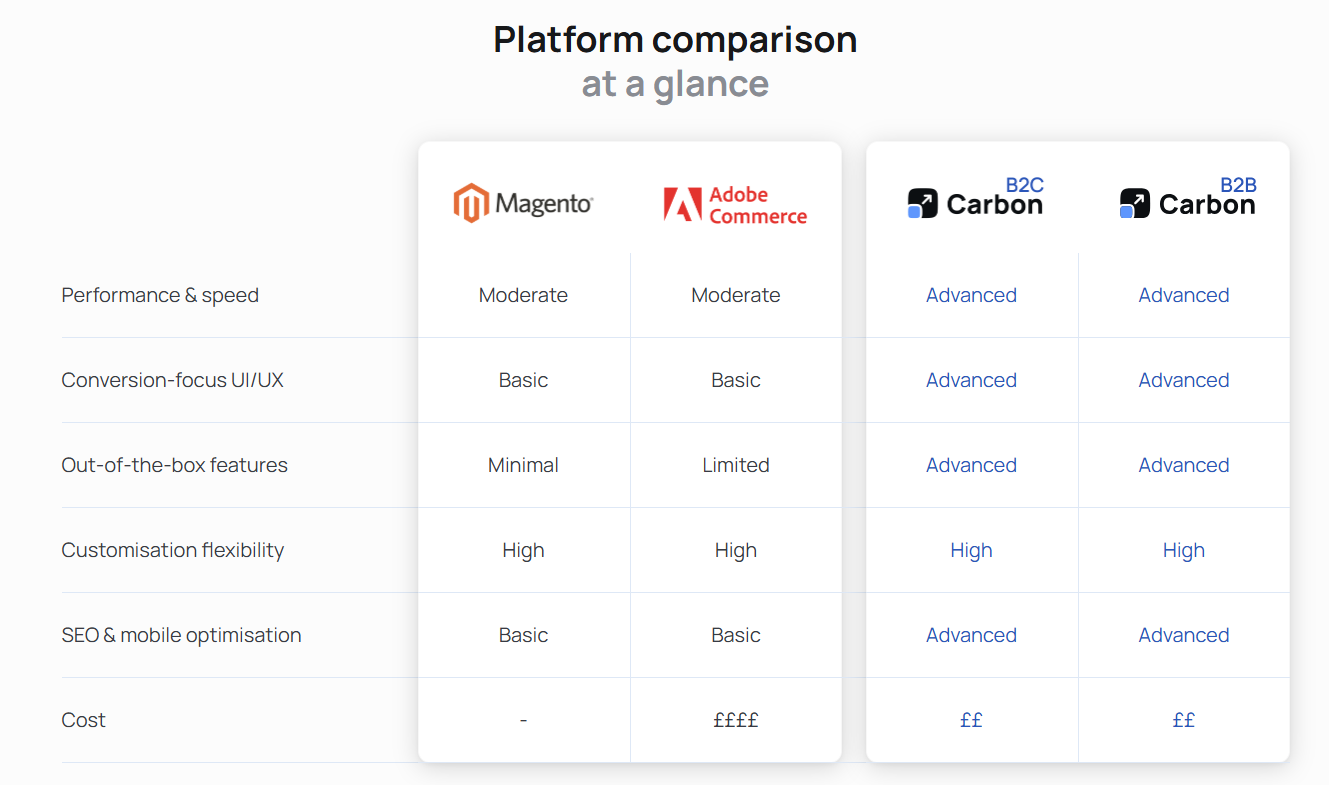
Carbon is a next-generation eCommerce platform that retains the best of Magento’s proven flexibility and scalability while eliminating its long-standing pain points, including complex maintenance, upgrade costs, and lengthy development cycles. It is a Hyvä ‑based, outcome‑driven rapid deployment system that ships with 100+ built‑in features for both B2C and B2B, designed to get merchants live with a fully featured website in as fast as four weeks - and to stay fast, flexible, and scalable long after launch.
What sets Carbon apart from other Magento alternatives is that it delivers the best of both the Open Source and SaaS models. Powered by the Hyvä frontend and fully compatible with Magento/Adobe Commerce, it retains the full flexibility of an Open Source model Fully managed by On Tap, it provides the simplicity, reliability, and stability of a SaaS environment. With free lifetime upgrades, merchants can eliminate upgrade costs and ongoing maintenance overhead, gaining a platform that remains cost-efficient and scalable over time.
By adopting Carbon, merchants can eliminate the risks and challenges typically associated with replatforming. Furthermore, the time and cost to relaunch with Carbon are significantly lower than those of a full migration to a new platform. Compared with replatforming to other Magento alternatives, this approach minimises the business disruption and enables merchants to generate revenue sooner with a pre-optimised and scalable foundation.
Comparable capabilities to Magento
-
Customisability: Merchants maintain full ownership and control of their codebase, retaining the ability to customise business logic, integrations, and user experience as needed.
Advantages compared with Magento
-
Total cost of ownership: More cost-effective and predictable than Magento
Carbon replaces the variable maintenance expenses of running Magento with a fixed annual licence fee that includes support, hosting flexibility, and free lifetime upgrades. This eliminates the need for recurring upgrade costs and gives merchants predictable, long-term budgeting. -
Performance and scalability: Exceptional site speed and stability
Carbon inherits a lightweight architecture that dramatically improves load times and user experience. Combined with On Tap Cloud’s fully managed, auto-scaling hosting, Carbon ensures consistent speed, stability, and scalability even during peak traffic. -
Ease of use: Significantly easier to manage than Magento
Carbon offers a cleaner admin experience and a modern CMS interface designed for merchants. Non-technical teams can edit products, content, and promotions directly, reducing reliance on technical staff and accelerating day-to-day operations. -
Native feature coverage: Broader functionality out of the box
Carbon includes a comprehensive suite of ready-to-use features for both B2C and B2B operations, such as advanced SEO tools, conversion-optimised UX components, custom checkout flows, integrated B2B pricing, and RFQ (request-for-quote) management. These features are informed by On Tap’s 19 years of eCommerce experience, ensuring best-practice design that improves conversions from day one. -
Ecosystem: Larger, more unified, and ready to scale
Carbon is fully compatible with Magento’s vast extension ecosystem while also integrating with On Tap’s managed product suite, which is designed to optimise performance and streamline operations.- On Tap Cloud: Fully managed, performance-optimised hosting built specifically for Carbon, combining enterprise-grade scalability with reliability.
- AuditIQ: A 24/7 intelligent monitoring system that continuously tracks performance, security, and configuration health, proactively preventing issues before they affect customers.
- Integration Flow: A managed integration platform that ensures seamless, real-time data exchange between eCommerce and back-office systems such as ERP, WMS, CRM, and accounting tools, accelerating capability expansion.
2. Medusa JS
Type: Open Source
Overview
Medusa is an open-source Node. js-based commerce framework built for modular, headless deployments. Each core function, including products, pricing, orders, and fulfilment, is delivered as an independent module that merchants can combine to create a lightweight, composable backend that connects to any storefront or service.
Compared with Magento, Medusa offers the same level of flexibility for customisation but with a smaller, easier-to-manage system footprint. Its modular design reduces hosting and maintenance costs over time, and updates can be deployed faster with fewer dependencies. While initial setup involves more integration effort, the long-term cost of ownership is typically lower and more predictable.
Compared with other Magento alternatives, Medusa gives merchants more architectural control than SaaS platforms but requires self-managed hosting and technical oversight. Against other open-source systems like Shopware or WooCommerce, it provides greater composability and developer freedom, enabling faster experimentation and more tailored workflows, but its smaller ecosystem can increase build effort and slow time to market.
Comparable capabilities to Magento
-
Customisability: Both Medusa and Magento give merchants full control over how the store operates. Each allows deep customisation of product data, pricing, checkout, and integrations to match specific business models.
The difference lies in how this flexibility works. Medusa offers a modular structure where each function can be replaced or extended independently, while Magento provides a unified framework that supports extensive customisation but often requires more development effort to modify safely. -
Performance and scalability: Both platforms can deliver fast performance and scale effectively when implemented correctly. Medusa’s lightweight, modular framework performs efficiently under typical conditions, while Magento’s mature caching and indexing tools help manage heavy catalogues and high traffic.
Advantages compared with Magento
-
Ease of use: Simpler and less overwhelming
Medusa’s focused admin interface is easier for merchants to navigate, with streamlined tools for products, orders, and fulfilment. It avoids the extensive configuration menus that often make Magento’s backend complex to manage. -
Total cost of ownership: Lower and easier to manage
Medusa’s smaller system footprint reduces hosting and maintenance costs. Updates are quicker, with fewer dependencies, and infrastructure requirements are lighter. Magento Open Source is also license-free, but its heavier infrastructure requirements and reliance on paid extensions often make it more expensive to maintain in the long term.
Limitations compared with Magento
-
Native feature coverage: Less comprehensive
Magento offers a broader native feature set and a mature extensions marketplace. In Medusa, advanced functionality such as complex B2B pricing or promotions typically requires additional development or third-party integrations. -
Ecosystem: Smaller and less mature
Magento’s ecosystem of developers, agencies, and extensions is significantly larger. Medusa’s ecosystem, while growing quickly, remains relatively young and may not yet match Magento’s breadth of enterprise-ready solutions.
3. Shopware
Type: Open Source
Overview
Shopware is a commerce platform that combines open-source flexibility with a modern, API-first architecture. It is available in both self-hosted and Shopware Cloud editions, giving merchants a choice between full control and managed convenience.
Compared with Magento, Shopware offers a broader set of native features for B2B and content that reduces reliance on third-party extensions and shortens implementation time. It is also easier to manage day to day. The admin interface is cleaner, more intuitive, and designed for business users, enabling teams to update catalogues, campaigns, and content without technical assistance.
Compared with other Magento alternatives, Shopware provides a balanced model. Merchants can self-host Shopware 6 for deeper customisation or use Shopware Cloud for automatic scaling and lower maintenance. This flexibility makes it easier to align technology management with internal resources and growth goals.
Comparable capabilities to Magento
-
Customisability: Both Shopware and Magento offer an open framework that gives merchants full control over code, integrations, and storefront design. Each supports custom extension development and integration with third-party systems. Shopware’s plugin system and API-first approach provide similar flexibility to Magento’s modular framework.
-
Performance and scalability: Both platforms can achieve excellent performance when implemented correctly. Shopware’s Symfony-based core offers efficient performance and modern caching tools, but speed and scalability ultimately depend on hosting quality, configuration, and optimisation, just as they do for Magento.
Advantages compared with Magento
-
Native feature coverage: Broader native feature coverage for content and B2B selling
Shopware includes key capabilities natively that often require separate modules elsewhere. These include customer-specific pricing, order approvals, company management, and an integrated visual content editor. -
Ease of use: Easier day-to-day management
Shopware’s interface is cleaner and easier to use. Tasks such as catalogue updates, promotions, and content creation can be managed by business users without technical support. -
Total cost of ownership: More predictable and typically lower
Shopware’s architecture is lighter, and its upgrade process is straightforward. The built-in plugin manager and consistent release cycle make updates easier to handle.
Merchants can also choose Shopware Cloud to reduce infrastructure and patch management costs. Overall, this results in a more predictable cost profile for mid-sized merchants seeking long-term efficiency.
Limitations compared with Magento
- Ecosystem: Smaller ecosystem and limited global reach
Shopware’s marketplace and community are concentrated in Europe, with fewer extensions, partners, and certified developers in other regions. As a result, global brands may face additional effort in integrating region-specific systems or scaling internationally compared with Magento’s broader ecosystem.
4. Bigcommerce

Platform type: SaaS
Overview
BigCommerce is a SaaS commerce platform that delivers a fully managed, cloud-hosted solution. It provides core commerce features such as product management, checkout, and order workflows while allowing merchants to extend functionality using APIs and apps.
Compared with Magento, BigCommerce offers faster deployment and lower maintenance requirements since it eliminates the need for self-hosting, upgrades, or patching. Its architecture also enables consistent performance and reliability at scale, making it appealing to merchants who prioritise simplicity and operational efficiency over deep backend control.
Compared with other Magento alternatives, BigCommerce sits between flexibility and convenience. It offers more native B2B and multi-channel capabilities than Shopify while maintaining an open API layer for greater customisability. Compared with open-source platforms, it provides less technical freedom than open-source solutions such as Shopware or Medusa, where merchants can directly modify code and deploy custom logic.
Advantages compared with Magento
-
Native feature coverage: Broader built-in tools for B2B and multi-channel commerce
BigCommerce includes a strong native feature set for B2B and omnichannel selling. It supports company accounts, custom pricing, quote management, and purchase orders directly within its B2B Edition. Merchants can also manage multiple sales channels such as Amazon, eBay, Google Shopping, and social commerce natively from one admin panel.
These features reduce dependency on third-party extensions and enable faster implementation for businesses expanding across channels or customer types. -
Ease of use: Streamlined admin and simplified management
BigCommerce provides a modern, intuitive interface designed for non-technical teams. Product, order, and marketing workflows are accessible from a unified dashboard, and most changes can be made without developer involvement.
For merchants used to managing complex Magento setups, this simplicity shortens training time and allows faster execution of routine updates. -
Performance and scalability: SaaS stability with global infrastructure
BigCommerce delivers consistent site performance by hosting all stores on its global cloud infrastructure. Merchants benefit from automatic scaling, CDN delivery, and managed uptime guarantees.
Unlike Magento, where speed depends on hosting and optimisation, BigCommerce’s performance is managed centrally, allowing stores to handle high traffic without dedicated technical resources. -
Total cost of ownership: Predictable and maintenance-free operation
BigCommerce’s subscription model covers hosting, security, updates, and technical maintenance, removing many of the recurring costs associated with infrastructure management.
While custom apps and transaction fees still contribute to overall spend, merchants gain clearer cost predictability and fewer unexpected expenses compared with self-managed platforms.
Limitations compared with Magento
- Customisability: Restricted backend access and dependency on platform APIs
BigCommerce provides flexibility through APIs, but does not allow direct modification of its core backend like Magento. Custom features must be built as external apps or integrated through available endpoints, which can limit control over complex workflows.
5. Shopify
Platform type: SaaS
Overview
Shopify is a fully managed SaaS commerce platform that provides merchants with an end-to-end solution for online selling. It delivers all core commerce functions, including product management, checkout, payments, and order processing, through a cloud-hosted environment that handles hosting, performance, and security automatically.
Compared with Magento, Shopify focuses on simplicity and speed. It enables merchants to launch quickly, manage operations without technical support, and scale through a wide ecosystem of apps and themes. This comes at the cost of limited backend control and customisation flexibility.
Compared with other SaaS platforms, Shopify is the most turnkey option, offering faster deployment and a larger app ecosystem than BigCommerce, resulting in quicker time to market and easier extensibility. Compared with open-source systems like Shopware or Medusa, it trades full code control for ease of use and reliability, appealing to merchants who prioritise operational simplicity over technical ownership.
Advantages compared with Magento
-
Ease of use: Streamlined operations with minimal technical effort
Shopify’s interface is built for accessibility. Its visual theme editor, intuitive navigation, and guided workflows allow non-technical teams to manage catalogues, promotions, and storefront updates independently. Routine tasks such as product uploads or campaign launches can be completed in minutes rather than hours, reducing dependency on developers and shortening time to market. For many merchants, this ease of use is Shopify’s greatest strength, enabling faster experimentation and smoother daily operations across teams. -
Native feature coverage: Rich out-of-the-box capabilities for quick launch
Shopify includes a broad set of native features such as product and order management, secure checkout, integrated payments, and marketing automation. Shopify Plus expands this with B2B tools, multi-location inventory, and advanced reporting. These capabilities allow merchants to go live faster and operate efficiently without building or maintaining separate modules. -
Performance and scalability: Fully managed cloud infrastructure
Shopify automatically manages performance, hosting, and security. All stores run on a global infrastructure with integrated CDN and scaling that adjusts to traffic levels. Merchants do not need to handle caching or server configuration, ensuring consistent uptime and fast page delivery during high-volume periods. -
Total cost of ownership: Lower upfront and predictable operating costs
Shopify’s subscription model covers hosting, maintenance, and upgrades. There are no infrastructure costs, and updates occur automatically. Merchants gain predictable monthly expenses and reduced dependency on technical teams. While app fees and transaction charges can add up, total ownership cost remains lower and easier to manage than Magento.
Limitations compared with Magento
-
Customisability: Limited backend control and dependency on platform rules
Shopify’s managed environment restricts access to core code and database structure. Custom logic must be implemented through its API layer or apps, which can limit flexibility for complex workflows or integrations.
Summary: Magento alternatives at a glance
The table below summarises how each major Magento alternative performs across five long-term evaluation criteria. The best choice ultimately depends on your business objectives, technical capacity, and priorities.
Legend:
✓ = Strong advantage △ = Moderate or situational ✗ = Limited or less suitable
|
Criteria |
Carbon |
Shopware |
BigCommerce |
Shopify |
Medusa |
|
Native feature coverage |
✓ Comprehensive B2B, CMS, and SEO tools built in |
✓ Broader B2B and content tools reduce extension needs |
✓ Strong B2B and multi-channel features |
✓ Rich out-of-the-box functionality for rapid launch |
△ Core commerce only; advanced features require a custom build |
|
Customisability |
✓ Full code access with upgrade-safe structure |
✓ Highly extensible via the Symfony framework |
△ Flexible through APIs; limited backend control |
✗ Restricted backend; custom logic via apps |
✓ Fully modular and composable, high developer control |
|
Ease of use |
✓ Pre-built components, guided setup, and stable admin workflows |
✓ Intuitive admin for business users |
✓ Simple SaaS dashboard and workflows |
✓ Market-leading ease of use and setup speed |
△ Developer-focused; less suitable for non-technical teams |
|
Performance and scalability |
✓ Optimised Hyvä frontend and scalable infrastructure |
△ Scales well for mid-market, less proven enterprise scale |
✓ SaaS-managed uptime and performance |
✓ SaaS-managed global CDN and scaling |
✓ Lightweight core; performance depends on implementation |
|
Total cost of ownership |
✓ Predictable, cost-effective, with free lifetime upgrades |
✓ Lower maintenance and flexible hosting options |
✓ Predictable subscription pricing, no hosting cost |
✓ Low setup and maintenance costs, but app fees scale |
✓ No licence fees; low infrastructure cost but higher build effort |
|
Ecosystem and partner network |
✓ Combines Magento’s open ecosystem with On Tap’s managed suite, creating an integrated, enterprise-ready environment |
△ Strong European base, smaller global network |
✓ Mature global partner and app ecosystem |
✓ Largest global app and service ecosystem |
△ Smaller developer community and limited marketplace |
Conclusion
Selecting the right Magento alternative goes beyond fixing short-term frustrations; it’s about building a more scalable, efficient, and sustainable foundation for your business. Whether your goal is to simplify operations, lower the total cost of ownership, or retain flexibility while modernising, the right platform choice should align with both your technical and commercial priorities.
At On Tap, we have spent nearly 20 years guiding merchants through these decisions. Our eCommerce consultancy services help you identify whether modernising Magento or replatforming entirely will deliver the best ROI. And through our proven eCommerce migration services, we execute transitions that safeguard data, preserve SEO equity, and minimise disruption, ensuring your new platform drives measurable business growth from day one.
If you’re assessing your next step beyond Magento, contact us to discuss your goals and design a growth-ready eCommerce strategy.