

According to OroCommerce, 64% of modern B2B buyers now prefer digital channels, reflecting a growing shift toward online interactions and accelerating the rapid growth of the B2B eCommerce sector. In fact, Research and Markets projects that the global B2B eCommerce market will reach $47.54 trillion by 2030, nearly three times larger than the B2C eCommerce market. To remain competitive in this evolving landscape, businesses must build and adopt a strategic approach that prioritises exceptional customer experience and operational efficiency online.
Therefore, this blog provides you with a comprehensive guide to B2B eCommerce, including a definition of what B2B eCommerce entails, clarification of its differences from B2C, and an outline of the mindset required for success. It then examines 7 core strategic areas and provides a step-by-step roadmap for building a high-performing B2B website. After reading this, you will have all the essential knowledge and strategic direction to begin your B2B eCommerce journey confidently.
What is B2B eCommerce?
B2B (business-to-business) eCommerce is the online sales of goods or services from one business to another via an online platform. Some key characteristics of B2B eCommerce include:
-
Online-driven transaction: All interaction, from product discovery to order placement and payment, takes place on dedicated websites, digital portals, or online marketplaces
-
Bulk purchasing: Orders are usually made in large quantities
-
Personalised pricing models: Pricing on-site is often negotiated and tailored based on factors like order volume, contract terms or long-term relationships between B2B buyers
-
Extend sales cycles: Decision-making and the buying process in B2B often involves multiple stakeholders and a more thorough approval process.
-
Role-based access needs: As many stakeholders, such as procurement officers, finance teams, and department heads, may need access to the platform, robust role-based permissions and multi-user account support are essential for secure and efficient operations.
-
Relationship-centric: Success in B2B eCommerce depends heavily on building and maintaining long-term relationships for recurring, high-value transactions.
Many types of B2B models are transitioning to online stores, with the common types being:
-
Manufacturers: Manufacturers produce raw materials or finished products and sell directly to other businesses such as wholesalers, distributors, or large retailers. For a B2B eCommerce website, manufacturers typically require robust product configuration tools and ERP integration to effectively manage complex product structures, high-volume orders, and production-to-order processes.
Learn more: Read the complete guide to B2B eCommerce solutions for manufacturers.
-
Distributors: Distributors serve as intermediaries between manufacturers and other businesses, including retailers and end consumers. They purchase in bulk and resell in smaller quantities, while often managing warehousing, logistics, and regional distribution. As a result, their B2B eCommerce platforms should support multi-warehouse management, logistics integration, and ERP connectivity to handle large-scale, high-value product distribution efficiently.
-
Wholesalers: Wholesalers buy products in bulk (often from distributors or manufacturers) and resell them to retailers, small businesses, or institutions, typically at lower prices than retail. They usually offer a broad product range and operate in highly price-sensitive markets. Key B2B eCommerce features for wholesalers include real-time inventory tracking, tiered pricing, and streamlined order processing, which enable them to serve diverse customers and manage complex pricing models effectively.
Learn more: Uncover scalable eCommerce strategies for wholesalers.
Differences between B2C eCommerce and B2B eCommerce strategies
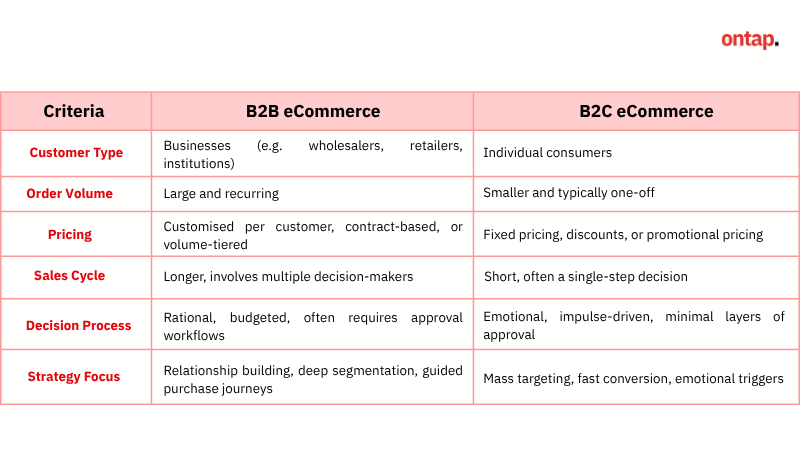
The distinctions between B2B and B2C eCommerce are significant, impacting every aspect of strategy and operations. On one hand, B2B eCommerce involves transactions between companies, such as manufacturers selling to wholesalers or retailers. It typically features large, recurring orders, customised pricing, and longer decision-making processes involving multiple stakeholders. B2B platforms often include features like bulk ordering, account management, and ERP integration.
On the other hand, B2C eCommerce (Business-to-Consumer) is businesses selling directly to individual customers through online stores. Purchases are typically quick, emotionally driven, and made with minimal decision-making layers.
This is why B2B eCommerce strategies differ significantly from B2C approaches, as each caters to distinct audiences, purchasing behaviours, and sales processes. B2C eCommerce strategies are typically mass-oriented, aiming to trigger quick and emotionally driven buying decisions by targeting the right moments in the customer's journey. Meanwhile, B2B eCommerce strategies often focus on understanding each customer segment deeply, nurturing relationships over time, and guiding multiple stakeholders through a longer and more complex buying process.
Essential mindsets for B2B eCommerce businesses to transform
Before embarking on any journey, the right mindset is critical for success. Below are the key mindsets that can empower and accelerate your B2B eCommerce growth.
Prioritise digital-first operations
As technology advances, traditional B2B commerce, which relies on offline transactions through sales reps, phone or email orders, and manual processes, becomes unsustainable for businesses seeking to remain competitive, scalable, and customer-focused. Hence, prioritising digital-first operations is an essential mindset to start with B2B eCommerce as:
-
Buyer expectations have shifted: A recent McKinsey study found that 35% of respondents now prefer B2B eCommerce as their primary sales channel, surpassing in-person interactions (26%) and phone calls (8%). Customer buying patterns have evolved substantially, as enterprise clients increasingly shift their focus from conventional physical storefronts to digital channels.
-
Manual processes slow growth: Manual order processing is time-consuming, error-prone, and resource-heavy. Each phone call or email order ties up staff time, introduces the risk of mistakes, and creates bottlenecks that limit how fast your business can grow.
That’s why the shift toward modern B2B eCommerce is essential, especially when this solution offers greater efficiency, scalability, automation, and enables businesses to operate 24/7, ultimately driving faster growth and stronger customer relationships.
Get more insights about effective strategies to attract customers from traditional B2B to modern B2B eCommerce with our blog: Comprehensive guide to B2B customer adoption in the digital era.
Customer-centric thinking
Every strategy you put on your website should be based on your customers' needs. This means you need to deeply understand your customers’ goals, challenges, and expectations and build an experience that meets them at every touchpoint. This mindset is highly prioritised as:
-
Complex buying cycles require a fast and convenient experience: Unlike one-off consumer purchases, B2B buyers often deal with large order volumes, approval hierarchies, negotiated pricing, and recurring purchases. Creating a digital experience that streamlines these complexities helps save them valuable time and effort.
-
B2B purchases involve multiple stakeholders: From procurement and finance to technical and operational teams, these teams are all working together on your eCommerce website. Each role has its priorities and touchpoints within the buying journey. If even one role encounters friction, such as missing documentation, unclear pricing, or limited access, the entire process can be delayed. A customer-centric approach ensures the platform supports all stakeholders, creating a smooth, coordinated experience across departments.
Learn more: Master B2B CX on digital store with our complete guide: Strategic guide to optimise B2B customer experience across 5 phases of the customer journey.
Commitment to cross-functional alignment
Regardless of the specific function being managed, effective B2B operations require cohesive collaboration across the entire organisation; this is where the mindset of cross-functional alignment becomes essential. It involves unifying teams, processes, and systems (for example, ERP, CRM, and PIM) across the organisation to support the inherently complex and collaborative nature of B2B operations. In B2B, where transactions often involve multiple stakeholders, custom workflows, and extended sales cycles, disconnected systems and siloed teams can significantly hinder both growth and efficiency. This mindset is especially critical for B2B because:
-
Operational efficiency and workflow: Enables smooth execution of complex B2B processes such as bulk ordering, role-based approvals, and negotiated pricing by ensuring alignment between departments and systems.
-
Consistent and scalable customer experience: Delivers a unified experience across touchpoints by aligning sales, service, and support functions, crucial for meeting the high expectations of B2B buyers and managing long-term relationships.
Agility and adaptability
For B2B organisations to succeed in eCommerce, agility must be built into the culture. It requires a willingness to experiment, learn from failures, and pivot swiftly in response to data or market shifts. This mindset is essential as:
-
Customer behaviour and markets constantly change rapidly: Buyer expectations shift quickly, new digital habits, product preferences, or service expectations can emerge almost overnight. This is especially true for B2B markets, which are volatile. Economic shifts, supply chain disruptions, and competitive innovations can prompt businesses to adjust their digital strategies rapidly.
-
Technology evolves constantly: New tools, features, and integrations become available, and your business must be ready to assess and adopt those that offer real value.
7 essential B2B eCommerce strategies to launch your digital storefront
With the right mindset in place, the next step is to turn it into action. In the following section, we outline six essential strategies your business should implement to enhance and scale your digital commerce operations.
To begin, it’s essential to define what a B2B eCommerce strategy entails. A B2B eCommerce strategy is a comprehensive plan for selling products or services online to other businesses through eCommerce platforms. It defines how a business attracts, engages, and serves its B2B customers, who may include wholesalers, manufacturers, distributors, or even different roles within a single organisation. Developing a thoughtful B2B eCommerce strategy enhances the customer experience by tailoring the buying process to business needs and increasing operational efficiency through automation. A strategic approach supports business growth by accommodating new products, markets, and customer segments.
An effective B2B eCommerce strategy should consist of all key focus areas, including user experience, segment personalisation, website architecture, AI-driven operations, and security and compliance. Let’s explore the strategy for each key area, along with actionable steps below.
1. A true B2B user-centred and mobile-optimised eCommerce site
As mentioned, B2B purchases are inherently complex, typically involving multiple stakeholders and interconnected workflows. This complexity makes a user-centred design essential, one that supports real operational needs and enables buyers to complete tasks efficiently and with minimal friction.
Beyond aligning the website with distinct user roles, businesses must also prioritise mobile responsiveness throughout the design process. According to Google, there has been a 91% increase in mobile usage throughout the entire B2B buying journey, making mobile responsiveness a non-negotiable factor in eCommerce website design.
Overall, to create a practical B2B eCommerce experience that meets both functional and usability standards, businesses should adopt the following strategic approaches:
-
Design around real B2B users: Your website must mirror the operational needs of your buyers. This means supporting account hierarchies and B2B-specific features while maintaining an intuitive and friction-free interface.
-
Build for ease of use and speed efficiency: B2B user groups are diverse, with varying behaviours and technical familiarity, many of them frequently access the site via mobile devices. Therefore, ensuring mobile-optimised interfaces and seamless cross-device experiences is crucial. Moreover, as there will be times when your website must handle concurrent access from a large number of users, system performance and scalability should be optimised to manage traffic spikes without causing service interruptions or slowdowns.
With these strategic approaches in place, below are some practical tactics that businesses can apply in real-world scenarios:
B2B-specific functionalities
The first priority is ensuring that your website fully addresses the specific needs and expectations of B2B customers. This includes:
-
A platform that supports core B2B features such as customer-specific pricing, personalised product catalogues, volume-based discounts, quote requests (RFQ), and approval workflows.
-
Your website should integrate all essential systems, such as ERP, CRM, PIM, and WMS, that support critical operations.
-
Depending on specific business needs, companies can also customise additional functionalities to streamline both the B2B buyer’s journey and internal operational workflows.
For more insights into the essential features of a B2B eCommerce website, refer to our blog: B2B eCommerce website features: Essential elements for B2B online success
B2B-user focus design
Design your platform to meet the specific needs of different roles in the B2B buying process. Below are some key user types and tailored design tactics for each:
-
Procurement executive: Responsible for daily ordering, comparing suppliers, checking stock levels, and executing purchases. This role requires speed, accuracy, and adherence to company policies.
→ Tactic: Prioritise streamlined reordering processes, enabling bulk add-to-cart functionality, providing real-time inventory tracking, offering clear access to negotiated pricing, and intuitive approval workflows to reduce time-to-purchase.
-
Finance executive: Focused on tracking expenditures, reconciling payments, managing taxes, and ensuring proper documentation for procurement. They seek transparency and control.
→ Tactic: Highlight total cost visibility, payment flexibility, and spend reporting tools.
-
Approval/manager: Responsible for overseeing budgets and making purchase decisions. They may not place the order, but must review, approve, and ensure purchases are compliant with internal policies.
→ Tactic: Build centralised dashboards to review pending orders and spending history, summary views with product details, prices, and justifications before approval and audit trail visibility for compliance tracking.
In addition to tailoring the experience to specific user roles, B2B businesses need to stay aligned with evolving buyer expectations. According to BigCommerce, 90% of global B2B buyers now expect a B2C-like online experience. Meeting this expectation requires more than functionality; it demands a well-designed interface that feels modern, intuitive, and familiar.
→ Tactic: Focus on clean, consistent UI design that enables users to explore, modify, and backtrack seamlessly. Adopt familiar interaction patterns from B2C platforms to minimise the learning curve and empower users to complete tasks with ease and confidence.
Empower customers through a self-service portal
A robust B2B self-service portal enables buyers to manage their own needs efficiently, thereby reducing their reliance on sales or support. With role-based access, users see only what's relevant to their role. Key features include:
-
Access to order history, invoices, and tracking
-
Ability to re-order with one click
-
Downloadable product specs or compliance documents
-
RFQ submissions and approvals
-
Account-level management: user/role creation, permission settings for each role, billing preferences, and shipping addresses
By reducing friction and putting control in the hands of your customers, a self-service portal increases efficiency while lowering the burden on your support team.
Mobile-optimised and website performance
A poor mobile experience can result in high bounce rates, with Google research saying that up to 62% of consumers say they wouldn’t return to a site after a negative mobile interaction. For B2B platforms, where users increasingly work on the go, mobile responsiveness has a direct impact on engagement and conversions. That’s why tactics for mobile optimisation are:
-
Embrace a mobile-first design approach from the start.
-
Ensure that key B2B workflows, such as product search, quote requests, approvals, and order tracking, are fully functional on mobile devices.
-
Conduct thorough testing across devices and screen sizes to ensure consistency and reliability.
Website performance is equally vital. B2B buyers are task-driven and have limited patience for delays. Slow-loading pages lead to drop-offs, particularly when buyers are working under time constraints. To optimise website performance, you can:
-
App & script optimisation: Remove unused apps and leftover code, replace heavy apps with native features, prevent multiple apps from injecting into the same storefront areas, and defer non-essential scripts to prioritise content loading.
-
Optimise images, video, and fonts: Compress and resize images with modern formats like WebP. Avoid autoplay by using click-to-load video embeds. Limit font families by preloading key fonts or using system fonts with font-display: swap.
-
Theme & site optimisation: Audit and clean up unused templates, sections, and code. Prevent layout shifts by using fixed dimensions for media and pop-ups, and defer non-critical assets for smoother performance.
-
Infrastructure & services: Use fast and reliable hosting, choose a stable DNS provider, leverage caching/CDNs for faster content delivery, and implement robust cybersecurity tools that block threats without slowing down legitimate traffic.

2. Hyper-personalisation experience on the website
Given the diverse nature of B2B eCommerce customers, personalisation has become a critical driver of success. In fact, customer expectations for personalisation are also growing. According to McKinsey, 77% of B2B companies implementing one-to-one personalisation saw an increase in market share, and B2B businesses that personalise their commerce experience achieve conversion rates 5 to 8 times higher than those that don’t.
To capture the full value of personalisation in B2B eCommerce, below are strategic approaches your business can adopt to make it actionable and scalable:
-
Treat segmentation as the foundation of digital strategy: Personalisation starts with understanding your audience. Define customer segments not only by industry or size, but also by behaviour, purchasing cycles, roles, and business objectives.
-
Move beyond generic personas to actionable segments: Use real transactional data, browsing patterns, and account structures to build meaningful buyer profiles. This enables content, pricing, and features tailored to the needs of each segment.
To achieve these results, below are key tactics businesses can apply to implement effective segment-driven personalisation:
Tiered pricing based on customer segments
Tailoring prices by customer segment is a key way to maintain profitability while delivering value to customers. A modern B2B eCommerce website should support:
-
Tiered pricing: Assigns different price levels based on a customer's classification, often tied to factors like order history, loyalty, or account value. Common tiers include Bronze, Silver, and Gold, each offering progressively better pricing or benefits.
-
Contract-specific pricing for long-term clients: This model offers custom pricing tied to a formal agreement or contract with a specific client. Prices are typically negotiated in advance and remain valid for the duration of the contract.
-
Customer group-based price lists: This approach establishes distinct price lists for specific customer groups, including distributors, wholesalers, government buyers, and resellers.
-
Volume-based discounts or pricing by MOQ (Minimum Order Quantity): Volume-based pricing offers lower unit prices for larger order quantities, while MOQ pricing sets a minimum purchase level that must be met to unlock bulk rates.
Role-based personalisation
Role-based personalisation ensures that every user, from procurement officers to finance managers, sees the most relevant information and tools tailored to their responsibilities. Key functions include:
-
Custom dashboards based on user roles (e.g., procurement executive, finance executive, general manager)
-
Access control and permissions based on user roles, restricting or enabling specific actions like placing orders, viewing prices, or managing invoices
-
Role-specific product catalogues showing only relevant items based on department or function
-
Tailored content and messaging, such as contract terms, negotiation tools, or budget alerts per user type
-
Approval workflows that reflect organisational hierarchies and role responsibilities
Quotation options
B2B purchases often require negotiation, making the “Request for Quotation” (RFQ) feature critical in any B2B eCommerce experience. Your B2B eCommerce website should allow customers to:
-
Select multiple products and submit a quotation request
-
Include custom notes or specifications
-
Receive dynamic or manually reviewed pricing in response
-
Track their quotation history and convert quotes into orders
Tailor payment and invoice management flow options
Personalisation in payment and invoice management is essential to meet the varied requirements of different business customers. Your site should support flexible workflows with options such as:
-
Multiple payment methods: Support bank transfers, purchase orders, credit terms (e.g., Net 30/60), and digital options to align with corporate procurement systems.
-
Payment by roles or stages: Allow workflows where buyers draft orders and finance teams approve or complete payment.
-
Automated invoicing: Automatically generate detailed invoices after order or shipment to simplify reconciliation.
-
Recurring billing and scheduled payments: Offer options for subscriptions or repeat orders to support long-term cash flow planning.
-
Invoice history and downloadable statements: Provide centralised access to past invoices and statements for easy tracking and audits.
Learn more: Explore more tailored B2B strategies in action with our blog: B2B eCommerce personalization: Definition, benefits, 6 key strategies and 9 must-have features

3. Lean, modern, and scalable infrastructure
Unlike traditional commerce models, B2B eCommerce must accommodate complex structures, customised workflows and long-term customer relationships, all of which require a robust and flexible foundation. That foundation should be built around several key priorities:
-
Lean infrastructure: Reduces unnecessary complexity, enabling businesses to operate more efficiently and adapt quickly to changing demands.
-
Modern architecture: Enables modularity, seamless integrations, and consistent customer experiences across multiple channels.
-
Scalability: Ensures your technology stack can grow in tandem with your business, whether you're expanding into new markets, serving new customer segments, or introducing new digital services, without the need for costly rework.
Ultimately, a scalable digital infrastructure empowers long-term innovation and adaptability. The following strategic approaches can help your business bring that vision to action:
-
Build with resilience and scale in mind: Prioritise systems that can perform under pressure, whether that’s seasonal demand spikes, sudden growth, or complex customer use cases. A scalable, cloud-native foundation ensures your systems never limit you.
-
Prioritise systems that can adapt: Flexibility is key. Your tech stack should be able to scale and adjust as your business expands, markets shift, or customer expectations evolve.
Below are the key tactics for building a foundation that supports sustainable growth:
Choosing the right architecture for scalable B2B growth
Each platform typically follows a different architectural model. To scale effectively, businesses must select an architecture model that aligns with their technical capabilities, growth ambitions, and the level of customisation required. Traditional monolithic architecture solution, though stable, often lacks the agility needed to support the growing complexity of B2B transactions, multi-channel operations, and ever-changing customer expectations. This is where other modern infrastructures become a game-changer, including:
-
Headless architecture: Decouples the frontend from the backend, allowing developers to build custom experiences across channels, buyer segments, or devices, without backend limitations. For B2B businesses managing multiple brands or regions, it supports scalable multi-storefronts powered by a centralised backend, ensuring consistency, reducing duplication, and improving operational efficiency.
-
Composable architecture: Embraces a modular, API-first approach where businesses can select and integrate best-of-breed services (e.g., PIM, CMS, checkout) into a flexible, tailored stack. This enables rapid innovation and easy adaptation without overhauling the entire system.
-
Microservice architecture: Breaks down the eCommerce system into small, independent services that handle specific business functions (e.g., pricing, inventory, search). This architecture offers maximum flexibility, scalability, and resilience, ideal for large or rapidly evolving B2B environments.
Make sure to evaluate which architecture your chosen platform is built on carefully, and whether it aligns with your business needs. It’s also essential to assess your internal technical capabilities to ensure the selected infrastructure is feasible to implement and scale effectively. If your in-house resources are limited, consider partnering with experienced digital agencies to bridge the gap and ensure a successful implementation.
Cloud hosting
For businesses aiming to scale resources on demand, reduce infrastructure costs and complexity, and respond quickly to traffic spikes, cloud hosting is a highly worthwhile solution to consider. With its auto-scaling capabilities, this approach offers the scalability, flexibility, and performance required to remain competitive in today’s fast-paced digital landscape.
Explore how On Tap’s hosting service enables auto-scaling and zero downtime, helping your B2B site stay fast, stable, and always available.

4. Omnichannel consistency and sales-marketing alignment
Your next priority is ensuring consistent brand, messaging, and value delivery across all digital touchpoints for customers. With B2B buyers engaging across various channels, owned, earned, and paid media, a lack of cohesion can weaken trust and reduce conversions. In fact, according to McKinsey, today’s B2B customers typically use 10 or more channels to interact with suppliers, making consistency more critical than ever. A strong strategy should include:
-
Leveraging a full media mix: Build and maintain a consistent presence across all relevant media types, owned, earned, and paid. Each touchpoint should reinforce the same brand identity and core value proposition, tailored for the context of the channel but aligned in tone and message.
-
Deliver a unified brand message: Your value proposition should remain consistent across all digital and offline channels. Whether a lead encounters your brand on LinkedIn, in a webinar, or via a sales call, they should immediately recognise who you are, what you offer, and why it matters to them.
Below are key tactics B2B companies can consider to increase visibility and engagement:
SEO optimisation for the website
SEO is one of the most cost-effective ways to use owned channels and attract high-intent B2B buyers. Since many decision-makers begin their research online, ranking well for relevant keywords can put your brand in front of them early in the buying process. Key B2B SEO tactics include:
-
Targeting long-tail, industry-specific keywords
-
Optimising product pages, landing pages, and category content for search engines
-
Creating educational blog posts, whitepapers, and how-to guides to capture organic traffic
-
Using technical SEO best practices: fast load speeds, mobile-friendliness, clean URL structures
Social media
Social media is also an effective owned channel for attracting B2B customers, not just for brand awareness but also for relationship-building and driving traffic back to your eCommerce site. Key tactics include:
-
Share a mix of content types (promotional, industry insights, educational posts, etc.)
-
Utilise social proof (customer testimonials, reviews, case studies)
-
Use platforms strategically based on audience behaviour: Focus on LinkedIn for thought leadership and product updates, and consider YouTube or short-form video content for product demonstrations or FAQs.
Email marketing
Email remains a powerful B2B marketing tool for nurturing leads, managing accounts, and driving retention. Personalised, timely emails help guide prospects through complex decisions. Effective tactics include:
-
Segment contacts by industry, role, or buying behaviour
-
Send targeted nurture campaigns based on the customer journey stage
-
Use triggered emails for RFQ follow-ups, reorder reminders, or cart abandonment
-
Include valuable content: product updates, insights, case studies, or webinars
Referral marketing
To encourage referrals, businesses can consider launching dedicated referral campaigns that incentivise satisfied customers to refer peers, business partners, or industry contacts. Offer rewards that are meaningful in a B2B context, such as account credits, service upgrades, exclusive access to premium resources, or co-branded promotional opportunities.
Paid channels
Paid marketing channels play a vital role in amplifying visibility, especially when you need to reach new audiences or promote time-sensitive campaigns. In B2B eCommerce, where the buying cycle is longer and decision-makers are more niche, precision targeting is key, and that’s precisely where paid channels excel. Key paid channels you can consider using are:
-
Google Search: Capture high-intent users actively looking for solutions. These ads are great for driving traffic to both product pages and helpful content like guides or case studies.
For example, a procurement manager at a manufacturing company searches for “bulk industrial machine parts supplier.” Your Google Search ad appears and directs them straight to a product landing page that highlights key features, pricing tiers, and a clear CTA to request a quote, capitalising on their strong purchase intent.
-
Display Ads: Boost brand visibility across a broad network of websites and apps. Display ads are also powerful for retargeting previous visitors and maintaining top-of-mind awareness.
For example, a procurement officer who previously visited your B2B website for industrial machinery parts sees your banner ad while reading an article on another machinery industry review website. This will remind them of your products and bring them back to complete their purchase of your solution.
-
LinkedIn Ads: The ideal social media platform for B2B. You can target by industry, job title, company size, and more, which is excellent for reaching decision-makers and influencers in specific sectors.
A well-executed omnichannel marketing strategy ensures your brand shows up consistently across every touchpoint — from search and social to email and paid media. At On Tap, we deliver digital marketing solutions tailored for B2B eCommerce, helping you reach the right buyers with the right message at every stage.

5. AI-driven operating leverage for automation and customer insight
With the rapid advancement of AI, particularly in automation and analytics, B2B businesses must adopt a straightforward strategic approach to unlock their potential fully. In fact, According to McKinsey, B2B sales leaders report a wide range of benefits from AI adoption, including increased efficiency (e.g. saving employee time, accelerating processes) at 24%, top-line growth (e.g. boosting sales and gaining market share) at 22%, and enhanced customer experience (e.g. greater personalization, faster response times) also at 22%. To unlock these key benefits, the strategic approach should include:
-
Integrate AI into existing workflows: AI should enhance, not disrupt, your current operations. Ensure that AI tools, such as sales enablement platforms or analytics dashboards, seamlessly integrate with your CRM, ERP, or eCommerce systems to boost adoption and operational efficiency.
-
Maintain human-AI collaboration: While AI excels at automation, human oversight remains essential, especially in sales and support. Combine AI-powered insights with human judgment to deliver a balanced, dependable experience for both internal teams and customers.
-
Invest in data infrastructure: AI relies on high-quality data to function effectively. Businesses must organise, centralise, and clean their data, especially customer behaviour, order history, and product details, to enable accurate predictions and meaningful personalisation.
With this strategic foundation in place, your teams can further apply AI across key use cases such as:
-
Intelligent product recommendations: Use AI to suggest relevant products based on customer behaviour, purchase history, and industry needs, such as recommending compatible accessories or restock items by segment.
-
Advanced analytics for customer insight: Apply machine learning to detect patterns in buyer behaviour, predict future actions, and continuously optimise business decisions through deeper customer insight.
-
Sales enablement tools: Equip sales teams with AI-powered interfaces (e.g., private ChatGPT trained on internal data) to retrieve insights, analyse customer interactions, and boost efficiency.
-
AI-powered customer support: Deploy custom-trained AI chatbots to handle complex product queries, order updates, and support requests 24/7, enhancing customer service while reducing workload.
-
AI-generated content: Use generative AI to scale content creation (e.g., product descriptions, blogs, emails) with accurate, relevant messaging tailored to your business and audience.
Learn more about how to unlock the full potential of AI in your B2B eCommerce site with On Tap’s AI solutions.

6. Security and compliance as a growth enabler
In B2B eCommerce, where transactions involve significant value and sensitive business data, security is a key factor in building buyer confidence and earning long-term trust. Failing to protect data, ensure privacy, or meet compliance standards can lead to legal risks and lasting damage to your brand. To address this effectively, your strategy should include:
-
Adopt a “security-by-design” mindset: Security should be embedded from the earliest stages of platform development and architecture planning, not treated as an afterthought. This proactive approach helps reduce risk while increasing system resilience.
-
Align with global and regional standards: Compliance with regulations such as GDPR, CCPA, PCI-DSS, and SOC 2 is essential, particularly for businesses operating across borders. Aligning with these standards demonstrates professionalism and builds credibility with buyers.
-
Build transparency into your operations: Proactively communicating your security practices, data usage policies, and compliance certifications helps establish trust with prospective customers, particularly for procurement teams evaluating long-term vendor partnerships.
With a clear strategy in place, your next step is to execute the following tactics:
-
Use enterprise-grade SSL and encryption protocols: Ensure all data exchanges are encrypted via SSL/TLS and that sensitive information is stored and transmitted securely.
-
Implement secure payment gateways: Choose payment solutions that are PCI-DSS compliant, support tokenisation, and offer fraud detection mechanisms.
-
Enforce access control and authentication: Adopt role-based access control (RBAC), multi-factor authentication (MFA), and single sign-on (SSO) to protect back-office systems and customer accounts.

7. Establish trust and repeat business purchase
In B2B eCommerce, sustainable growth is built on trust. While acquiring new customers is essential, long-term value comes from nurturing relationships that lead to repeat purchases. B2B buyers are not just looking for a vendor; they’re looking for a reliable, strategic partner who can consistently deliver, communicate transparently, and support their evolving business needs. Trust, once established, becomes a powerful driver of retention, account expansion, and brand advocacy. To earn and sustain that trust, businesses should adopt a strategic approach centred on:
-
Transparent and real-time communication: Maintain openness at every stage of the customer journey, especially post-purchase. Proactively providing accurate, timely updates reduces uncertainty and gives buyers a greater sense of control.
-
Operational reliability: Ensure accurate product availability, dependable delivery timelines, and minimal order disruption through strong backend processes and inventory management.
With this strategic foundation in place, the following tactics can help execute it effectively:
-
Ensure post-purchase transparency and real-time updates: Provide clear, real-time visibility into shipping timelines, carrier details, and expected delivery dates. If delays occur, proactively notify the customer, offer resolutions, and keep communication consistent across channels.
-
Implement a loyalty program tailored for B2B buyers: Design a rewards program that incentivises repeat purchases, long-term partnerships, and account expansion. This could include tiered benefits, volume-based discounts, exclusive access to new products, or co-marketing opportunities.
-
Provide dedicated account support and relationship management: Assign account managers or success teams to key clients to offer tailored support, strategic guidance, and regular business reviews.
-
Showcase proven experience and social proof: Build credibility by highlighting successful case studies, client testimonials, industry certifications, and long-standing partnerships.
7 key steps to start a B2B eCommerce website with strategic impact
Now that we’ve explored strategic approaches and tactics across key areas, it’s time to shift from planning to actual execution. In this section, we’ll walk through the essential steps to building a B2B eCommerce website that not only functions effectively but also aligns with your broader business goals and delivers real strategic impact.
1. Define clear business objectives
To kick-start your B2B eCommerce journey, it’s essential first to understand your starting point and then determine what your business needs explicitly from a B2B website in that context. This clarity allows you to prioritise effectively and focus your efforts where they’ll have the most significant impact. For example:
-
A B2C brand entering B2B may prioritise building tailored workflows, such as RFQs, account-based pricing, and tiered access, designed to serve business buyers without disrupting the retail experience.
-
A traditional B2B business going digital should focus on creating a clear onboarding process for both internal teams and customers, while investing in automation to streamline operations and reduce manual workload.
-
A new venture building from scratch may concentrate on marketing and brand credibility through its website to gain early trust, while also ensuring operational stability as a foundation for long-term scalability.
Once you’ve identified your context, define what success looks like. Common objectives may include:
-
Growing revenue through new digital sales channels
-
Expanding into new customer segments or regions
-
Reducing operational inefficiencies and costs
-
Improving customer retention with a better buying experience
-
Enabling 24/7 self-service for accounts and reorders
Remember to tie these goals to measurable KPIs such as sales volume, average order value (AOV), customer acquisition cost (CAC), and repeat purchase rate to track progress effectively.
2. Segment your customers
Customer segmentation is the first area to focus on when aiming to understand your customers. It involves dividing your customer base into smaller groups with shared characteristics, enabling more targeted and personalised service efforts. This practice is especially critical in B2B, where customer relationships tend to be complex, spanning various industries and involving multiple roles within each organisation. Several segmentation methods can be considered:
-
Demographic segmentation: Group customers based on factors such as industry, company size, annual revenue, job function, or management level. This enables the creation of highly targeted messages and content for the right decision-makers.
-
Firmographic segmentation: Analyse company-specific attributes, such as the number of employees, market share, business lifecycle stage, or funding status, to better understand business needs and purchasing power, enabling the delivery of tailored promotions.
-
Behavioural segmentation: Segment customers by their interactions with your products or services, including purchase history, website activity, social media behaviour, decision-making patterns, and research habits. This helps identify high-value customers and implement personalised retention strategies, such as targeted emails for inactive users.
-
Segmentation by buyer committee role: In B2B, purchasing decisions often involve multiple stakeholders. This method segments individuals based on their role in the buying process, such as user, initiator, influencer, budget owner, or decision-maker, allowing for tailored messaging.
3. Conduct comprehensive research on your target audience and market
Simple segmentation alone isn’t enough to build an effective customer-centric strategy. To truly meet buyer expectations and create a relevant B2B eCommerce experience, businesses must conduct in-depth research on both their customers and the market they operate in. This ensures your website strategy is grounded in real-world insights and aligned with industry dynamics. Key steps include:
-
Internal research: Go beyond basic segments by mapping out typical B2B purchasing workflows, approval chains, and buying behaviours. Hence, you can truly understand how your target buyers evaluate vendors, place orders, and interact after the sale. This groundwork helps your business develop buyer personas that reflect not just who your customers are, but also what drives them, their pain points, motivations, budget constraints, and digital habits.
-
Competitive analysis: Study your competitors’ eCommerce platforms to understand their strengths and weaknesses. Review their site structure, customer reviews, pricing models, payment terms, and value-added services (such as shipping, customer support, or technical resources). Identifying where they fall short opens the door to differentiation.

4. Choose a suitable B2B eCommerce platform
Selecting the right eCommerce platform is one of the most critical decisions in building a B2B site with long-term value. Your platform will impact the user experience and also how efficiently your business can scale, integrate, and adapt to future needs. To make the right choice, you’ll need to evaluate both the technical foundation and the functional capabilities your business requires.
-
Define the right platform model and architecture:
-
Start by selecting a platform model that aligns with your business goals, available resources, and desired level of control. Common options are to decide between SaaS (faster setup, less maintenance), open-source (more flexibility and power) or PaaS (balance of control and scalability with managed infrastructure).
-
Your platform’s architecture also plays a critical role in how well your B2B site performs and scales. Monolithic architectures suit businesses with straightforward needs and limited technical resources. Headless setups give you more flexibility to customise frontend experiences across channels. For complex operations, composable or microservice architectures allow you to build modular, scalable systems that evolve as your business grows.
-
B2B feature readiness: Check if B2B functions you likely need, such as account-based pricing, RFQs, role-based access, or custom checkout, are built-in, available via apps, or require custom development. This directly impacts development time, scalability, and total cost of ownership.
The current market offers a wide range of B2B eCommerce platforms, each catering to different business sizes and requirements. Learn more with our detailed guide on how to choose the right platform for your needs here: 10 best B2B eCommerce platforms for growth and scaling your business
5. Map your website development process
Once your choice of platform is clear, the next step is mapping out a straightforward website development process. While the level of complexity varies depending on your business model and scale, most projects follow a similar set of core steps:
-
Hosting: Select a reliable hosting solution that meets your performance, security, and scalability requirements.
-
Choose a theme: Select a website theme or base design that suits your industry and branding. A good theme should not only be visually aligned with your brand but also support responsive design and intuitive user flows for B2B buyers.
-
Set up and configure features: Install and configure essential B2B features. Most platforms offer built-in features or third-party apps to cover these needs.
-
Customise features if needed: If your workflows or user experience require more than what off-the-shelf tools provide, custom development may be needed. This includes modifying checkout flows, building personalised dashboards, or adapting order management processes.
-
System integration: Ensure your website connects seamlessly with key back-end systems such as ERP, CRM, inventory, and accounting platforms. These integrations are crucial for data accuracy, operational efficiency, and a unified customer experience.
-
Testing and afterwards: Before launch, conduct thorough testing across devices and user roles to ensure everything works as intended. After going live, monitor performance, fix bugs, and continuously optimise the site based on customer feedback and analytics.
For deeper insights, explore our complete guide to building a successful B2B eCommerce website: B2B eCommerce website development: 11-step guide for the best customer experience & sales
6. Learn from best practices and real-world success stories
Always remember to study proven B2B eCommerce case studies and industry best practices to gain valuable insights and inspiration. These success stories highlight the importance of customisation, seamless integration, and customer-centric approaches that drive adoption and revenue growth. By analysing how top brands overcome challenges and scale their eCommerce operations, you can apply relevant lessons to your strategy and avoid common pitfalls.
For practical examples on building a future-ready B2B store, check out our blog: 14 B2B eCommerce best practices: 14 B2B eCommerce best practices for online store success
7. Consult with a trusted eCommerce agency
Partnering with an experienced B2B eCommerce agency or consultant can accelerate your strategy development and implementation. These experts bring deep industry knowledge, help select the best platforms and tools, customise solutions to your needs, and ensure smooth integration with your existing systems. They also provide ongoing support and optimisation, allowing you to focus on your core business while benefiting from proven best practices and cutting-edge technologies.
Conclusion
Overall, this guide equips you with the foundational knowledge and actionable strategies needed to understand B2B eCommerce, implement an effective digital strategy, and confidently build a website that drives growth and long-term success.
While understanding B2B eCommerce strategies is essential, achieving real impact demands expert execution and industry experience. As mentioned, collaborating with a trusted partner can bridge this gap and accelerate your digital transformation journey. As a proud member of the B2B eCommerce Association, On Tap, a certified B2B eCommerce agency, offers nearly two decades of experience and a team of 400+ specialists to deliver full-service, end-to-end solutions for B2B. From strategy to implementation and long-term support and consultation, we are delighted to help your business turn vision into value. Ready to build your smarter B2B eCommerce experience? Get in touch with On Tap’s team today.