

As the eCommerce market grows faster than ever, many enterprises are launching their own digital stores. However, as businesses scale, many discover that their platform cannot effectively support high traffic volumes, streamline operations across teams, enable international selling, or power custom experiences across multiple storefronts and channels - ultimately leading to costly replatforming. In fact, 77% of large companies expressed a strong sense of urgency to migrate to a new eCommerce platform in 2025, driven by scalability limitations and poor user experience on their current systems. Therefore, ensuring the right enterprise eCommerce platform from the start is critical to avoid unnecessary expenses and to support sustainable growth.
To support enterprises in choosing the most suitable platform from the outset, this report highlights the top 8 enterprise eCommerce platforms, carefully curated by our eCommerce experts:
2. Carbon
3. Shopify Plus
For each platform, we cover all the essential factors to evaluate, including enterprise-grade capabilities, customisation options, performance, security, long-term costs, and ecosystem support. With this information, you can select the platform that best fits your enterprise’s needs and avoid the expense and disruption of a later replatforming.
Key factors to evaluate when choosing an enterprise eCommerce platform
Choosing the right enterprise eCommerce platform lays the foundation for long-term growth, competitiveness, and operational efficiency. It is less about fixing short-term gaps and more about ensuring the platform can support evolving business needs without adding unnecessary complexity, cost, or the risk of replatforming later.
Below are factors that enterprises should consider:
Advanced enterprise features and integration capabilities
A capable enterprise eCommerce platform should do more than support basic online selling. It must enable efficient operations across teams, integrate with core systems such as ERP and OMS, support international expansion across multiple markets, and deliver consistent, custom experiences across storefronts and channels - all while maintaining performance at scale.
-
B2B and B2C readiness: Enterprise businesses often serve diverse customer types, from wholesale clients to individual consumers. Choose a platform with built-in features that support both B2B and B2C models, allowing flexibility as your company scales.
-
International growth built-in support: Enterprises often operate across multiple regions and markets. Look for a platform that supports international expansion, whether through multi-language, multi-currency, and tax management in a single storefront or via multiple localised stores.
-
AI-powered capabilities: AI has become a global trend, and customers increasingly expect personalised, seamless experiences. For enterprises managing large volumes of data and interactions, AI can automate repetitive tasks, deliver personalised recommendations, and provide predictive insights for pricing and demand. AI can also enhance customer engagement through chatbots or virtual assistants. Selecting a platform that covers these competencies can boost business efficiency and meet evolving customer expectations.
-
Operational management abilities: Enterprise businesses handle high volumes of orders, complex catalogues, and multi-team workflows. Therefore, a platform with intuitive, role-based admin controls, automated workflows, and streamlined order and catalogue management will enable operational efficiency and reduce manual errors.
-
Advanced analytics: For enterprises, this feature is crucial due to the scale and complexity of their operations. The platform should equip deep, organisation-wide insights into sales performance, customer behaviour, and operational efficiency.
-
Integration connectivity: Enterprise platforms must seamlessly connect with external systems such as ERP, CRM, WMS, and marketing tools. Strong integration functions reduce data silos, streamline workflows, and ensure that orders, inventory, and customer information remain consistent across all channels.
Customisation ability
Customisation determines how well an eCommerce platform aligns with your enterprise’s specific requirements. This is not just about website appearance, like changing text, image or colours, but its underlying structure and functionality. A truly enterprise-ready platform should have:
-
Customisable features flexibility: Enterprises often have complex and evolving requirements across both customer needs and internal business processes. A platform that allows teams to customise or modify features (for example, adding a new payment method for a regional market or flexible pricing tools) to help businesses adapt quickly without disrupting operations.
-
Personalised experience and front-end control: For enterprise businesses, the ability to customise the storefront and user journeys on their website is critical, as they often serve diverse customer segments with different needs, expectations, and buying behaviours. Hence, businesses should choose a platform that offers control over templates, dynamic content, and customer segmentation to deliver personalised experiences across regions, customer types, and buying stages.
Performance and scalability
Performance is a key factor in evaluating an enterprise eCommerce platform. It influences both customer experience and operational efficiency. Beyond page speed, actual performance reflects the platform’s stability, scalability, and capacity to support growth without compromising quality.
-
Frontend and backend efficiency: Evaluate the platform’s performance from both user-facing and system-facing perspectives.
-
On the frontend, ensure a responsive design and optimise for speed across devices (both desktop and mobile) to minimise bounce rates and improve user satisfaction.
-
On the backend, assess whether the platform can sustain consistent performance and fast load times under enterprise workloads, including concurrent users, multi-region fulfilment, and API-heavy integrations.
-
Scalable infrastructure: Choose a platform built on modern, high-performance infrastructure that can grow alongside your business. It should handle increased traffic, larger transaction volumes, and an expanding product catalogue without compromising performance or modern stability.
Security and compliance
Security and compliance are fundamental to protecting customer trust and ensuring business continuity. An enterprise eCommerce platform must not only safeguard sensitive data but also meet global and regional regulatory requirements.
-
Adherence to industry standards: Ensure the platform complies with major security frameworks such as PCI DSS for payment data protection and privacy regulations like GDPR and CCPA.
-
Comprehensive protection tools: Look for built-in fraud-prevention mechanisms, audit logs, and granular user permission controls to detect suspicious activity, track system changes, and manage data access effectively.
-
Ongoing updates and monitoring: Choose a platform that provides regular security patches, threat monitoring, and automated vulnerability management to minimise risks.
Total cost of ownership
Evaluating the total cost of ownership (TCO) helps enterprises make informed long-term decisions beyond the platform’s upfront price. TCO includes all direct and indirect expenses involved in building, operating, and maintaining your enterprise eCommerce platform over time. To be specific:
-
Licensing and subscription fees: Depending on the platform, pricing can be fixed, usage-based, or revenue-tiered. Some enterprise platforms allow room for negotiation, especially for multi-year contracts, while others apply fixed pricing with limited flexibility. Be mindful of potential hidden costs such as transaction fees, additional users, or charges for exceeding API limits.
-
Development and implementation costs: This covers the setup, configuration, and customisation needed to align the platform with your business processes. It may include feature extensions, integration with ERP or CRM systems, and data migration. The more complex the enterprise architecture, the higher these costs can be.
-
Apps, themes, and third-party extensions: Most platforms rely on external apps or plug-ins to expand functionality, which come with recurring subscription fees or one-time purchase costs. Premium themes or design templates can also add to the total investment.
-
Maintenance and operational costs: Beyond launch, ongoing costs can include system hosting, updates, security patches, bug fixes, and technical support. Enterprises should clarify whether these are included in the subscription or billed separately. Regular maintenance is essential to maintain performance, security, and compliance standards; neglecting it can lead to higher expenses later.
Long-term reliability
Choosing a reliable enterprise eCommerce platform means ensuring it will continue to evolve and support your business in the long run. This includes:
-
Continuous improvement: Select a platform that regularly updates its features and technology.
-
Ecosystem and partner network: Opt for a platform with a rich ecosystem of apps, modules, and partners, indicating strong maturity and flexibility for native feature customisation.
-
Platform commitment: Evaluate whether the platform’s support team is dedicated to long-term service and provides reliable 24/7 support.
Selecting the right enterprise eCommerce platform is a critical business decision, as the wrong choice can drain enormous resources, budgets, and time. Let our expert with 19 years of eCommerce experience help you align your business vision with the right solution. Explore our eCommerce consultation service today!
Top 8 enterprise eCommerce platforms driving long-term digital growth
Below are the top 8 eCommerce platforms we recommend for enterprises - complete with key criteria for easy comparison.
✓ = Strong advantage △ = Moderate or situational ✗ = Limited or less suitable
Let’s review the details of each platform so you can decide with clarity.
Adobe Commerce
Adobe Commerce (formerly Magento Commerce) is a robust eCommerce platform designed for enterprise-scale operations, offering extensive customisation and advanced workflow capabilities, including purchase order approvals and AI-driven product recommendations. It caters well to both B2B and B2C models and supports complex multi-site deployments.
The platform is available in two main editions: Adobe Commerce Cloud Service (a fully managed solution where hosting, upgrades, and maintenance are handled for you) and Adobe Commerce on Cloud (a more customisable solution, but your business has to handle maintenance/updates and performance optimisation). While its flexibility in customisation is a key strength, Adobe Commerce, regardless of the edition, often requires significant implementation effort, resulting in a longer time-to-market (typically months).
Features included
|
Features |
Coverage in Adobe Commerce |
|
Corporate account hierarchy |
✓ Included |
|
Advanced filtering and search |
✓ Included |
|
Customer-specific product catalogues |
✓ Included |
|
Customer-specific pricing and payment terms |
✓ Included |
|
Request-for-Quote (RFQ) and negotiation |
✓ Included |
|
Order approval workflow and PO checkout optimised |
✓ Included |
|
Customer self-service portal |
✓ Included |
|
Quick reorder and saved purchase lists (requisition lists) |
✓ Included |
|
Loyalty and incentive programme |
✓ Included |
|
Advanced analytic features |
✓ Included |
|
Enhanced SEO features |
✓ Included |
|
Multi-store/ Multi-site |
✓ Included |
|
AI capabilities |
✓ Included |
System integration capabilities
Adobe Commerce supports a variety of integration methods. In addition to native integration, further systems can be achieved through other ways, such as third-party extensions, custom modules, middleware, APIs, and connectors.
Customisation flexibility
Adobe Commerce offers extensive customisation through its modular architecture and APIs, supporting both native and third-party extensions. This allows enterprises the flexibility to evolve their digital store based on their needs.
Performance and scalability
Adobe Commerce as a Cloud Service automatically scales resources to handle traffic spikes, delivers continuous updates, and ensures fast, global storefronts through edge deployment. In contrast, self-hosted deployments rely on customer-managed infrastructure. The platform also supports global operations and multi-store management, making it highly scalable for enterprises with expanding or complex sales channels.
Security and compliance
Adobe Commerce upholds enterprise-grade security and compliance standards, supporting major certifications such as PCI DSS and GDPR. The platform includes managed WAF and CDN protection, along with built-in tools like role-based admin controls, logging, and proactive patching. Beginning in 2026, Adobe will issue monthly security patches to strengthen platform resilience further.
Total cost of ownership
Adobe Commerce’s TCO depends on scale and deployment type. Key cost drivers include licensing, development, hosting, and ongoing maintenance. License fee based on GMV and Average Order Value (AOV). Hosting is included for cloud customers, while self-hosted merchants must account for additional infrastructure expenses.
Maintenance is also a significant expense, especially since Adobe releases monthly security patches, which can increase costs over time. Understanding this pain point, On Tap has started offering free upgrades for all our Adobe Commerce and Magento Open Source merchant customers. This helps businesses allocate resources more effectively, focusing on growth, innovation, and customer success, rather than routine updates.
Continuous improvement and ecosystem
Adobe Commerce boasts one of the largest eCommerce communities, offering 24/7 support and access to a global network of certified solution partners. Its ecosystem includes over 3,000 extensions on the Adobe Marketplace, and numerous hosted SaaS add-ons.
Carbon
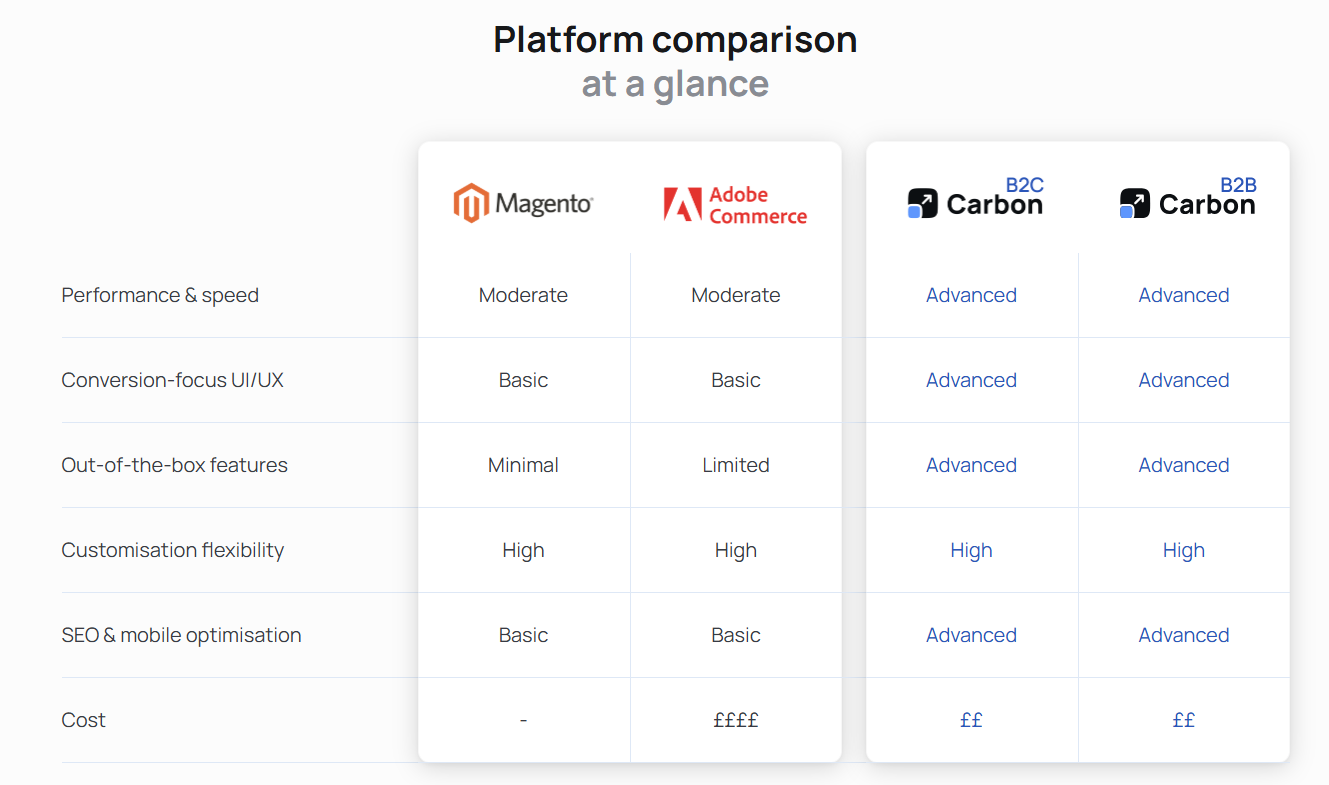
Carbon is a rapid-deployment eCommerce solution developed by On Tap, a leading agency with 19 years of experience in the eCommerce market. Built on the foundations of Hyvä, it comes with 100+ best-practice features for B2C and B2B pre-integrated. This enables faster development in as fast as four weeks. With free lifetime upgrades included, businesses can enjoy a seamless, hassle-free experience.
Features included
|
Features |
Coverage in Carbon |
|
Corporate account hierarchy |
✓ Included |
|
Advanced filtering and search |
✓ Included |
|
Customer-specific product catalogues |
✓ Included |
|
Customer-specific pricing and payment terms |
✓ Included |
|
Request-for-Quote (RFQ) and negotiation |
✓ Included |
|
Order approval workflow and PO checkout optimised |
✓ Included |
|
Customer self-service portal |
✓ Included |
|
Quick reorder and saved purchase lists (requisition lists) |
✓ Included |
|
Loyalty and incentive programme |
✓ Included |
|
Advanced analytic features |
✓ Included |
|
Enhanced SEO features |
✓ Included |
|
Multi-store/ Multi-site |
✓ Included |
|
AI capabilities |
✓ Included |
System integration capabilities
Carbon takes an API-first approach, enabling seamless integration with essential enterprise systems, including ERP, WMS, CRM, and accounting systems. This ensures that data flows smoothly across the digital store and backend operations.
Customisation flexibility
While Carbon offers extensive built-in functionality, it remains highly extensible and can be customised by any developer. Businesses can customise pricing logic, workflows, and storefront design to align with their specific distribution models and operational needs.
Performance and scalability
Carbon features a lightweight architecture that significantly enhances load times and overall user experience. Paired with optimised Hyvä frontend and On Tap Cloud’s fully managed, auto-scaling hosting, it delivers consistent speed, stability, and scalability even during peak traffic.
Security and compliance
Carbon provides standard security and compliance. On Tap also handles all technical support, regular updates, and security patches, ensuring your eCommerce store runs smoothly and stays up to date.
Total cost of ownership
Carbon offers a single annual license that includes hosting, maintenance, and support. With deployment achievable in weeks, the predictable cost structure becomes even clearer. The merchant also benefits from free lifetime upgrades, avoiding recurring version-update costs and time - a frequent pain point on open-source platforms.
Continuous improvement and ecosystem
Carbon is fully compatible with Magento/Adobe Commerce’s extensive extension ecosystem and is supported by On Tap’s team of 400+ eCommerce experts, delivering B2B and B2C solutions to merchants worldwide. Carbon customers enjoy continuous 24/7 support and proactive optimisations, ensuring not only short-term assistance but lasting success for their businesses. By adopting Carbon, enterprises also gain access to the wider On Tap ecosystem, which includes advanced tools such as:
-
On Tap Cloud: A fully managed, performance optimised hosting solution for Carbon, designed to maximise performance, scalability and reliability at an enterprise standard.
-
API-first Integration Flow: An iPaaS solution designed to connect eCommerce platforms with external systems such as ERP, WMS, CRM, and accounting. As an API-first tool, it enables fast, reliable real-time data sync between systems.
-
AuditIQ: A solution that operates 24/7 to monitor performance, security, and configuration health of your eCommerce website. It alerts merchants before potential issues affect sales or customer experience, providing a complete, real-time view of website health.
Shopify Plus
Shopify Plus is Shopify’s enterprise-grade solution, purpose-built for large merchants. As a fully managed SaaS platform, it handles hosting, security, and updates automatically, while providing advanced customisation options, automation tools, and built-in B2B features to support enterprise-level scalability.
It works best for businesses that prioritise ease of use, rapid deployment, and centralised management within a single admin. However, its constrained flexibility and dependence on third-party apps make it less ideal for complex or heavily customised setups.
Features included
|
Features |
Coverage in Shopify Plus |
|
Corporate account hierarchy |
✓ Included |
|
Advanced filtering and search |
✗ Not available |
|
Customer-specific product catalogues |
✓ Included |
|
Customer-specific pricing and payment terms |
✓ Included |
|
Request-for-Quote (RFQ) and negotiation |
✓ Included |
|
Order approval workflow and PO checkout optimised |
✓ Included |
|
Customer self-service portal |
✓ Included |
|
Quick reorder and saved purchase lists (requisition lists) |
✓ Included |
|
Loyalty and incentive programme |
✗ Not available |
|
Advanced analytic features |
✓ Included |
|
Enhanced SEO features |
✓ Included |
|
Multi-store/ Multi-site |
✓ Included |
|
AI capabilities |
✓ Included |
System integration capabilities
Shopify Plus supports integrations through APIs, Shopify Flow, and third-party apps, but complex systems often require middleware or custom development due to API rate limits and restricted backend access.
Customisation flexibility
Shopify Plus offers greater customisation, though within certain boundaries. It enables flexibility across storefront design, product pages, and branding through tools like Liquid. For even greater flexibility, Shopify Plus supports headless commerce, allowing businesses to customise front-end experiences while keeping the backend fully stable. However, core elements such as URL structures, checkout flow, and product variant limits still have certain restrictions.
Performance and scalability
Shopify Plus provides enterprise-grade performance and reliability through a fully managed infrastructure that scales automatically to handle extensive catalogues and peak traffic. Its global CDN, built-in caching, and multiple points of presence ensure fast storefront response and robust checkout performance. For highly specialised backend workflows, additional middleware or headless setups may be needed. The platform also supports up to 9 expansion stores, over 200 inventory locations, and global multi-currency and multi-language capabilities, enabling confident international growth.
Security and compliance
Shopify Plus ensures enterprise-grade security and compliance, including PCI DSS certification, SOC reports, and GDPR-ready tools. Built-in features such as staff access controls, activity logs, and fraud analysis help protect merchant operations, while additional capabilities can be added via third-party apps. Shopify Plus also manages platform updates, patching, and monitoring, providing continuous security without requiring merchant intervention.
Total cost of ownership
Shopify Plus follows a subscription-based pricing model, starting at approximately USD 2,300/month (3-year contract) or USD 2,500/month (1-year contract). This base fee includes hosting, platform maintenance, and access to native B2B features. However, for merchants surpassing certain revenue thresholds, Shopify Plus applies a variable pricing structure based on a percentage of gross merchandise value (GMV). This model helps keep initial costs low but can lead to higher total expenses as sales volume increases.
In addition to the licence fee, enterprises should also account for costs related to third-party apps, premium themes, developer support for customisation, and transaction fees. While the SaaS model reduces infrastructure and maintenance costs, cumulative spend on add-ons and extensions can significantly increase overall TCO.
Continuous improvement and ecosystem
Shopify Plus benefits from frequent, centrally managed updates that improve platform features, store performance, and overall commerce capabilities. Its large app marketplace (~13,000 apps) and network of certified partners (>100,000 partners globally) provide extensive tools, integrations, and support for merchants. Plus, customers also received dedicated support with Launch Engineers and Merchant Success Managers. The broad pool of developers, theme providers, and agency partners also makes it easier to find talent and implement solutions compared with more specialised enterprise platforms.
For more information about how Shopify fits with enterprise, check out our latest blog.
BigCommerce Enterprise
BigCommerce Enterprise is a SaaS ecommerce platform built for mid-market and enterprise brands, offering robust APIs, headless capabilities, and built-in features. It delivers flexibility without the complexity of on-premise management. While suitable for most enterprise needs, some advanced options still require dependence on third-party apps or self-customisation.
Features included
|
Features |
Coverage in BigCommerce Enterprise |
|
Corporate account hierarchy |
✓ Included |
|
Advanced filtering and search |
✓ Included |
|
Customer-specific product catalogues |
✓ Included |
|
Customer-specific pricing and payment terms |
✓ Included |
|
Request-for-Quote (RFQ) and negotiation |
✓ Included |
|
Order approval workflow and PO checkout optimised |
✓ Included |
|
Customer self-service portal |
✓ Included |
|
Quick reorder and saved purchase lists (requisition lists) |
✓ Included |
|
Loyalty and incentive programme |
✗ Not available |
|
Advanced analytic features |
✓ Included |
|
Enhanced SEO features |
✓ Included |
|
Multi-store/ Multi-site |
✓ Included |
|
AI capabilities |
✓ Included |
System integration capabilities
With a broad ecosystem of prebuilt ERP, CRM, and logistics connectors, BigCommerce Enterprise simplifies integration management and ensures scalability over time. However, highly intricate enterprise integrations may still require careful design and external orchestration.
Customisation flexibility
With its API-first architecture, BigCommerce enables tailoring storefront experiences, workflows, and UI without managing underlying infrastructure. The platform also supports a headless commerce architecture, allowing businesses to use BigCommerce as a backend while building custom frontends with frameworks such as Reactor and Next.js.
Performance and scalability
BigCommerce delivers strong performance and scalability through its fully managed SaaS infrastructure. The platform's global CDN and edge network ensure fast page load times, security, and consistent uptime. The platform also supports multiple storefronts and numerous inventory locations (up to 2,000 products or variants per request).
Security and compliance
BigCommerce maintains strong enterprise-grade security and compliance standards, holding PCI DSS Level 1 certification, as well as SOC and ISO accreditations. The platform is also supported by proactive threat intelligence partnerships with Recorded Future and by engaging with communities such as RH-ISAC, InfraGard, and the Cybersecurity and Infrastructure Security Agency (CISA). As a hosted service, BigCommerce performs platform updates and security patching centrally.
Total cost of ownership
BigCommerce follows a subscription-based model with custom-quoted prices for Enterprise plans. Enterprise pricing depends on annual revenue, GMV, and required features or support levels. Hosting and enterprise-level support are included in the SaaS fees, minimising infrastructure management costs. However, TCO can increase with headless development, custom integrations, and third-party apps.
Continuous improvement and ecosystem
BigCommerce demonstrates a strong commitment to continuous innovation and ecosystem growth. The platform delivers regular feature enhancements and maintains transparency through its public Trust Center and analyst insights. Enterprise customers benefit from 24/7 support, a dedicated Customer Success Manager, and optional technical account management for complex needs. With over 1,200 integrations and apps available in the BigCommerce App Marketplace, businesses can easily extend functionality, connect core systems, and scale with confidence.
SAP Commerce Cloud
SAP Commerce Cloud is an eCommerce platform within the SAP Customer Experience suite (a comprehensive suite of solutions for managing customer relationships, sales, marketing, and service - previously known as SAP Hybris Commerce Cloud), built natively on Microsoft Azure. It offers a comprehensive and mature set of commerce features, making it well-suited for complex, large-scale B2B, B2C, and B2B2C operations. However, its robust capabilities often come with long implementation timelines and high upfront investment.
Features included
|
Features |
Coverage in SAP Commerce Cloud |
|
Corporate account hierarchy |
✓ Included |
|
Advanced filtering and search |
✓ Included |
|
Customer-specific product catalogues |
✓ Included |
|
Customer-specific pricing and payment terms |
✓ Included |
|
Request-for-Quote (RFQ) and negotiation |
✓ Included |
|
Order approval workflow and PO checkout optimised |
✓ Included |
|
Customer self-service portal |
✓ Included |
|
Quick reorder and saved purchase lists (requisition lists) |
✓ Included |
|
Loyalty and incentive programme |
△ Limited (addressed via separate SAP Loyalty Management solutions) |
|
Advanced analytic features |
✓ Included |
|
Enhanced SEO features |
✓ Included |
|
Multi-store/ Multi-site |
✓ Included |
|
AI capabilities |
✓ Included |
System integration capabilities
The platform provides robust integration capabilities through REST APIs and prebuilt connectors. It is particularly strong with SAP S/4HANA (SAP’s ERP system) and other SAP Customer Experience solutions. Integrations with other systems often require additional middleware.
Customisation flexibility
SAP Commerce Cloud offers extensive flexibility for custom storefronts, workflows and product catalogues, thanks to its modular, headless architecture and API-first approach. While highly flexible, customisation can be complex and often requires specialised development resources.
Performance and scalability
Built on a cloud-native, modular architecture on Microsoft Azure, SAP Commerce Cloud is engineered for large-scale enterprise operations. It efficiently handles extensive product catalogues and high transaction volumes while supporting multi-region, multi-language, and multi-currency environments, making it an ideal solution for global businesses.
Security and compliance
SAP Commerce Cloud follows stringent enterprise security standards, including PCI DSS, ISO, and SOC certifications. As part of SAP’s managed cloud service, continuous monitoring and timely patching are handled by SAP, though organisations with extensive customisations should schedule upgrade windows and testing to maintain compliance and stability.
Total cost of ownership
SAP Commerce Cloud follows a custom subscription model, typically priced based on annual order volume or GMV under multi-year contracts. Hosting and core cloud management are included, but enterprises should budget for additional implementation, integration, and ongoing SAP or partner support costs.
Continuous improvement and ecosystem
SAP Commerce Cloud benefits from SAP’s continuous investment and regular feature releases, supported by a strong global partner network. The platform’s updates are well documented in public release notes, though customers must handle testing and validation for custom implementations. Backed by SAP’s extensive PartnerEdge ecosystem, enterprises have access to a broad pool of certified integrators and developers.
Oracle Commerce Cloud
Oracle Commerce Cloud is Oracle’s cloud-native SaaS solution designed for large-scale B2C, B2B, and B2B2C enterprises. It delivers a comprehensive suite of commerce capabilities with deep integration across Oracle’s ecosystem, particularly benefiting organisations already using Oracle ERP, CRM, or marketing solutions. However, the platform typically requires a longer implementation cycle and higher upfront effort.
Features included
|
Features |
Coverage in Oracle Commerce Cloud |
|
Corporate account hierarchy |
✓ Included |
|
Advanced filtering and search |
✓ Included |
|
Customer-specific product catalogues |
✓ Included |
|
Customer-specific pricing and payment terms |
✓ Included |
|
Request-for-Quote (RFQ) and negotiation |
△ Limited (B2B/contract pricing exists; full RFQ/negotiation flow may require integration/custom setup.) |
|
Order approval workflow and PO checkout optimised |
△ Limited (account & contract flows, quick order exists; advanced multi‑stage approvals may require integration/custom setup.) |
|
Customer self-service portal |
✓ Included |
|
Quick reorder and saved purchase lists (requisition lists) |
✓ Included |
|
Loyalty and incentive programme |
✓ Included |
|
Advanced analytic features |
✓ Included |
|
Enhanced SEO features |
✓ Included |
|
Multi-store/ Multi-site |
✓ Included |
|
AI capabilities |
✓ Included |
System integration capabilities
It integrates most seamlessly within the Oracle ecosystem, with prebuilt connectors and proven integration patterns for Oracle ERP and CX products. For non-Oracle environments, middleware or system integrators are often used. While integration scalability is robust, extensive customisations can increase upgrade complexity and require structured governance.
Customisation flexibility
Oracle Commerce Cloud offers substantial flexibility for tailoring business logic and storefront experiences. The platform supports customisation through configuration, APIs, and extension frameworks. This enables brands to tailor workflows, pricing, and promotions to meet the complex needs of enterprises.
Performance and scalability
Oracle Commerce Cloud is built on Oracle Cloud Infrastructure, offering enterprise-grade scalability and managed performance for high-traffic events. The platform supports both classic and modern headless storefronts, enabling faster experiences through CDN and PWA optimisation. Cloud operations, updates, and scaling are handled by Oracle, with SLAs defined in customer agreements. While the cloud delivery model streamlines deployment, heavily customised implementations still require structured development and testing processes to maintain stability during updates.
Security and compliance
Oracle Commerce Cloud aligns with leading enterprise security standards, including PCI DSS 4.0, and provides formal compliance documentation. The platform supports GDPR and CCPA requirements, with configurable data privacy tools for merchants. Built-in protections include secure webhook handling, role-based administration, logging, and CSP/CORS controls to prevent data exposure. Oracle manages cloud patching and monitoring centrally, ensuring regular updates and vulnerability mitigation.
Total cost of ownership
The modern Commerce Cloud employs a subscription or usage-based pricing model, typically quoted on a per-customer basis. Hosting is bundled for cloud deployments, with additional support and SLAs negotiated per contract. For enterprises, implementation, integration, and ongoing customisation often make up the largest share of expenses. Although the SaaS model reduces operational overhead, TCO can scale with project complexity and the level of professional services required.
Continuous improvement and ecosystem
Oracle offers 24/7 enterprise support for CX Commerce, with optional premium success plans for enhanced service. Its extensive ecosystem includes a global network of hundreds of CX and ERP system integration partners.
commercetools
commercetools is a pure API-first, microservices-based commerce solution purpose-built for headless and composable architectures. It serves enterprises seeking flexibility, scalability, and modular control over their digital commerce stack. The solution offers three editions: Core Commerce Edition (for digitally mature teams prioritising API access), Foundry Edition (for retailers and manufacturers aiming for faster time-to-value), and Premium Edition (for large enterprises needing scale and reliability). While its architecture empowers innovation and speed, successful adoption requires skilled engineering teams and thoughtful architectural planning.
Features included
|
Features |
Coverage in commercetools |
|
Corporate account hierarchy |
✓ Included |
|
Advanced filtering and search |
✓ Included |
|
Customer-specific product catalogues |
✓ Included |
|
Customer-specific pricing and payment terms |
✓ Included |
|
Request-for-Quote (RFQ) and negotiation |
△ Limited (Approval workflows and quoting capabilities exist; full RFQ/negotiation flow may require integration/custom setup.) |
|
Order approval workflow and PO checkout optimised |
✓ Included |
|
Customer self-service portal |
✓ Included |
|
Quick reorder and saved purchase lists (requisition lists) |
✓ Included |
|
Loyalty and incentive programme |
✗ Not available |
|
Advanced analytic features |
✓ Included |
|
Enhanced SEO features |
✗ Not available |
|
Multi-store/ Multi-site |
✓ Included |
|
AI capabilities |
✓ Included |
System integration capabilities
The platform is built for seamless integration with systems such as ERP, CRM, and accounting via APIs and connectors, enabling real-time data synchronisation, automation, and operational efficiency.
Customisation flexibility
commercetools offers exceptional flexibility through its API-first and microservices architecture. It enables businesses to fully tailor the frontend experience, from storefront design and checkout flow to personalised product recommendations and content presentation. This composable architecture empowers enterprises to innovate faster and adapt quickly to evolving customer expectations and market trends.
Performance and scalability
commercetools delivers strong scalability and performance through its cloud-native, microservices-based architecture. Its headless model gives businesses full control to optimise frontend speed with CDNs and PWA frameworks, ensuring consistent performance across devices. The platform is designed to enable CI/CD for shoteams; many customers report moving from monthly releases to multiple releases per week after adopting composable patterns.
Security and compliance
commercetools maintains enterprise-grade security with certifications such as PCI, ISO, and SOC, detailed in its Trust documentation. Fraud prevention and advanced monitoring are supported through partners. As a managed cloud service, commercetools delivers continuous security updates and frequent microservice patches, helping enterprises stay protected with minimal disruption compared to large-scale monolithic upgrades.
Total cost of ownership
The TCO is driven by the platform’s subscription fee (which follows an order-based pricing model), frontend and integration development, and third-party services such as payments or CDPs. Although initial setup and architecture investments can be significant, the platform’s modular and composable design enables businesses to control long-term costs by scaling services selectively and optimising spend as they grow.
Continuous improvement and ecosystem
commercetools maintains a strong pace of innovation, with frequent feature releases and transparent documentation through its developer portal and community channels. An extensive global partner network, including certified agencies, system integrators, and technology partners back the platform. There is also a dedicated commercetools Marketplace offering ready-to-use integrations and extensions.
Salesforce Commerce Cloud
Salesforce Commerce Cloud is an AI-driven PaaS enterprise eCommerce platform that unifies B2C, B2B, and in‑store (POS/OMS) operations under a single cloud environment. Its strengths lie in robust out-of-the-box commerce capabilities and deep strategic integration with Salesforce CRM and the broader Salesforce CX suite (Marketing Cloud, Service Cloud, Sales Cloud). While the platform is robust, implementing heavy customisations or non-standard workflows can require significant effort.
Features included
|
Features |
Coverage in Salesforce Commerce Cloud |
|
Corporate account hierarchy |
✓ Included |
|
Advanced filtering and search |
✓ Included |
|
Customer-specific product catalogues |
✓ Included |
|
Customer-specific pricing and payment terms |
✓ Included |
|
Request-for-Quote (RFQ) and negotiation |
△ Limited (Quoting capabilities exist; full RFQ/negotiation flow may require integration/custom setup.) |
|
Order approval workflow and PO checkout optimised |
✓ Included |
|
Customer self-service portal |
✓ Included |
|
Quick reorder and saved purchase lists (requisition lists) |
✓ Included |
|
Loyalty and incentive programme |
△ Limited (Available via separate product Salesforce Loyalty Management and integrations) |
|
Advanced analytic features |
✓ Included |
|
Enhanced SEO features |
✓ Included |
|
Multi-store/ Multi-site |
✓ Included |
|
AI capabilities |
✓ Included |
System integration
The platform offers native integration with Salesforce CRM and other CX products, while integration with additional complex systems typically requires connectors or middleware.
Customisation flexibility
Through APIs and modular components, Salesforce Commerce Cloud allows businesses to build or modify a wide range of functionalities, including checkout flows, product recommendations, and content, while configuring business logic and workflows.
Performance and scalability
Salesforce's cloud-based infrastructure ensures stable operation even during peak seasons, while the Progressive Web Application (PWA) kit delivers fast, responsive shopping experiences across all devices. Businesses benefit from Salesforce’s managed scaling and uptime commitments, reducing the need for heavy infrastructure management. Deployment is supported by staging environments and modern DevOps practices, enabling faster releases and reliable performance as the business grows.
Security and compliance
Salesforce Commerce Cloud offers robust enterprise-grade security and compliance standards, including PCI DSS, ISO, and SOC certifications, ensuring businesses meet global regulatory requirements. The platform provides built-in safeguards, such as role-based access control, audit trails, and secure API management, while allowing additional layers, such as bot protection via CDN partners. As a fully managed SaaS, Salesforce handles regular updates, patches, and proactive threat monitoring, minimising customer maintenance efforts and ensuring consistent protection against evolving risks.
Total cost of ownership
Salesforce Commerce Cloud follows an enterprise licensing model with costs driven by subscription fees, implementation and integration efforts, and third-party services. Pricing is negotiated based on business revenue. While upfront investments are typically higher than plug-and-play SaaS solutions, the platform’s maturity and managed hosting can lower long-term operational expenses.
Continuous improvement and ecosystem
Salesforce ensures ongoing platform improvement through regular product updates, detailed release notes, and best-practice guidance. Businesses benefit from 24/7 support and flexible success plans (Standard, Premier, and Signature) tailored to different service needs. Its extensive global partner network includes numerous certified Commerce Cloud agencies. At the same time, the Salesforce AppExchange marketplace offers a wide range of complementary apps for analytics, POS, B2B, and other commerce capabilities, helping businesses extend functionality and accelerate innovation.
Conclusion
Choosing the right enterprise eCommerce platform is a critical decision, as it directly impacts the long-term growth of your business. Among the options, Adobe Commerce and commercetools excel in deep customisation for complex enterprise needs. SAP Commerce Cloud, Oracle Commerce Cloud, and Salesforce Commerce Cloud provide robust ecosystem capabilities. Meanwhile, Shopify Plus and BigCommerce Enterprise offer faster time to market with lower management overhead.
On Tap’s Carbon combines all these advantages, delivering websites with built-in best-practice enterprise features, limitless customisation, lightning-fast deployment in just weeks, and lifetime free upgrades to keep your eCommerce experience ahead of the curve.
With nearly two decades of experience across multiple eCommerce platforms, On Tap is ready to support you! We provide end-to-end eCommerce development services, guiding you from initial consultation through implementation and offering long-term support. Our solutions are always designed for scalability and sustained efficiency. Reach out now to take the first step toward long-term success!