
This review evaluates Shopify Plus across the key areas that matter most to merchants: performance, checkout flexibility, international expansion, B2B commerce, automation, integrations, and pricing. It highlights not only the advertised advantages but also the often-overlooked limitations. To put it into context, the review also compares Plus against other Shopify plans and alternative enterprise platforms. The goal is to provide an insider’s perspective, offering an objective and balanced view so you can judge whether Shopify Plus is the right fit for your business.
Speed, reliability & performance review
Shopify Plus runs on a multi-tenant SaaS architecture where hosting, scaling, and security are fully managed by Shopify. This removes the burden of infrastructure and system upgrades from merchants. Performance is delivered through a global Content Delivery Network (CDN), which serves static assets such as images and scripts from servers close to each shopper. Shopify also applies automatic image compression to improve consistency and speed across devices. On top of these performance foundations, Plus provides a 99.99% uptime SLA, giving enterprises contractual assurance that their store will remain available during high-traffic events such as Black Friday.
Benefits
-
Resilience during peak events: The platform automatically scales to handle surges in demand, protecting revenue during critical campaigns and reducing the need for contingency planning.
-
Revenue protection with SLA: A 99.99% uptime guarantee acts as insurance for enterprise merchants where even short outages could translate into six- or seven-figure losses.
-
Global performance uplift: The CDN reduces latency worldwide, keeping page loads fast for international shoppers and helping sustain conversion rates across regions.
-
Reduced IT overhead: Because Shopify manages infrastructure, merchants avoid the cost and distraction of maintaining servers, monitoring uptime, or applying security patches.
Limitations
-
Much of this infrastructure is also available on standard Shopify plans. Smaller merchants enjoy the same baseline uptime and server resilience, so Plus’s performance edge is more about contractual assurance and scale than unique technology.
-
Being a hosted SaaS means no low-level control. Enterprises that want to fine-tune server configurations or infrastructure will find themselves constrained, as Shopify is effectively a black box. While this is a relief for most businesses, highly technical teams may see it as a trade-off.
-
Media optimisation is another consideration. Shopify automatically compresses images for consistency and speed, but this reduces creative control. In sectors like fashion, beauty, or luxury, where visual quality is directly tied to conversion, brands often invest in external image optimisation or Digital Asset Management (DAM) tools to achieve the right balance between performance and presentation.
-
Global performance gaps in emerging markets: Shopify’s CDN accelerates static assets worldwide, but dynamic requests such as cart updates or personalised recommendations still route back to Shopify’s central servers. In regions like APAC, the Middle East, or Latin America, this can sometimes create slower response times compared to North America or Europe. For global brands, agencies often recommend strategies such as regional expansion stores, or edge-side optimisation to keep the shopper experience consistent.
Merchant feedback
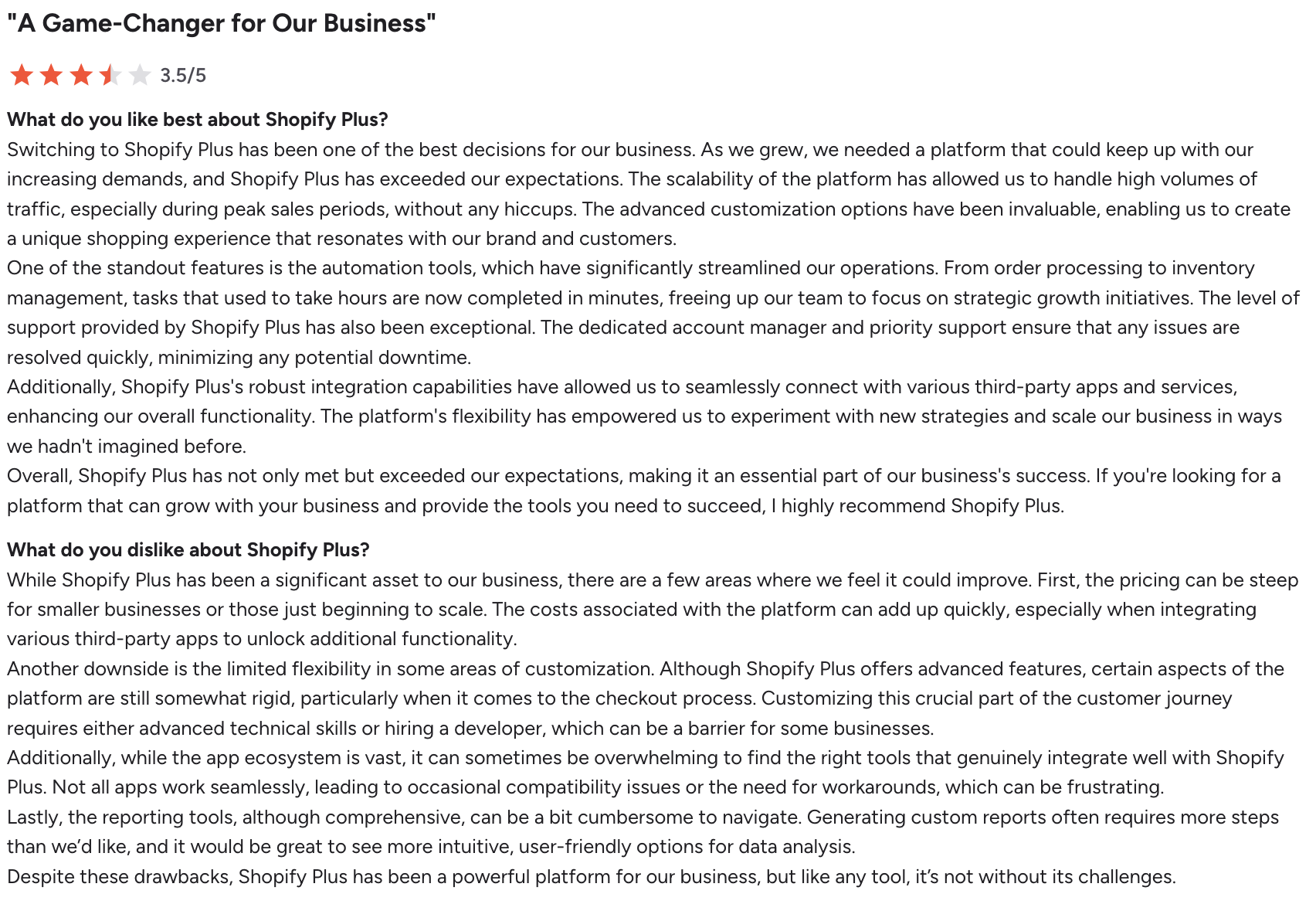
Merchants frequently cite reliability and performance as some of the strongest benefits of Shopify Plus:
-
“We went through our first Black Friday on Plus with zero downtime. On our old platform, we always had outages during peak campaigns.” – G2 Review
-
“Page load speed is fast globally without us adding extra infrastructure, which has been a big improvement.” – Software Advice Review
-
“Shopify Plus has been a game-changer for us. Conversion rates improved 50% after deployment. Site speed is phenomenal, the dashboards are great, and uptime is great.” – Capterra Review
Some concerns remain:
-
“We do not have the same hosting flexibility as Magento, which is limiting for certain edge cases.” – Capterra Review
The feedback reveals a clear pattern. Merchants moving from self-hosted platforms consistently describe the shift from infrastructure firefighting to business continuity as transformative. The elimination of downtime during seasonal peaks is seen as a major commercial advantage, directly tied to revenue protection. Many also highlight faster global performance, especially when entering new markets. The main criticism comes from highly technical teams who value hosting control, but for most retailers, the trade-off is worthwhile for stability and speed at scale.
Checkout & conversion flexibility review
On standard Shopify plans, the checkout is mostly locked down. Shopify Plus unlocks Checkout Extensibility and Shopify Functions, which allow you to customise both the checkout experience and the backend logic in a scalable way. You can:
-
Apply your brand colours, fonts, and trust badges directly in checkout.
-
Add fields such as gift messages, loyalty redemptions, or age verification.
-
Show different shipping and payment options for specific customer segments.
-
Automatically apply tiered or complex discounts (e.g. bundles, BOGOs, payment method rules) without relying on third-party apps.
-
Show or hide inputs based on customer type, tags, or basket contents.
-
Build one-page or simplified checkouts to reduce friction.
-
Test variations with third-party A/B tools without risking update breakage.
Benefits
-
Unlock higher conversion rate and larger AOV: The customisability made possible by Shopify Plus Checkout Extensibility and Shopify Functions helps merchants create a faster, more personalised purchase flow, lifting both conversion rates and average order value (AOV).
-
Room for optimisation and testing: While Shopify Plus does not provide a built-in A/B testing tool, the open checkout access means you can integrate third-party testing solutions or custom scripts to experiment with layouts, fields, and promotions. This ability to run iterative tests is highly valued by growth-focused teams looking for marginal gains at scale.
-
Low maintenance: Checkout Extensibility is designed to be upgrade-safe because it works through official APIs and extension points that Shopify keeps stable across platform updates. In practice, this means your customisations continue to work when Shopify rolls out new features or compliance changes, without the need for constant fixes or re-development. This reduces the long-term maintenance overhead.
Limitations
-
Framework boundaries remain: Checkout customisation does not mean you can fully reinvent the process. Key elements of Shopify’s checkout, especially the payment flow, remain locked for compliance and security reasons. Unsupported payment providers cannot be added.
-
Developer skills required: While some changes can be made without code, unlocking the full capabilities of Shopify Functions and extensibility typically requires development expertise.
For more details on Shopify Plus checkout capabilities and how to unlock them, read our full guide: Shopify Plus checkout explained: Capabilities and best practices for customisation.
Merchant feedback
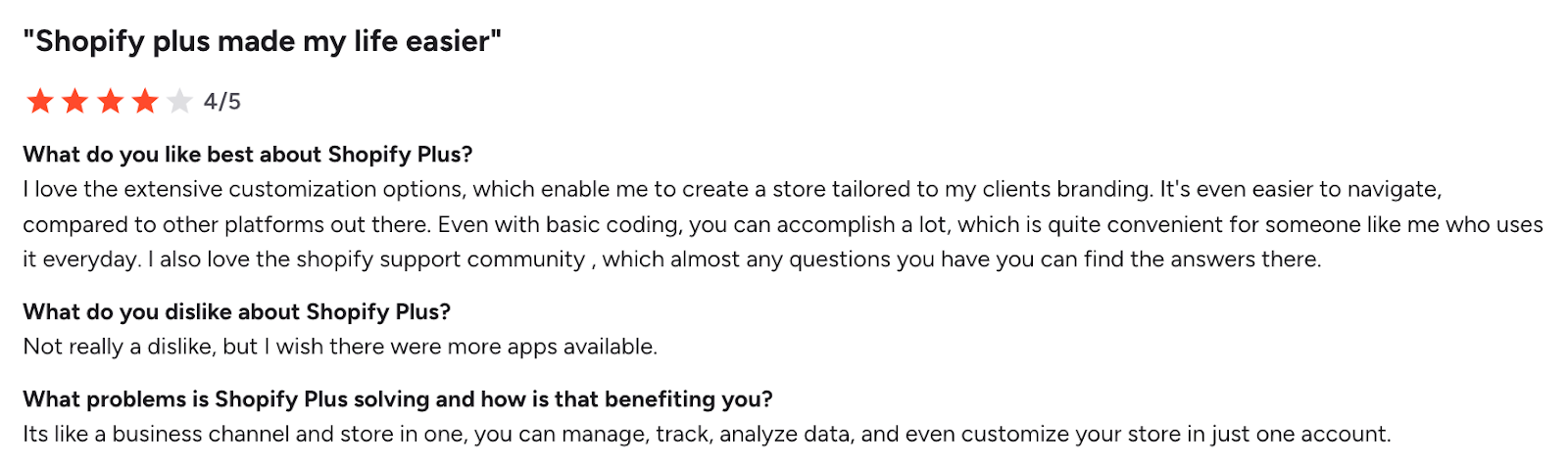
Merchants often describe checkout on Plus as a clear improvement in both performance and conversion outcomes:
-
“The checkout is fast and simple, and we noticed fewer abandoned carts after moving to Plus.” – G2 Review
-
“We were able to customise checkout with loyalty points and extra payment options, which made it easier for customers to complete orders.” – Capterra Review
Some note limitations: “It’s still not fully customisable. We sometimes need third-party apps for things that aren’t supported out of the box.” – Software Advice Review
Shopify Plus opens the door to meaningful checkout customisation, but it is not a guarantee of higher conversion. The impact depends on how well a merchant designs their changes, and whether those align with Shopify Plus capabilities. Many businesses move to Plus expecting checkout customisation alone to solve conversion challenges, only to find performance gains smaller than anticipated. The real value comes when checkout flexibility is part of a broader optimisation strategy, not treated as a silver bullet.
International expansion & multi-store management review
Shopify Plus provides a toolkit for global growth that combines:
-
Shopify Markets: Localise pricing, currencies, taxes, and languages within one store.
-
Expansion Stores (exclusive to Shopify Plus): up to 9 stores included under one licence for regions needing autonomy.
-
Shopify Payments: Shopify’s own payment gateway that supports multi-currency checkout, direct settlement into local bank accounts, and lower transaction fees than third-party gateways. Required to access Shop Pay and many cross-border optimisation.
-
Shop Pay: Shopify’s accelerated checkout option, exclusive to Shopify Payments. It securely stores customer details and enables one-click checkout, proven to increase conversion rates, especially on mobile.
-
Managed Markets: A premium cross-border service powered by Global-e. It automates duty and tax calculation, generates compliant shipping documents, and handles remittance abroad.
Together, these tools enable merchants to sell internationally with less friction, though scaling globally still brings operational and financial trade-offs.
Benefits
-
Offers flexibility for international expansion: Shopify Plus supports a wide range of internationalisation strategies. Brands can start with a single store serving multiple markets for efficiency, then add Expansion Stores when a region requires its own catalogue, payment methods, or compliance structure. This gives companies the ability to scale international growth in phases and adjust based on market maturity.
-
Scalable architecture: The platform can support up to 50 active markets within a store and up to 10 stores under a single Plus licence. This gives businesses the capacity to expand broadly without maintaining separate platforms.
-
Improves cross-border conversion rate with checkout localisation: Shopify Plus provides built-in support for local currencies, duties and tax estimation, and fulfilment from over 200 locations. Customers can see prices and landed costs in their own currency, and orders can be routed to the nearest warehouse. This transparency and speed directly improve conversion rates and reduce returns.
-
Acceleration of market entry: Merchants can clone themes and settings between stores and manage users and billing through Organisation Admin. This makes it easier to launch new regions quickly and keep governance consistent across multiple markets.
Limitations
-
Eligibility of Shopify Payments: Shopify Payments underpins most of Plus’s cross-border features (multi-currency checkout, Shop Pay, reduced FX costs). However, it is only available in around 40 countries. Where it is not supported, merchants must rely on third-party gateways, which introduce additional transaction fees and remove access to features like Shop Pay. This limitation is less visible to smaller merchants but becomes critical when modelling enterprise-level global expansion.
-
Cross-border costs: International selling on Shopify Plus carries several additional fees beyond standard card processing. These include a currency conversion fee of 1.5% (US) or 2% (other regions) when settling payouts in a currency different from the customer’s, and tax and duty calculation fees of 0.5–1.5% per order when using Delivered Duty Paid (DDP). At scale, these costs can erode margins.
-
Overheads of multi-store management: Each store still manages its own catalogue, orders, and content. Organisation Admin does not unify this data, so without ERP or PIM integrations, merchants often face duplicated effort across stores.
-
Rising app costs: The Plus licence covers up to 10 stores, but most apps charge per store. Scaling internationally often multiplies costs for apps, which raises the total cost of ownership.
-
Brand restriction: All stores under a Plus licence must operate under the same brand. Merchants with multi-brand portfolios cannot allocate Expansion Stores to separate brand identities, which limits flexibility for holding groups or diversified enterprises.
Merchants feedbacks
Merchants often highlight the advantages of Plus for international selling:
-
“Shopify Markets makes it easy to test demand in new countries without having to launch a full store immediately. We started selling in Canada and Australia with just one click, and it worked smoothly.” – G2 Review
-
“The ability to show duties and taxes at checkout cut returns dramatically in our international orders and gave buyers confidence to complete purchases.” – Capterra Review
At the same time, some caution that scaling globally introduces challenges:
-
“As soon as we grew in Europe, we needed separate stores for compliance and product variations.” – G2 Review
-
“Running multiple stores is powerful but also heavy. Without integrations, it feels like running five backends instead of one.” – Software Advice Review
In summary, merchant feedback suggests Shopify Plus lowers the barrier to international entry with tools like Markets and localised checkout, but once regions scale, multi-store management and integration overheads become critical factors to plan for.
For a deeper breakdown of how Shopify Plus facilitates international expansion, read our full analysis at Shopify Plus for international expansion: Is it the right fit and how to utilise it?
B2B Commerce capabilities review
Shopify Plus introduced its native B2B feature set in mid-2022, designed to bring wholesale and direct-to-consumer operations into one platform. The suite includes company accounts, custom price lists, purchase order workflows, and differentiated catalogues or payment terms, all managed directly in the Shopify admin.
Benefits
-
Works well for straightforward B2B: Shopify Plus suits wholesalers with fixed catalogues, agreed pricing, and repeat orders. Typical examples include fashion brands supplying boutiques with seasonal lines or food producers selling bulk ingredients to restaurants.
-
Fast path off spreadsheets and portals: Moving complex B2B workflows into a digital system usually requires significant technical investment with custom development and integration, as well as time to train staff and onboard customers. Shopify Plus provides a lighter entry point by including essential B2B features and intuitive interfaces, which can be enabled without extensive technical resources. For many traditional B2B businesses, this means moving from emailed POs and spreadsheets to live online ordering in a matter of weeks, instead of the year-long projects typical of heavier B2B systems.
-
Consolidated operations for DTC-led businesses: For brands already on Shopify DTC, adding B2B means managing both channels in one admin. Orders, stock, and reporting are consolidated, reducing duplication while still allowing teams to track B2B and DTC performance separately.
Limitations
-
Lack of support for advanced B2B workflows: e.g. quoting workflows or multi-user approval flows aren’t fully native (you might need apps or custom code to handle, say, a buyer submitting an order for manager approval).
-
Structural limitations of both B2B models: blended store and dedicated stores:
For blended stores: combining retail and wholesale in one site can complicate the user experience or analytics. Some promotions or features (discount codes, gift cards, etc.) apply platform-wide and thus affect both B2C and B2B customers in a blended setup. Segmenting those experiences may require workarounds or a separate store.
Running a dedicated wholesale store avoids that, but introduces the multi-store maintenance issues mentioned earlier (like syncing products and inventory). -
User friction in account management: Early adopters have flagged issues with Shopify’s new customer account model, which underpins B2B. Passwordless logins with mandatory two-factor authentication can frustrate wholesale buyers who expect faster re-order access.
Merchant feedback
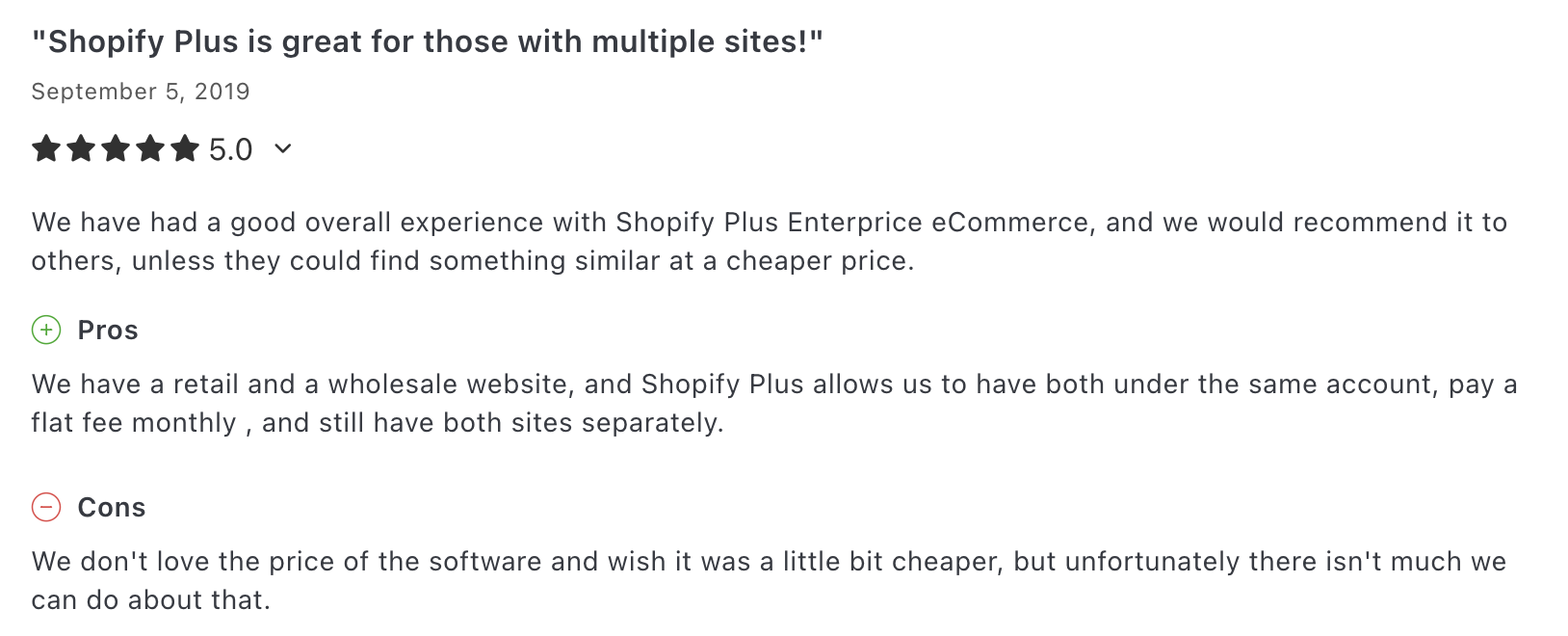
Merchants testing Shopify Plus B2B report a mix of strengths and challenges. Many value the fact that wholesale and DTC channels can be managed in one admin, reducing duplication and eliminating the need for a separate wholesale platform.
At the same time, users point to areas of friction. Shopify’s B2B account system relies on the new passwordless login, which forces an email-based code each time. As one merchant described, “B2B features are only available using the new customer accounts, which are passwordless and force an email 2FA every time — it ended up annoying some clients.” More advanced workflows, such as quoting or multi-user approvals, also remain dependent on apps or custom development.
Overall, feedback shows that Shopify Plus B2B lowers the barrier for brands moving wholesale online but still has limitations for businesses with more complex B2B requirements.
For a full breakdown of Shopify’s B2B capabilities and best practices, read our full guide: Shopify B2B: In-depth evaluation of features, limitations, and business fit.
At On Tap, we have worked with a wide range of B2B merchants, from established wholesalers modernising manual processes to global brands unifying complex DTC and B2B operations. Our B2B solutions are designed to align Shopify Plus with real-world buying journeys, ensuring adoption by both internal teams and buyers. Recognised by industry peers for our expertise, our founder, Dan Garner, has shared insights at events including IRX and the iMedia B2B eCommerce Summit (APAC), reflecting our leadership within the B2B community.
Automation & operational efficiency review
Shopify Plus is not only about customer-facing upgrades; it also provides a suite of tools to streamline operations and reduce manual effort. Core to this is Shopify Flow, a visual automation builder that lets you design “if-this, then-that” workflows without code. Flow can handle tasks such as tagging VIP customers, triggering alerts in Slack when a large order is placed, creating support tickets after negative reviews, or adjusting stock rules when inventory runs low.
Complementing Flow is Launchpad, which allows teams to pre-schedule campaign activity. Discounts, theme changes, or product launches can be set to start and stop automatically — a capability that takes stress out of high-stakes events like Black Friday. Finally, Shopify Functions allows deeper operational logic to be customised natively, reducing reliance on third-party scripts or apps.
By replacing multiple third-party apps, these tools reduce costs, simplify the tech stack, and cut down risks of app conflicts.
Benefits
-
Simplifies complex operations: Flow and Functions let merchants automate business rules that would otherwise require extra staff or multiple apps, turning routine tasks into reliable background processes.
-
Reduces manual workloads and errors: Automation ensures consistency. For example, promotions launch on time through Launchpad, and inventory rules apply instantly without staff intervention. This reduces operational risk during peak trading.
-
Lower dependency on apps: Many Plus merchants find they can remove automation apps once they adopt Flow, which saves subscription costs and reduces the complexity of maintaining their stack.
Limitations
-
It’s worth noting that not every process can be automated with Shopify Functions, Flow or Launchpad. Flow has a defined set of triggers and actions; very complex workflows or cross-system processes might need a more powerful integration or custom app. Similarly, Launchpad is mostly for storewide events and can’t handle every scenario (for example, it won’t manage complex staggered product drops without some manual input or scripting). In some cases, merchants end up using additional automation tools or services beyond what Shopify provides.
Merchant feedback
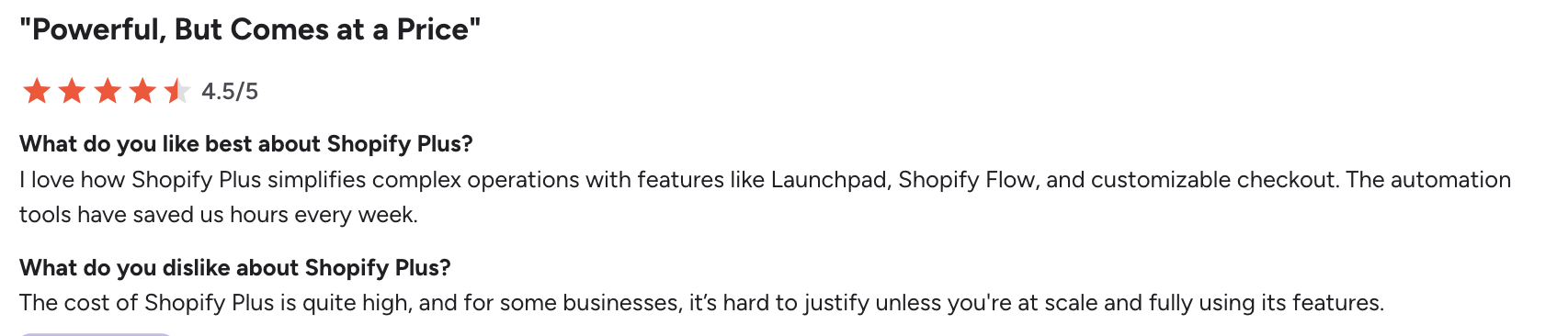
As one merchant notes, “Shopify Flow and Launchpad have saved us hours every week by automating key processes like tagging customers, managing inventory rules, and scheduling promotions.” – G2 Review
One reviewer mentioned: “The monthly cost seemed high at first, but the fee savings alone cover most of it, and Flow saved us from paying for multiple automation apps.” – essentially, by using built-in Flow workflows, they could uninstall other paid apps. Fewer apps not only save budget but also reduce the risk of apps slowing down the store or conflicting with each other.
All told, Shopify Plus can significantly improve operational efficiency by automating tasks and providing better tools for your team. Companies that lean into these features often find that Plus “pays for itself” in time saved and systems consolidated.
Integrations & extensibility review
Enterprise commerce rarely runs on a single system. Most businesses rely on ERP, OMS, CRM or PIM tools, and accurate operations depend on synchronising data across them. Shopify Plus supports this with API-driven integrations, high-throughput API capacity for large data volumes, and advanced capabilities such as Multipass for single sign-on and Gift Card API for loyalty and payment use cases. Together with a mature app ecosystem, these features provide merchants with a secure and scalable way to connect their store to core business systems, while adapting to complex workflows.
Benefits
-
Faster and more reliable enterprise integrations: Shopify Plus integrations are built on APIs rather than custom database access or file transfers. This approach means data flows are secure, consistent, and upgrade-safe. The practical value is that integrations are faster to implement, easier to maintain during platform updates, and flexible enough to evolve as business processes change.
-
Scalable data synchronisation at high volumes: Shopify Plus provides high-throughput API access (10x over the standard plans), allowing reliable synchronisation of orders, inventory, and customer data with ERP or OMS systems. For example, merchants can update thousands of SKUs in near real time and automatically route orders into finance or fulfilment systems. This accuracy improves stock visibility and reduces costly fulfilment errors.
-
Advanced integration capabilities: Shopify Plus offers exclusive features like Multipass (single sign-on integration) and Gift Card API. Multipass is ideal for brands running headless sites or enterprise portals wanting a unified customer login. Gift Card API allows gift cards issued from loyalty platforms to be redeemed at checkout. These integrations enhance the customer journey by reducing friction and aligning with existing digital ecosystems.
-
Extensive and certified app ecosystem: The Shopify App Store offers more than 12,000 apps covering functions from CRM and subscriptions to 3PL and analytics. Shopify Plus merchants also benefit from a network of certified apps that have been vetted for performance and scale in high-volume environments. Certified partners in areas like search, loyalty, reviews, and subscriptions often provide priority support and onboarding. Together, this ecosystem accelerates deployment of standard integrations, reduces custom build costs, and gives enterprises confidence that critical extensions will scale.
Limitations
-
API coverage gaps: Some data points and workflows are not exposed through Shopify’s APIs to the depth enterprises expect. For example, detailed tax records, certain refund operations, or complex discount logic may require custom workarounds to integrate with ERP or BI systems.
-
Inconsistent app quality across the ecosystem: While Shopify’s app ecosystem is extensive, the quality of solutions varies widely. Some apps are engineered for high-volume merchants with robust support, while others are lightweight and may struggle with large catalogues, high order volumes, or complex data flows. Poorly optimised apps can slow site performance or disrupt the buyer experience, which is a critical risk for enterprise merchants.
Merchant feedback
-
“We connected Shopify Plus directly to Mintsoft and Extensiv through APIs, and the integrations have been seamless. Reporting exports and inventory management are now much easier and more reliable.” — G2 Review
-
“Shopify Plus integrates smoothly with major third-party apps and enterprise systems, which made it straightforward to connect the platform to our existing tools.” — G2 Review
Merchants consistently highlight that Shopify Plus’s integration capabilities offer both speed and stability, whether connecting via APIs to enterprise systems or installing apps from the mature ecosystem. Positive sentiment centres on the smooth connectivity, reliable performance during peak traffic, and breadth of app choices. Even so, businesses implicitly underscore the importance of vetted apps and responsive support, especially when scaling nationally or globally.
On Tap delivers enterprise-grade integrations for Shopify Plus merchants through both tailored services and our proprietary Integration Flow. Integration Flow is an automated, fully managed middleware solution that streamlines and standardises connections between Shopify Plus and ERP, CRM, WMS, or PIM systems. By combining this managed approach with our hands-on expertise, we help retailers reduce reliance on fragile custom builds, accelerate deployment, and ensure stable operations at scale.
Pricing & value review
Shopify Plus starts at $2,300 per month on a 3-year contract or $2,500 per month on a 1-year contract. At very high volumes, Shopify may apply a variable platform fee based on GMV.
Other cost drivers
-
Payment processing: Shopify Payments typically ranges between 2.4%–2.9% + $0.30 per transaction, with an additional 1.5% (US) or 2% (other regions) currency conversion fee for cross-border orders.
Using third-party gateways adds 0.20% per transaction. At scale, these costs often outweigh the base licence fee. -
Shopify Tax: After the first $100,000 in annual sales, Shopify charges 0.15%-0.25% per order (depends on your region), capped at $0.99, max $5,000 per region per year.
-
Apps and integrations: Most Plus merchants use apps for marketing, loyalty, subscriptions, or operations. Costs can range from $20 to several hundred per month per app, often multiplied by each Expansion Store.
-
Optional extras: Expansion Stores beyond the 9 included cost $250 per month each; POS Pro beyond 20 locations adds $79 per location per month.
Note: These are platform-level costs. They do not include development and maintenance spend, which varies by business and project scope (e.g. custom theme builds, ERP integrations, ongoing optimisation).
Strategic value beyond fees
-
Revenue uplift: Checkout Extensibility lets brands customise discounts, payment flows, and loyalty logic. Even small improvements in conversion or average order value can offset the subscription fee quickly.
-
Operational efficiency: Flow, Launchpad, and Functions reduce manual workloads, while Organisation Admin streamlines governance across multiple stores. Many merchants replace third-party apps with built-in Plus tools, cutting both costs and complexity.
-
B2B and international growth: Native wholesale tools, Expansion Stores, and multi-currency support allow brands to add new channels and markets without separate platforms, consolidating growth under one ecosystem.
Considerations
-
Contract length: Shopify Plus requires a 1-year or 3-year commitment. This delivers cost predictability but reduces flexibility. Businesses need confidence in their growth trajectory before committing.
-
Value vs cost: The return on Shopify Plus is highly situational. For merchants already on standard Shopify plans, the lower transaction fees on Plus may justify the licence once the monthly GMV is high enough. Others may see ROI through improved conversion rates or operational efficiencies. Equally, there are cases where the licence feels premature if these capabilities are not priorities. The overall return is therefore situational and tied to how closely Plus aligns with a merchant’s current scale, operating model and growth strategy.
Merchant Feedback
Reviews show a divided picture. Some merchants highlight clear returns at scale:
-
“The monthly cost seemed high at first, but the fee savings alone cover most of it, and Flow saved us from paying for multiple automation apps.” – Capterra Review
-
“Shopify Plus pays for itself once you’re doing high volume, but if you’re under that threshold, it feels expensive.” – G2 Review
-
“The included POS Pro licences saved us a lot, since we were already paying separately for that.” – Software Advice Review
Others, particularly smaller or mid-growth retailers, caution that the pricing feels premature:
- “It’s a great platform, but at our current size, the monthly cost is hard to justify.” – G2 Review
Merchant feedback reflects a split: larger or more complex businesses often find Shopify Plus pays for itself through savings, efficiency gains, or bundled licences, while smaller or mid-growth merchants caution that the cost feels premature. The underlying message is that value depends less on any single feature and more on whether the business has reached a scale or level of complexity where Plus delivers material returns.
Pros and cons of Shopify Plus compared to other alternatives
To put Shopify Plus in perspective, it helps to compare it against other enterprise eCommerce solutions:
-
Other Shopify tiers (Basic, Grow, Advanced): This baseline shows what merchants already get without upgrading. It makes clear whether Plus features are incremental or transformative compared to Shopify’s standard plans.
-
Open-source and licensed self-hosted platforms (Magento Open Source, Adobe Commerce, Shopware): Magento Open Source represents the free, flexible edition, where merchants carry all hosting and DevOps costs. Adobe Commerce adds enterprise features and vendor support under a licence model, but still requires significant infrastructure and development investment. Shopware is another open-source option, more common in Europe. These represent the most common alternatives for merchants wanting maximum flexibility and control.
-
Enterprise SaaS platforms (Salesforce Commerce Cloud, BigCommerce Enterprise): These are Shopify Plus’s closest peers in the managed SaaS space.
It is worth noting that many of the key differences explored in this review are not solely a matter of whether a platform is SaaS or open source. They often reflect the specific architectural choices and feature sets of each competitor, such as how checkout can be extended, how international expansion is structured, or how integrations are managed.
|
Context |
Pros |
Cons |
|
Compared to standard Shopify plans |
- Higher conversion: Checkout Extensibility enables loyalty, upsells, and local payment logic not available on lower tiers. - Lower costs at scale: Reduced transaction fees on Plus create meaningful savings once GMV is high. - Channel consolidation: Run DTC, B2B, and international in one ecosystem, reducing duplicate apps and admin effort. - Efficiency gains: Flow and Launchpad automate campaigns and workflows beyond standard plans. |
- High fixed cost: $2,300+ per month only pays off when fee savings or efficiency gains outweigh the licence. - Contract terms: One- or three-year agreements reduce flexibility. - Under-utilisation risk: Some merchants expect revenue to rise automatically, but Plus only delivers ROI if features like checkout customisation, automation, and international tools are implemented in ways that create real business impact. |
|
Compared to other platforms |
- Quicker time to value: Managed SaaS avoids hosting and major upgrade projects, so implementations are typically shorter and less resource-intensive than Magento or Salesforce. - Lower infrastructure burden: Fully hosted with high uptime, removing DevOps and patch management common on open-source stacks. - Continuous innovation: Multi-tenant SaaS delivers automatic updates and access to a large app ecosystem without costly upgrades. - Predictable TCO: Subscription pricing bundles hosting, scaling, and security, unlike GMV-based contracts or variable open-source costs. |
- Customisation limits: Less code-level flexibility than Magento or BigCommerce for unique workflows. - Scaling constraints: One brand per contract with a 10-store cap; multi-brand groups may face added overhead. - B2B depth: Native features cover common needs; advanced quoting and approvals are stronger on Adobe Commerce or BigCommerce B2B. |
For deeper comparisons, see our full guides on Shopify vs Shopify Plus, Shopify Plus vs Adobe Commerce, and Shopify Plus vs BigCommerce Enterprise.
Deciding on Shopify Plus means weighing cost, operational efficiency, and growth plans across both standard Shopify tiers and alternative platforms. On Tap brings over 19 years of enterprise eCommerce experience and expertise across multiple platforms. Clients often highlight our ability to quickly understand business and industry-specific requirements, offering strategic guidance that translates into measurable improvements in performance and conversions. Contact us to discuss whether Shopify Plus is the right fit for your business.
Conclusion: Is Shopify Plus worth it?
Deciding whether Shopify Plus is worth the investment depends on how your business uses the platform’s capabilities. Across this review, several consistent themes emerge. Below is a summary of the key benefits and limitations by area:
|
Area |
Benefits |
Limitations |
|
Performance & Scalability |
SLA-backed uptime, elastic infrastructure, and a global CDN ensure stable performance during peak trading and global reach. |
Less backend control than open-source platforms, limiting bespoke optimisation of infrastructure. |
|
Checkout & Conversion |
Checkout Extensibility enables loyalty, upsells, and tailored payments, often reducing abandonment and raising AOV. |
Not fully customisable; some workflows still rely on third-party apps or custom development. |
|
International Expansion |
Shopify Plus provides a toolkit for international expansion, which includes Expansion Stores, Shopify Markets, Shopify Payments and Shopify Tax. These features simplify global selling and shorten time to market. |
Expansion Stores add management overhead and duplicated apps, with further constraints such as Shopify Payments eligibility, brand limits, and the need for ERP or PIM to avoid duplicated work. |
|
B2B Commerce |
Native company accounts, price lists, and PO support simplify wholesale, allowing B2B and DTC to be managed in one admin. |
Advanced features like quotes, multi-user approvals, and requisition lists still require apps or custom builds. |
|
Automation & Efficiency |
Flow, Launchpad, and Functions automate campaigns and workflows, reducing manual work and staff dependency. |
Scope is limited to predefined triggers and simpler workflows; complex processes often still need third-party apps or customisation. |
|
Integrations |
Higher API throughput and a mature app ecosystem enable reliable ERP, CRM, WMS, and PIM connections. |
Some data points and workflows are not fully exposed via APIs, and app quality is inconsistent. Complex or highly customised processes may still require bespoke development or third-party middleware. |
|
Pricing & Value |
$2,300+ licence often offset at scale by transaction fee savings, automation, and consolidation of B2B/international. |
TCO also includes transaction fees, apps, expansion stores, and ongoing development; ROI depends on feature adoption and GMV scale. |
So, for the question “Is Shopify Plus worth the investment?” the answer depends on the business context. Some merchants offset the cost quickly through lower transaction fees, automation, or by consolidating B2B and international operations. Others may find the licence premature if those capabilities are not yet required. The return on Plus is therefore highly situational and tied to how fully its features are leveraged.
At On Tap, we bring over 19 years of enterprise eCommerce expertise with a track record of delivering complex Shopify Plus projects without disruption. Our approach combines strategic planning with proven tools like Integration Flow and AuditIQ to reduce migration risks, accelerate time to value, and ensure merchants get full ROI from Plus. To learn how we can help you leverage Shopify Plus effectively, visit our Shopify Plus development services or contact us for a tailored consultation.